Aircraft Accident Investigation Bureau Latest News
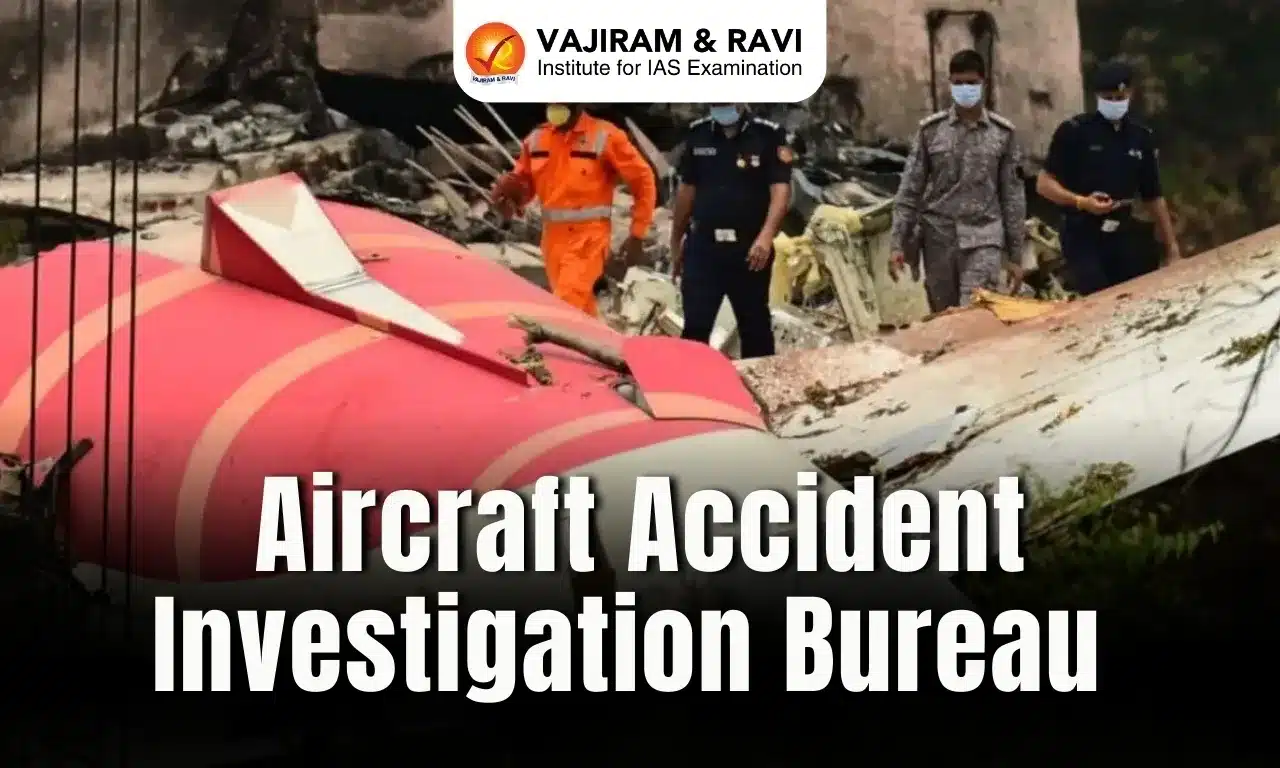
- A month after the Air India AI 171 crash in Ahmedabad, where 241 of 242 onboard died, the Aircraft Accident Investigation Bureau (AAIB) released its preliminary report.
- The report revealed both engine fuel control switches moved from ‘RUN’ to ‘CUTOFF’ within seconds of takeoff, raising serious concerns.
- One pilot reportedly questioned the other about cutting off fuel, but the latter denied doing so.
- Since these switches don’t usually move accidentally, the incident has prompted deeper scrutiny, especially of the cockpit voice recorder (CVR) and flight data recorder (FDR), as part of the AAIB’s ongoing investigation process.
Investigating Aircraft Crashes
- Under the 1944 Chicago Convention, overseen by the International Civil Aviation Organization (ICAO), aircraft crash investigations are primarily conducted by the ‘State of Occurrence’—the country where the accident takes place.
- ICAO is a specialized agency of the United Nations that promotes the safe and orderly development of international civil aviation.
- Established in 1944, it sets standards and recommends practices for aviation safety, security, efficiency, and environmental protection.
- Additionally, the State of Registry, State of the Operator, State of Design, and State of Manufacture have formal rights to participate in the investigation process.
- State of Registry – where the aircraft is registered,
- State of the Operator – which operated the flight,
- State of Design – The country that regulates and oversees the organization responsible for designing and ensuring the airworthiness of an aircraft.
- State of Manufacture – the country or jurisdiction that has authority over the organization responsible for the final assembly of an aircraft.
- These protocols are detailed in Annex 13 of the Convention.


AAIB: India’s Independent Air Crash Investigation Body
- The Aircraft Accident Investigation Bureau (AAIB), under India’s Ministry of Civil Aviation, investigates civil aviation accidents and serious incidents.
- It was established in 2012 to ensure investigation independence from regulatory bodies like the Directorate General of Civil Aviation (DGCA), following global standards set by the International Civil Aviation Organization (ICAO).
Legal Framework of the AAIB
- Under Section 7 of the Aircraft Act, 1934, the Government of India is empowered to make rules for investigating aircraft accidents in India or involving Indian-registered aircraft.
- Initially, the Air Safety Directorate of DGCA handled these investigations under the Aircraft Rules, 1937, aligned with Article 26 of the Chicago Convention.
Governing Rules
- The Aircraft (Investigation of Accidents and Incidents) Rules, 2012 were formulated to formalize AAIB’s role.
- These rules were later amended in 2017 and 2021.
- AAIB is now designated as an “Attached Office” of the Ministry of Civil Aviation.
Functions and Role of the AAIB
- AAIB classifies safety occurrences as Accidents, Serious Incidents, and Incidents.
- It is empowered with immediate and unrestricted access to all relevant evidence from any agency or organisation, without requiring prior approval from judicial or government authorities.
- It investigates all Accidents and Serious Incidents involving aircraft over 2,250 kg All Up Weight (the total weight of an aircraft with passengers and cargo) and Turbojet aircraft.
- Investigations focus solely on preventing future accidents, not on assigning blame or liability (as per Rule 3 of Aircraft (Investigation of Accidents and Incidents) Rules, 2017).
- Investigation Process
- Immediate site investigation: AAIB sends investigators to collect and preserve perishable evidence, black boxes, wreckage samples, etc.
- Evidence collection: Includes data from operators, regulators, involved personnel, and unrestricted access to all relevant materials.
- Expert analysis: AAIB may engage domain experts and collaborate with agencies like Hindustan Aeronautics Limited and DGCA laboratories.
- Report preparation: After internal review, a final report is published and shared with the ICAO and involved states.
- Additional Functions
- Conducting safety studies.
- Issuing safety recommendations to DGCA India or other international aviation regulatory bodies for implementation and monitoring.

 Last updated on Oct, 2026
→ UPSC 2027 Notification will be released on 13 January 2027 at upsconline.nic.in.
→ Check Nobel Prize 2026 Winners List here.
→ Download PIB PRiSM Monthly Magazine 2026 here.
→ Check UPSC Monthly Current Affairs Magazine The Recitals here.
→ Check out the latest UPSC Syllabus here.
→ Download UPSC Model Answers for Mains 2026
→ UPSC Mains Question Paper 2026 is out now for Essay & GS Paper 1, 2, 3 & 4.
→ UPSC Calendar 2027 has been released.
→ Enroll in Vajiram & Ravi’s UPSC Mains Test Series 2027 for structured answer writing practice, expert evaluation, and exam-oriented feedback.
→ Join Vajiram & Ravi’s UPSC Mentorship Program 2027 for personalized guidance, strategy planning, and one-to-one support from experienced mentors.
→ Go through the UPSC Mains Previous Year Papers to enhance your preparation.
→ UPSC has released UPSC Toppers List 2025 with the Civil Services final result on its official website.
→ Also check Best UPSC Coaching in India
Aircraft Accident Investigation Bureau FAQs
Q1. What is AAIB India? +
Q2. When was AAIB established?+
Q3. What powers does AAIB have?+
Q4. Which laws govern AAIB? +
Q5. How does AAIB investigate crashes? +
Tags: aircraft accident investigation bureau mains articles upsc current affairs upsc mains current affairs