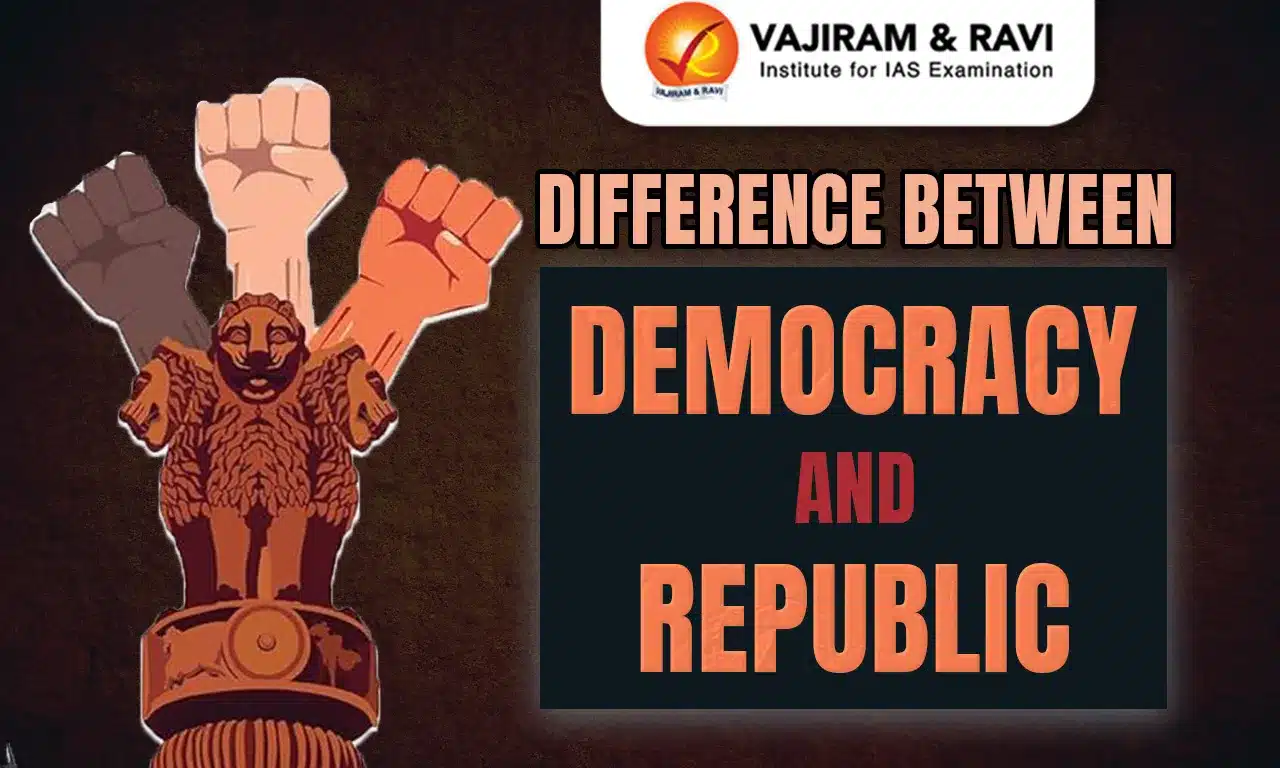
The terms Democracy and Republic are often used interchangeably, especially in political discussions. However, while they share foundational principles like the participation of citizens in governance, there are significant differences in how power is structured and exercised. The Athenian Democracy of ancient Greece is regarded as the earliest known example of democracy, while the Roman Republic, which existed from approximately 510 BCE to 27 BCE, is recognized as one of the earliest and most influential republican systems of governance.
Democracy
Democracy is a form of government where the power lies with the people. The government is either directly elected by the citizens or through representatives chosen via elections. Citizens elect their representatives to legislate and make decisions on their behalf, embodying the principles of a government “by the people, for the people, and of the people.”
Key Features of Democracy
- Rule by the people, either directly or indirectly.
- Based on principles of equality, freedom, and participation.
- Elections are held periodically and fairly.
- Citizens enjoy civil liberties like freedom of speech and expression.
Republic
A Republic is a type of government in which the head of state is elected and not a hereditary monarch. It emphasizes the rule of law and a constitutionally-limited government. All republics are democratic, but not all democracies are republics (e.g., constitutional monarchies like the UK). Republic refers to a form of government where the state is considered a “public matter” (from the Latin term Res Publica), and the head of state is usually elected and not a hereditary monarch.
Key Features of a Republic
- The head of state is elected (e.g., a President).
- Operates under a written constitution.
- Laws apply equally to all citizens, including leaders.
- Focuses on minority rights and legal framework.


Difference between Democracy and Republic
The table below include the Difference between Democracy and Republic:
| Difference between Democracy and Republic | ||
| Aspect | Democracy | Republic |
|
Definition |
Rule by the people, either directly or through representatives |
A government where the head of state is elected, not hereditary |
|
Head of State |
Can be elected or hereditary (e.g., monarch) |
Always elected (e.g., President) |
|
Form of Government |
Can include both direct and indirect systems |
A form of representative democracy with a constitutional framework |
|
Focus |
Majority rule |
Rule of law and protection of individual rights |
|
Existence of Constitution |
May or may not have a formal constitution |
Always operates under a written constitution |
|
Examples |
UK (Democratic but Monarchy), India, USA |
India, USA, France |
|
Minority Rights |
Can be overlooked under majority rule |
Protected under constitutional guarantees |
|
Type of Democracy |
Broad concept (direct or representative) |
Specific type – representative democracy |
Difference Between Democracy and Republic Key Points
- Democracy is a broader term that refers to rule by the people, while a Republic is a specific form of democracy with a constitutionally limited government.
- In a Republic, the head of state is elected and there is no place for monarchy. A democracy can have a monarch (e.g., UK).
- Republics focus more on individual rights and laws, whereas democracies may prioritize majority rule.
- India is both a sovereign democratic republic, meaning it is governed by elected representatives and has no monarchy.

 Last updated on Oct, 2026
→ UPSC 2027 Notification will be released on 13 January 2027 at upsconline.nic.in.
→ Check Nobel Prize 2026 Winners List here.
→ Download PIB PRiSM Monthly Magazine 2026 here.
→ Check UPSC Monthly Current Affairs Magazine The Recitals here.
→ Check out the latest UPSC Syllabus here.
→ Download UPSC Model Answers for Mains 2026
→ UPSC Mains Question Paper 2026 is out now for Essay & GS Paper 1, 2, 3 & 4.
→ UPSC Calendar 2027 has been released.
→ Enroll in Vajiram & Ravi’s UPSC Mains Test Series 2027 for structured answer writing practice, expert evaluation, and exam-oriented feedback.
→ Join Vajiram & Ravi’s UPSC Mentorship Program 2027 for personalized guidance, strategy planning, and one-to-one support from experienced mentors.
→ Go through the UPSC Mains Previous Year Papers to enhance your preparation.
→ UPSC has released UPSC Toppers List 2025 with the Civil Services final result on its official website.
→ Also check Best UPSC Coaching in India
Difference Between Democracy and Republic FAQs
Q1. Is every democracy a republic?+
Q2. Is India a republic or a democracy?+
Q3. What is the major difference between a democracy and a republic?+
Q4. Can a monarchy be democratic?+
Q5. Which countries are considered republics?+
Tags: difference between democracy and republic