


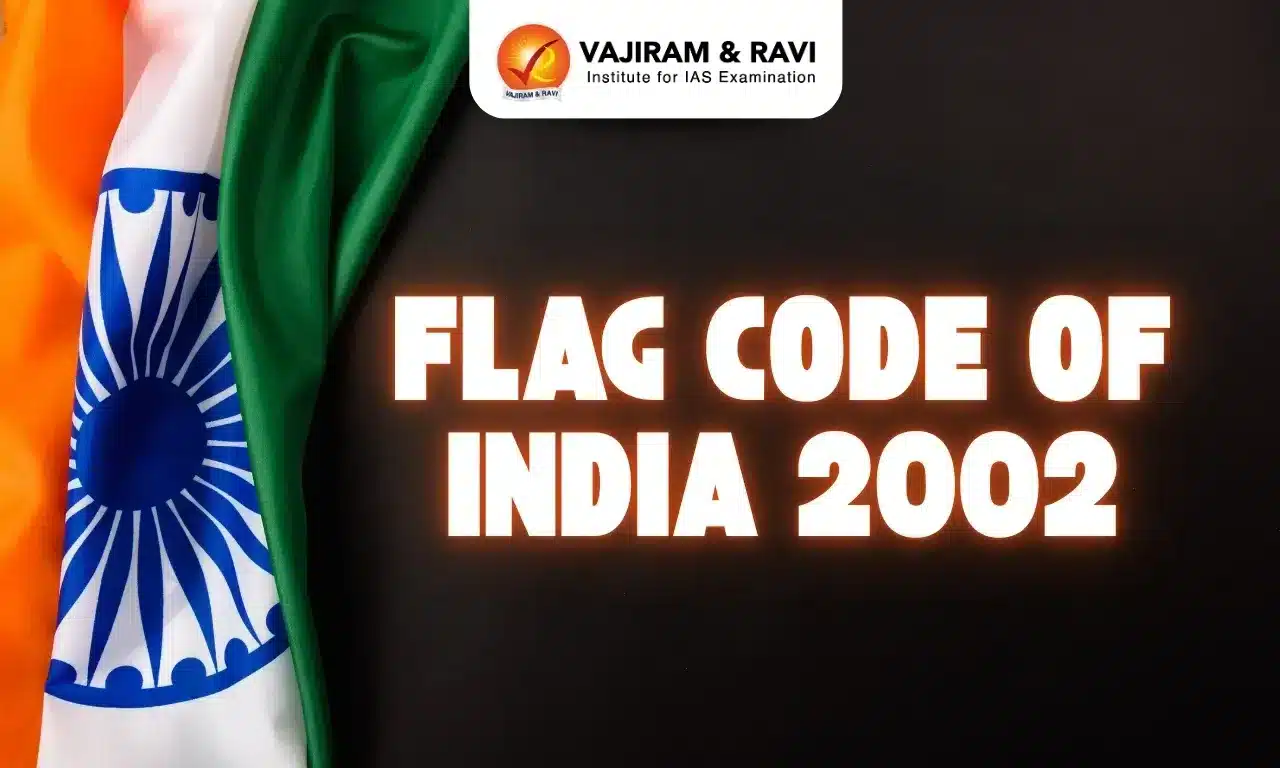
The Flag Code of India 2002 includes the rules and protocols for displaying and using the National Flag which was adopted in 1950, following India’s independence, includes multiple amendments to align with evolving traditions and official guidelines. A significant amendment in 2002 permitted the National Flag of India to be flown at night, an earlier restriction that limited hoisting between sunrise and sunset. The most recent amendment came with the introduction of the Har Ghar Tiranga campaign.
Flag Code of India 2002
The National Flag of India symbolises national pride, respect and affection towards the nation. The Flag Code of India 2002 is the set of rules and regulations, guidelines for the hoisting of National Flag which is divided into three sections:
- National Flag general description
- Display of National Flag by Institutions such as Educational, Public, Private etc.
- Display of National Flag by Central Government as well as State Governments and their agencies as well.
Indian National Flag Designer
Indian National Flag Designer was Pingali Venkayya, a freedom fighter and a Gandhian. First, the design was presented to Mahatma Gandhi and later adopted during the Constituent Assembly meeting on July 22, 1947.


Flag Hoisting on 78th Independence Day 2024
India celebrated the 78th Independence Day on August 15, 2024 where the Prime Minister of India hosted the National Flag at Red Fort, New Delhi. The Flag Hoisting was held across the government offices and educational institutions to celebrate the freedom of India.
National Flag of India
The National Flag of India is known as Tiranga which stands for Tricolour having 3 strips horizontally of saffron, white and green along with a blue Ashoka Chakra. The flag has a 3:2 width-to-length ratio, and the Ashoka Chakra represents the eternal wheel of law. Each color has a symbolic meaning:
- Saffron (Top) denotes courage and sacrifice.
- White (Middle) represents peace and truth. The white stripe contains the Ashoka Chakra (wheel) in navy blue, which has 24 spokes.
- Green (Bottom) stands for faith, fertility, and the land.
Flag Hoisting Time
Traditionally, the National Flag was hoisted at sunrise on Independence Day. With recent amendments, it can now be hosted at any time of the day or night, as long as it is treated with due respect and dignity.
Flag Code of India 2002 History
The evolution of the Indian Flag Code is deeply connected to the development of the National Flag and the values of respect and honour associated with it. Initially, the display of the Indian flag was regulated by two key legislations: the Emblems and Names (Prevention of Improper Use) Act, 1950 and the Prevention of Insults to National Honour Act, 1971.
To unify these regulations, the Flag Code of India, 2002 was introduced, establishing guidelines for the proper use of the tricolour. Advocate B. M. Birajdar stated, “The Flag Code of India 2002 permits the unrestricted display of the tricolour, consistent with the honour and dignity of the flag.” Below is a Flag Code of India 2002 History.
| Flag Code of India 2002 History | |
|
Year/Date |
Event/Development |
|
1906 |
First unofficial Indian flag was hoisted on August 7, 1906, in Calcutta (now Kolkata) with three horizontal stripes of green, yellow, and red. |
|
1921 |
Pingali Venkayya presented a design of the national flag to Mahatma Gandhi at the Indian National Congress session, which was later modified. |
|
1931 |
The Indian National Congress adopted the Tricolour as its official flag, with saffron, white, and green stripes and the spinning wheel (Charkha) in the centre. |
|
1947 |
The Constituent Assembly of India adopted the current version of the Indian national flag on July 22, 1947. The Ashoka Chakra replaced the spinning wheel. |
|
1950 |
Emblems and Names (Prevention of Improper Use) Act, 1950 enacted to prevent improper use of the national flag and other national symbols. |
|
1971 |
Prevention of Insults to National Honour Act, 1971 enacted to prohibit disrespect to the national flag and the Constitution of India. |
|
1995 |
Naveen Jindal’s Legal Battle: Naveen Jindal, an industrialist, filed a petition challenging restrictions on flag hoisting by citizens. |
|
2002 |
Flag Code of India, 2002 introduced on January 26, 2002. It allowed Indian citizens to hoist the national flag at their homes, ending years of legal restrictions. |
|
2021 (December) |
The amendment allowed machine-made polyester flags. Previously, only hand-spun and handwoven flags were allowed. |
|
2022 (July) |
The amendment allowed the national flag to be hoisted day and night at private homes, public places, and institutions, provided it was displayed with dignity. |
Indian National Flag Origin
The Indian National Flag’s design was officially adopted by the Constituent Assembly on July 22, 1947, just before the country became independent from British rule. It consists of three horizontal bands: saffron at the top, white in the middle, and green at the bottom. At the center of the white stripe is the blue Ashoka Chakra, a 24-spoke wheel. Each element of the flag carries deep significance, symbolizing India’s rich heritage, cultural values, and aspirations for the future.
Flag Code of India 2002 and 2022 Amendment
The use and hosting of the Indian National Flag are regulated by the Prevention of Insults to National Honour Act, 1971 and the Flag Code of India, 2002. Below are some key provisions of the Flag Code of India, 2002, for public awareness:
- Amendment of 2021: As per the order dated December 30, 2021, the use of machine-made polyester flags was permitted. The national flag can now be made of hand-spun, hand-woven, or machine-made cotton, polyester, wool, silk, or khadi fabric.
- Public Display: Citizens, private organizations, and educational institutions are allowed to hoist or display the national flag on any day or occasion, provided it is done with dignity and respect.
- Amendment of 2022: An order dated July 19, 2022, modified clause (xi) of paragraph 2.2 of Part II, allowing the flag to be flown day and night when displayed in the open or on a citizen’s house.
- Shape & Size: The national flag must always be rectangular, with a length-to-width ratio of 3:2. It can be of any size while maintaining this proportion.
- Position of Honour: The flag should always be placed in a position of prominence and must be distinctly displayed.
- Condition of the Flag: A damaged, torn, or disheveled flag must not be displayed.
- Masthead Protocol: The National Flag should not be flown from the same masthead as any other flag.
- Usage on Vehicles: Only select dignitaries, including the President, Vice President, Prime Minister, Governors, and other officials specified in Section IX of Part III of the Flag Code, are permitted to display the flag on their vehicles.
- No Higher Placement: No other flag or decorative bunting should be placed higher than or alongside the national flag.
Recent Changes on Flag Code of India 2002
| Recent Changes on Flag Code of India 2002 | ||
| Date | Change/Amendment | Details |
|
December 30, 2021 |
Use of Machine-Made Polyester Flags |
An amendment was made allowing the use of machine-made polyester flags in addition to hand-spun and handwoven cotton, wool, silk, or khadi flags. |
|
July 20, 2022 |
Day and Night Hoisting of Flags |
Another amendment permitted the national flag to be hoisted day and night at private homes, public places, and institutions, provided it is displayed with dignity. |
|
2022 (General Update) |
Flexibility in Flag Display |
The government allowed citizens to display the flag on all occasions, formal or informal, not just national holidays, expanding the flexibility of usage. |

 Last updated on Oct, 2026
→ UPSC 2027 Notification will be released on 13 January 2027 at upsconline.nic.in.
→ Check Nobel Prize 2026 Winners List here.
→ Download PIB PRiSM Monthly Magazine 2026 here.
→ Check UPSC Monthly Current Affairs Magazine The Recitals here.
→ Check out the latest UPSC Syllabus here.
→ Download UPSC Model Answers for Mains 2026
→ UPSC Mains Question Paper 2026 is out now for Essay & GS Paper 1, 2, 3 & 4.
→ UPSC Calendar 2027 has been released.
→ Enroll in Vajiram & Ravi’s UPSC Mains Test Series 2027 for structured answer writing practice, expert evaluation, and exam-oriented feedback.
→ Join Vajiram & Ravi’s UPSC Mentorship Program 2027 for personalized guidance, strategy planning, and one-to-one support from experienced mentors.
→ Go through the UPSC Mains Previous Year Papers to enhance your preparation.
→ UPSC has released UPSC Toppers List 2025 with the Civil Services final result on its official website.
→ Also check Best UPSC Coaching in India
Flag Code of India 2002 FAQs
Q1. What is the Indian flag code rule? +
Q2. Is flag code a law under article 13?+
Q3. What time flag to be taken down today?+
Q4. What is flag code 2002?+
Q5. What is the punishment for violating the flag code?+
Tags: flag code of india 2002








