Vice President Resignation Latest News
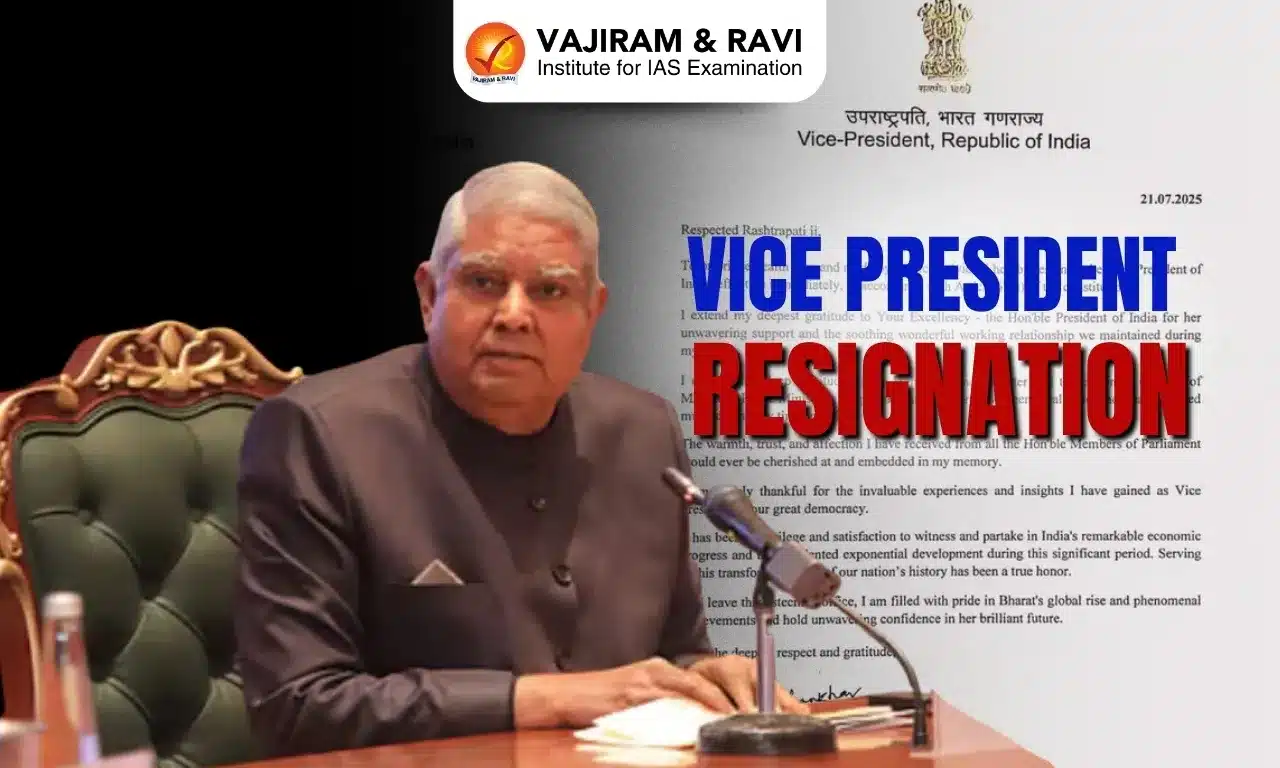
- In an unexpected development, Vice President Jagdeep Dhankhar resigned from his post on July 21, the opening day of the Monsoon session of Parliament.
- Citing health concerns and following medical advice, Dhankhar submitted his resignation to President Droupadi Murmu, invoking Article 67(a) of the Constitution.
- Jagdeep Dhankhar is the third Vice President in India’s history to resign mid-term, after V. V. Giri and R. Venkataraman, who resigned to contest presidential elections.
Vice President’s Resignation Procedure
- As per Article 67 of the Constitution, the Vice President can resign anytime by submitting a written resignation to the President.
- Once accepted, the resignation takes immediate effect, requiring only formal communication and acknowledgment—no approval process is needed.
Article 67(a)
- Article 67(a) of the Indian Constitution allows the Vice President to resign before completing the five-year term by submitting a written resignation to the President.
- Jagdeep Dhankhar, who became Vice President in August 2022, invoked this article to step down two years early, well before his term was due to end in 2027.


Succession After Vice President’s Resignation
- When the Vice President of India resigns, an election must be held to fill the vacancy, as per constitutional provisions.
- The Constitution does not provide for an acting Vice-President.
- However, since the Vice-President is also the ex-officio Chairman of the Rajya Sabha, the Deputy Chairman, currently Harivansh Narayan Singh, will preside over the House in his absence.
- This seamless succession mechanism ensures that the functioning of the Rajya Sabha continues without disruption.
Timeline for Vice-Presidential Election
- Unlike the President’s post, the Constitution does not set a fixed deadline for filling a Vice-Presidential vacancy.
- The only stipulation is that the election be conducted “as soon as possible” after the office falls vacant.
- The Election Commission is responsible for announcing the schedule.
- The election is held under the Presidential and Vice-Presidential Elections Act, 1952.
- Traditionally, the Secretary General of either House of Parliament is appointed as the Returning Officer on a rotational basis.
Tenure of the New Vice President
- A newly elected Vice President, in the event of a mid-term vacancy, will serve a full five-year term from the date of assuming office, not merely the remaining period of the predecessor’s term.
- This is a crucial distinction from some other constitutional offices where successors may serve only the unexpired term.
Eligibility Criteria for Vice-President of India
- As per Article 66 of the Indian Constitution, a person is eligible to contest for the office of Vice-President if:
- He is an Indian citizen,
- at least 35 years old, and
- qualified to be elected as a member of the Rajya Sabha.
- Additionally, the candidate must not hold any office of profit under the Central or State Government or any local or public authority.
Election Process for the Vice-President of India
- The Vice-President is elected by an electoral college consisting of members from both the Lok Sabha and Rajya Sabha, including nominated members.
- State legislatures do not participate in this process.
- Voting takes place in the Parliament House through a secret ballot, using the proportional representation system with a single transferable vote.
- Each Member of Parliament ranks candidates in order of preference, with all votes carrying equal weight.
- A candidate must secure a quota of votes — calculated by dividing the total valid votes by two and adding one — to win.
- If no candidate reaches the quota initially, the one with the fewest first-preference votes is eliminated, and their votes are redistributed according to second preferences.
- This elimination and transfer process continues until a candidate meets the required quota.
Role and Importance of the Vice President of India
- The Vice President is the second-highest constitutional authority in India and acts as the ex-officio Chairperson of the Rajya Sabha.
- Though not a member of any House or state legislature, the Vice President ensures smooth conduct of proceedings in the Upper House.
- In the event of the President’s death, resignation, removal, or inability to perform duties, the Vice President temporarily assumes presidential responsibilities until a new President is elected.

 Last updated on Oct, 2026
→ UPSC 2027 Notification will be released on 13 January 2027 at upsconline.nic.in.
→ Check Nobel Prize 2026 Winners List here.
→ Download PIB PRiSM Monthly Magazine 2026 here.
→ Check UPSC Monthly Current Affairs Magazine The Recitals here.
→ Check out the latest UPSC Syllabus here.
→ Download UPSC Model Answers for Mains 2026
→ UPSC Mains Question Paper 2026 is out now for Essay & GS Paper 1, 2, 3 & 4.
→ UPSC Calendar 2027 has been released.
→ Enroll in Vajiram & Ravi’s UPSC Mains Test Series 2027 for structured answer writing practice, expert evaluation, and exam-oriented feedback.
→ Join Vajiram & Ravi’s UPSC Mentorship Program 2027 for personalized guidance, strategy planning, and one-to-one support from experienced mentors.
→ Go through the UPSC Mains Previous Year Papers to enhance your preparation.
→ UPSC has released UPSC Toppers List 2025 with the Civil Services final result on its official website.
→ Also check Best UPSC Coaching in India
Vice President resignation FAQs
Q1. Why did Vice President Jagdeep Dhankhar resign?+
Q2. What happens after a Vice President resigns?+
Q3. How is a new Vice President elected?+
Q4. What are the eligibility criteria for Vice President?+
Q5. What is the Vice President’s role in India?+
Tags: mains articles upsc current affairs upsc mains current affairs vice president resignation