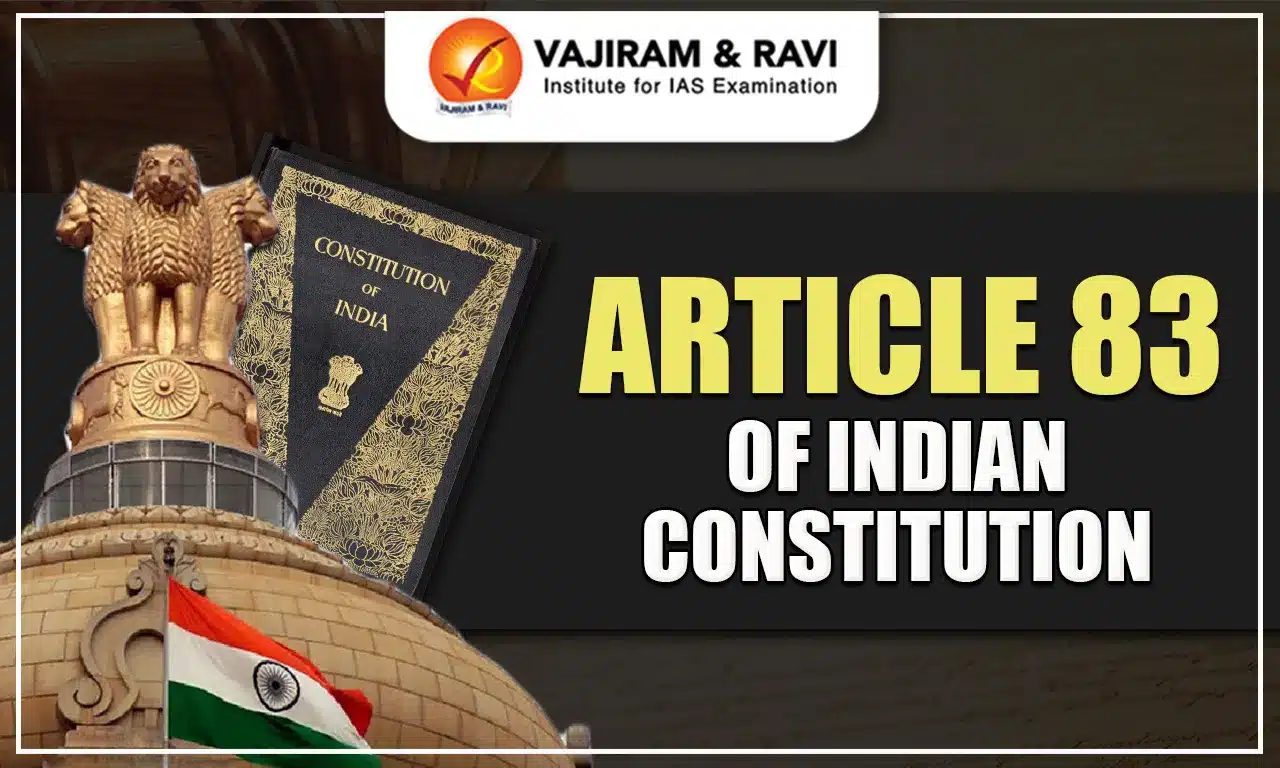
Article 83 of the Constitution of India provides the duration of both the Houses of Parliament that is the Lok Sabha and the Rajya Sabha. It provides a five-year term to the Lok Sabha in order to ensure governance and the Rajya Sabha is a permanent body which does not have a fixed term. One-Third members of Rajya Sabha keep retiring every two years. In this article, we are going to discuss Article 83 of the constitution, its interpretations and significance.
Article 83 of Indian Constitution Interpretation
Article 83 of the Indian Constitution states – “1)The Council of States shall not be subject to dissolution, but as nearly as possible one-third of the members thereof shall retire as soon as may be on the expiration of every second year in accordance with the provisions made in that behalf by Parliament by law. 2)The House of the People, unless sooner dissolved, shall continue for five years from the date appointed for its first meeting and no longer and the expiration of the said period of five years shall operate as a dissolution of the House: Provided that the said period may, while a Proclamation of Emergency is in operation, be extended by Parliament by law for a period not exceeding one year at a time and not extending in any case beyond a period of six months after the Proclamation has ceased to operate.”
Article 83 of the Constitution of India can be interpreted in the following manner:
- According to Article 83, Rajya Sabha is a permanent body that has an indefinite tenure.
- One-third members of the Rajya Sabha retire every two years in order to maintain continuity and stability in the legislative process.
- The Lok Sabha on the other hand, has a defined tenure of five years and can also be dissolved earlier.
- The tenure of Lok Sabha can be extended in the case of national emergency. In such cases, the tenure can be extended up to six months after the Proclamations ceased to operate.
Article 83 of the Constitution of India Significance
Article 83 talks about the tenure of the Houses of Parliament, with the goal of providing stability, continuity, and democratic accountability in the functioning of the Lok Sabha and Rajya Sabha. Article 83 is important because:
- The Rajya Sabha is declared as a permanent body not subject to dissolution, with one-third of its members retiring every two years, ensuring continuity in legislation.
- The Lok Sabha has a fixed term of five years, unless dissolved earlier, which provides a definite electoral cycle, ensuring democratic renewal.


 Last updated on Oct, 2026
→ UPSC 2027 Notification will be released on 13 January 2027 at upsconline.nic.in.
→ Asian Games 2026 are being held in Aichi-Nagoya, Japan, from 19 September to 4 October.
→ Check Nobel Prize 2026 Winners List here.
→ Download PIB PRiSM Monthly Magazine 2026 here.
→ Check UPSC Monthly Current Affairs Magazine The Recitals here.
→ Check out the latest UPSC Syllabus here.
→ Download UPSC Model Answers for Mains 2026
→ UPSC Mains Question Paper 2026 is out now for Essay & GS Paper 1, 2, 3 & 4.
→ UPSC Calendar 2027 has been released.
→ Enroll in Vajiram & Ravi’s UPSC Mains Test Series 2027 for structured answer writing practice, expert evaluation, and exam-oriented feedback.
→ Join Vajiram & Ravi’s UPSC Mentorship Program 2027 for personalized guidance, strategy planning, and one-to-one support from experienced mentors.
→ Go through the UPSC Mains Previous Year Papers to enhance your preparation.
→ UPSC has released UPSC Toppers List 2025 with the Civil Services final result on its official website.
→ Also check Best UPSC Coaching in India
Article 83 of Indian Constitution FAQs
Q1. What is the Article 83 of the Constitution?+
Q2. What is Article 83 of the Lok Sabha?+
Q3. What is the tenure of Lok Sabha?+
Q4. Can Rajya Sabha be dissolved?+
Q5. What is Article 84 of the Indian Constitution?+
Tags: article 83 of indian constitution