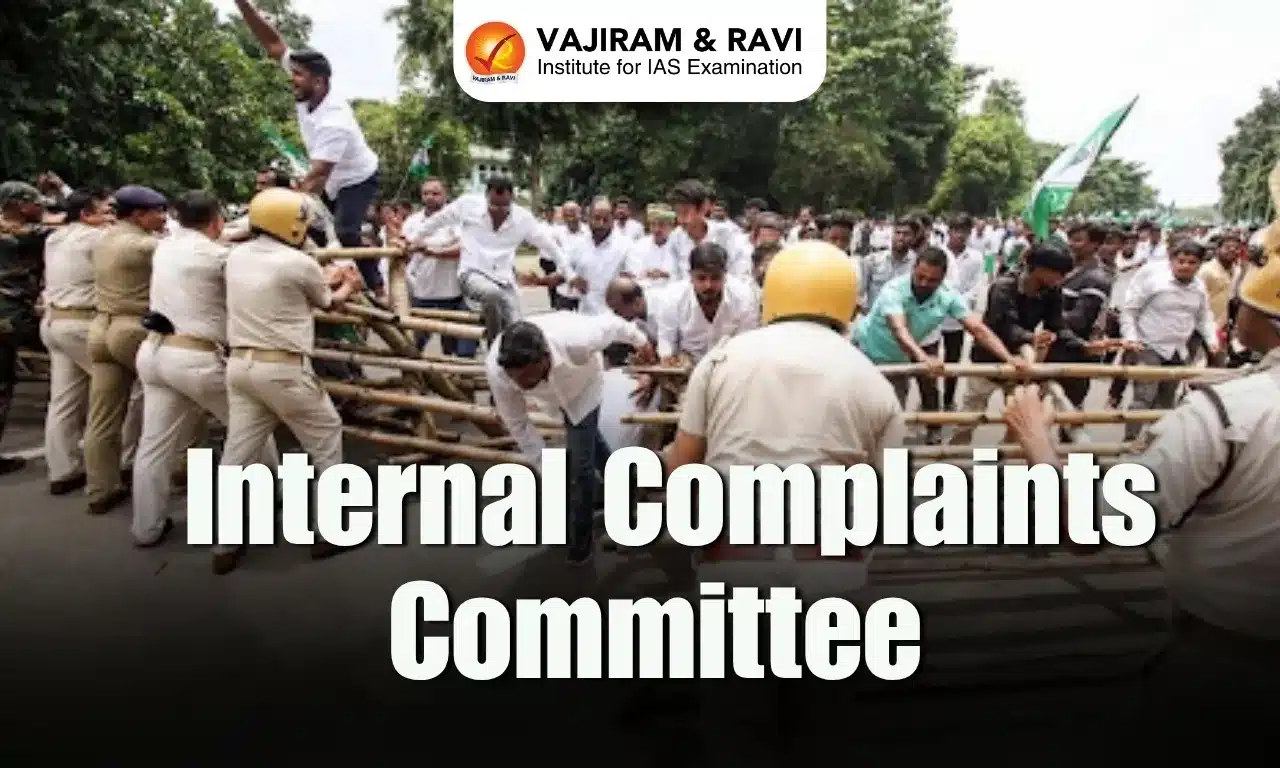
Internal Complaints Committee Latest News
- A student in Balasore, Odisha, died by self-immolation after her sexual harassment complaints against the head of her department were dismissed by the college’s Internal Complaints Committee (ICC).
- Her family alleges that the ICC lacked proper training and operated in a biased environment that favoured the accused, raising serious concerns about the effectiveness and neutrality of institutional grievance redressal systems.
Legal Framework Behind ICCs: From Vishaka Guidelines to the POSH Act
- The foundation for Internal Complaints Committees (ICCs) was laid by the Supreme Court in 1997 through the Vishaka Guidelines, following the gang-rape of Bhanwari Devi, a social worker in Rajasthan.
- These guidelines defined sexual harassment at the workplace and mandated the creation of complaint committees to address such cases.
- Each committee was to be headed by a woman, include at least 50% women members, and involve an external third party to ensure fairness.
- However, these guidelines remained advisory until the 2012 Nirbhaya case prompted legislative action.
- This led to the enactment of the Sexual Harassment of Women at Workplace (Prevention, Prohibition and Redressal) Act, 2013, commonly known as the POSH Act.
- The Act made it mandatory for all workplaces with more than 10 employees to establish ICCs.
- It also ensured that women in smaller or informal workplaces could seek redress through Local Committees formed by district authorities.


Powers and Responsibilities of the Internal Complaints Committee (ICC)
- The ICC, mandated under the POSH Act, is empowered to address complaints of sexual harassment at the workplace.
- It must be headed by a senior woman employee as the Presiding Officer, and should include at least two internal members with experience in social work, legal knowledge, or commitment to women’s causes.
- Additionally, one member must be an external expert, typically from an NGO or with knowledge of sexual harassment issues. Half of the ICC members must be women.
- Process of Filing Complaints
- Any aggrieved woman can submit a written complaint within three months of the incident.
- Upon receiving the complaint, the ICC can either initiate an inquiry or help settle the matter, if the complainant requests.
- The committee enjoys civil court powers under the Code of Civil Procedure, allowing it to summon witnesses, examine evidence, and conduct proceedings accordingly.
- It must complete the inquiry within 90 days and recommend appropriate action if the complaint is upheld.
- The employer is also obligated to assist the complainant in filing a criminal case if she chooses to do so.
- Strict confidentiality is mandated by law—covering the identity of the complainant, accused, witnesses, and details of the proceedings or recommendations—to protect the privacy of all parties involved.
Poor Implementation of the POSH Act
- Even after ten years since the enactment of the POSH Act, the implementation of Internal Complaints Committees (ICCs) remains patchy and inadequate across institutions.
- In December 2024, the Supreme Court expressed concern over the “serious lapses” in enforcement, calling the state of affairs “disquieting” and ordering immediate compliance across both public and private sectors.
- Activists pointed out that although ICCs exist in some places, they often lack training, maintain no confidentiality, and fail to address workplace power imbalances—rendering them ineffective.
- They criticised the lack of coordination between ministries—where the Women and Child Development Ministry oversees the Act, but actual employers fall under the Labour and Industries Ministries.
- This disconnect has resulted in little to no monitoring or analysis of the law’s functioning, leaving a “black hole” in accountability and data.
- The recent Balasore case underscores how ICCs, without proper structure and enforcement, are reduced to being symbolic rather than functional bodies.

 Last updated on Sep, 2026
→ UPSC 2027 Notification will be released on 13 January 2027 at upsconline.nic.in.
→ Asian Games 2026 are being held in Aichi-Nagoya, Japan, from 19 September to 4 October.
→ Check out the latest UPSC Syllabus here.
→ Download UPSC Model Answers for Mains 2026
→ UPSC Mains Question Paper 2026 is out now for Essay & GS Paper 1, 2, 3 & 4.
→ UPSC Calendar 2027 has been released.
→ Enroll in Vajiram & Ravi’s UPSC Mains Test Series 2027 for structured answer writing practice, expert evaluation, and exam-oriented feedback.
→ Join Vajiram & Ravi’s UPSC Mentorship Program 2027 for personalized guidance, strategy planning, and one-to-one support from experienced mentors.
→ Go through the UPSC Mains Previous Year Papers to enhance your preparation.
→ UPSC has released UPSC Toppers List 2025 with the Civil Services final result on its official website.
→ Also check Best UPSC Coaching in India
Internal Complaints Committee FAQs
Q1. What is an Internal Complaints Committee?+
Q2. When was the ICC legally mandated?+
Q3. Who must be on an ICC panel?+
Q4. How effective is the ICC system today?+
Q5. What powers does the ICC hold?+
Tags: internal complaints committee mains articles upsc current affairs upsc mains current affairs