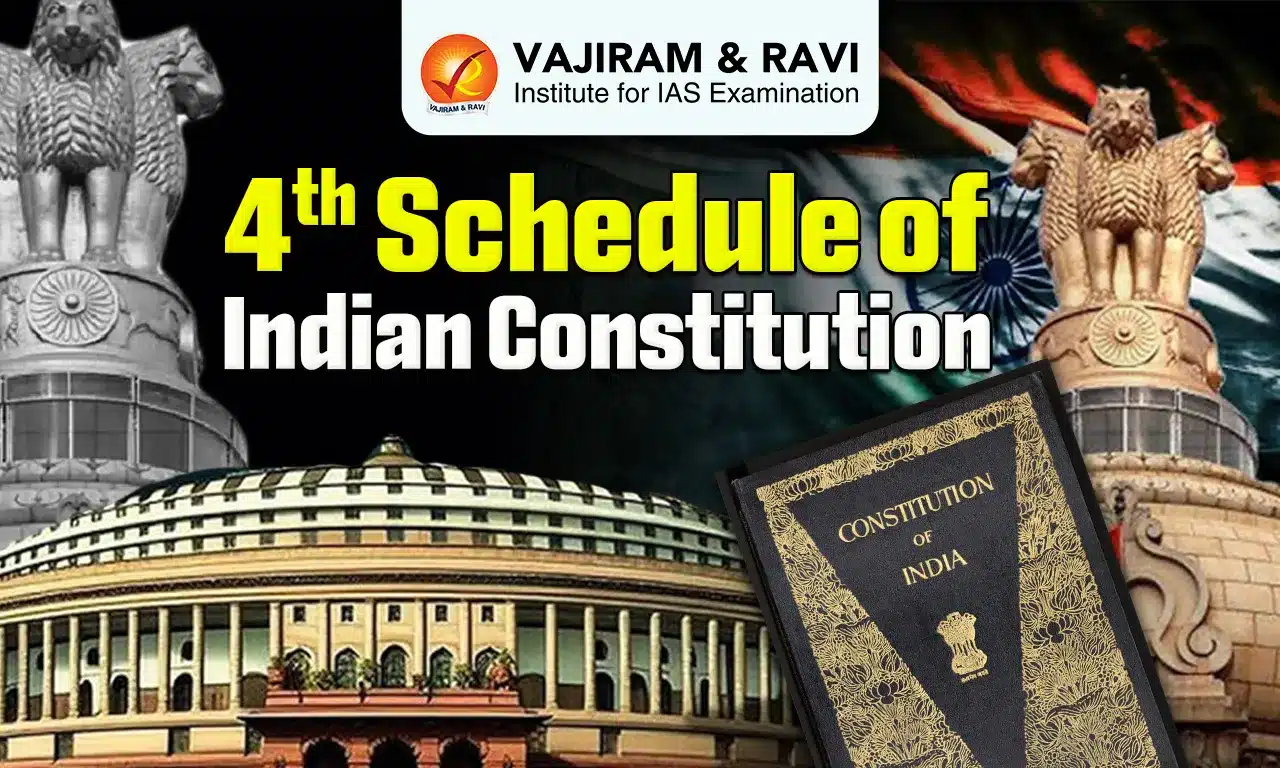
The 4th Schedule of Indian Constitution discusses how seats in the Rajya Sabha are allocated among various states and Union Territories. Out of the total 250 seats, 238 are elected members representing States and Union Territory, while 12 are nominated by the President for their expertise in fields like literature, science, art, and social service. Originally, the Constitution had just eight schedules. The total went up to twelve over time through amendments.
4th Schedule of Indian Constitution
The 4th Schedule of Indian Constitution deals with the allocation of seats in the Rajya Sabha (Council of States). It specifies how many seats each State and Union Territory allocated in the Rajya Sabha. Elected members (238) are chosen through indirect elections by the elected members of State Legislative Assemblies. 12 members are nominated by the President for their contribution to arts, science, literature, and social service. The allocation of seats is not uniform, it usually varies based on the population of each State and Union Territory. Though the Rajya Sabha has a maximum strength of 250, the current strength is 245:
- 233 are elected members from States and UTs
- 12 are nominated members by the President
Also Check:
Schedule of Indian Constitution
The Constitution of India was adopted on January 26, 1950 which consists of 8 Schedules initially which expanded to 12 Schedule of Indian Constitution through amendment.


4th Schedule of Indian Constitution History
In 1949, when the Indian Constitution was adopted, the idea was to have 217 seats in the Rajya Sabha from which 205 elected and 12 nominated. By the time the Constitution of India came into force in 1950, the seats were adjusted to 216 seats, 204 elected and 12 nominated. Over the years, the number of elective seats has increased in response to new states being formed, territories reorganized and population changes:
- 1954: 204 elected seats
- 1956: Increased to 207
- 1970: Increased again to 220
- Present: 238 elective seats allotted; currently, 233 are filled
4th Schedule of Indian Constitution Articles
The 4th Schedule of Indian Constitution is linked to Articles 4(1) and 80(2).
- Article 4(1) explains that when Parliament passes a law under Article 2 or 3 (which deals with the formation or alteration of states), it must also include changes to the First and Fourth Schedules, wherever necessary.
- Article 80(2) deals with the Rajya Sabha (Council of States) and says that the number of seats allocated to each State and Union Territory must follow the structure laid out in the Fourth Schedule.
4th Schedule of Indian Constitution Provisions
- The Rajya Sabha (Council of States) can have a maximum of 250 members.
- Out of these, 238 seats are allocated to States and Union Territories, while 12 members are nominated by the President for their expertise in fields like literature, science, art, and social service.
- As of now, the total strength of Rajya Sabha is 245 with 233 elected members from States and Union Territories and 12 nominated members.
- The elected members are chosen by the elected MLAs (Members of Legislative Assemblies) of each State and Union Territory.
- The election process follows the system of proportional representation by means of a single transferable vote, ensuring fair representation for political parties based on their strength in the State Assemblies.
List of Seats Allocated to State and Union Territory
The 4th Schedule of Indian Constitution outlines how seats in the Rajya Sabha are distributed among the States and Union Territories. Uttar Pradesh has the highest representation with 31 seats in the Rajya Sabha. Some Union Territories like Andaman and Nicobar Islands and Chandigarh have no seats allotted. The table below includes the List of Seats Allocated to State and Union Territory:
| List of Seats Allocated to State and Union Territory | |
| State/Union Territory | Number of Seats |
|
Total |
233 |
|
Uttar Pradesh |
31 |
|
Maharashtra |
19 |
|
Tamil Nadu |
18 |
|
West Bengal |
16 |
|
Bihar |
16 |
|
Karnataka |
12 |
|
Madhya Pradesh |
11 |
|
Gujarat |
11 |
|
Andhra Pradesh |
11 |
|
Rajasthan |
10 |
|
Odisha |
10 |
|
Kerala |
9 |
|
Telangana |
7 |
|
Punjab |
7 |
|
Assam |
7 |
|
Jharkhand |
6 |
|
Chhattisgarh |
5 |
|
Haryana |
5 |
|
Jammu and Kashmir |
4 |
|
Himachal Pradesh |
3 |
|
National Capital Territory of Delhi |
3 |
|
Uttarakhand |
3 |
|
Arunachal Pradesh |
1 |
|
Goa |
1 |
|
Manipur |
1 |
|
Nagaland |
1 |
|
Mizoram |
1 |
|
Meghalaya |
1 |
|
Puducherry |
1 |
|
Sikkim |
1 |
|
Tripura |
1 |
|
Lakshadweep |
0 |
|
Daman and Diu |
0 |
|
Dadra and Nagar Haveli |
0 |
|
Andaman and Nicobar Islands |
0 |
|
Chandigarh |
0 |

 Last updated on Sep, 2026
→ UPSC 2027 Notification will be released on 13 January 2027 at upsconline.nic.in.
→ Asian Games 2026 are being held in Aichi-Nagoya, Japan, from 19 September to 4 October.
→ Check out the latest UPSC Syllabus here.
→ Download UPSC Model Answers for Mains 2026
→ UPSC Mains Question Paper 2026 is out now for Essay & GS Paper 1, 2, 3 & 4.
→ UPSC Calendar 2027 has been released.
→ Enroll in Vajiram & Ravi’s UPSC Mains Test Series 2027 for structured answer writing practice, expert evaluation, and exam-oriented feedback.
→ Join Vajiram & Ravi’s UPSC Mentorship Program 2027 for personalized guidance, strategy planning, and one-to-one support from experienced mentors.
→ Go through the UPSC Mains Previous Year Papers to enhance your preparation.
→ UPSC has released UPSC Toppers List 2025 with the Civil Services final result on its official website.
→ Also check Best UPSC Coaching in India
4th Schedule of Indian Constitution FAQs
Q1. What does the 4th Schedule of the Constitution deal with?+
Q2. Under which Article is the 4th Schedule covered?+
Q3. How many total seats are there in the Rajya Sabha?+
Q4. On what basis are seats allotted to states?+
Q5. Do Union Territories have representation in the Rajya Sabha?+
Tags: 4th schedule of indian constitution