Tsunami Latest News
A powerful 8.8-magnitude earthquake struck Russia’s Kamchatka Peninsula recently, triggering tsunami warnings across the northern Pacific, including Alaska, Hawaii, and down to New Zealand.
About Tsunami
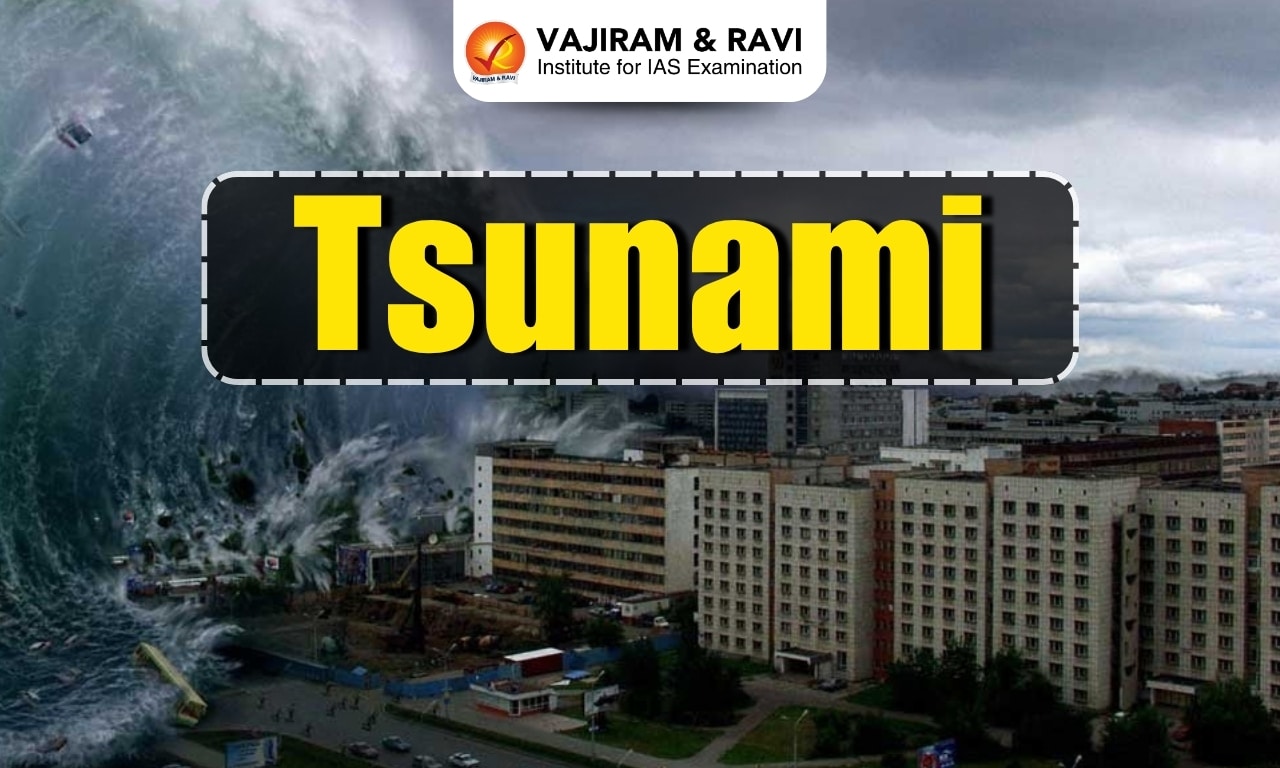
- A tsunami is a series of waves generated by a large and sudden displacement of the ocean.
- Tsunamis can have devastating and wide-ranging effects, especially in coastal regions.
- The word tsunami is composed of the Japanese words “tsu” (which means harbor) and “nami” (which means “wave”).
- Large earthquakes below or near the ocean floor are the most common cause (about 80% of all known tsunamis are triggered by earthquakes), but landslides, volcanic activity, certain types of weather, and meteorites can also cause tsunamis.
- Not all earthquakes cause tsunamis; they must be strong and shallow (at least 6.5 magnitude and less than 70 km from the Earth’s surface), and move the seafloor vertically.
- Tsunamis radiate outward in all directions from their source and can move across entire ocean basins, around islands, and into bays, sounds, and up rivers.
- Out in the depths of the ocean, tsunami waves do not dramatically increase in height.
- But as the waves travel inland, they build up to higher and higher heights as the depth of the ocean decreases.
- The speed of tsunami waves depends on ocean depth rather than the distance from the source of the wave.
- Tsunami waves may travel as fast as jet planes over deep waters, only slowing down when reaching shallow waters.
- Tsunamis can have heights of up to 30 m (98 ft) and reach speeds of 950 km per hour.
- It is hard to see that a tsunami is approaching. The most obvious sign is when coastal water retreats just before the waves reach the shore. This is actually the trough of the wave following behind.
Source: TOI


 Last updated on Oct, 2026
→ UPSC 2027 Notification will be released on 13 January 2027 at upsconline.nic.in.
→ Asian Games 2026 are being held in Aichi-Nagoya, Japan, from 19 September to 4 October.
→ Check Nobel Prize 2026 Winners List here.
→ Download PIB PRiSM Monthly Magazine 2026 here.
→ Check UPSC Monthly Current Affairs Magazine The Recitals here.
→ Check out the latest UPSC Syllabus here.
→ Download UPSC Model Answers for Mains 2026
→ UPSC Mains Question Paper 2026 is out now for Essay & GS Paper 1, 2, 3 & 4.
→ UPSC Calendar 2027 has been released.
→ Enroll in Vajiram & Ravi’s UPSC Mains Test Series 2027 for structured answer writing practice, expert evaluation, and exam-oriented feedback.
→ Join Vajiram & Ravi’s UPSC Mentorship Program 2027 for personalized guidance, strategy planning, and one-to-one support from experienced mentors.
→ Go through the UPSC Mains Previous Year Papers to enhance your preparation.
→ UPSC has released UPSC Toppers List 2025 with the Civil Services final result on its official website.
→ Also check Best UPSC Coaching in India
Tsunami FAQs
Q1. What is the most common cause of tsunamis?+
Q2. In which direction do tsunami waves radiate from their source?+
Q3. What happens to tsunami waves as they approach the coastline?+
Q4. What is often the first visible sign of an approaching tsunami?+
Tags: prelims pointers tsunami upsc current affairs upsc prelims current affairs