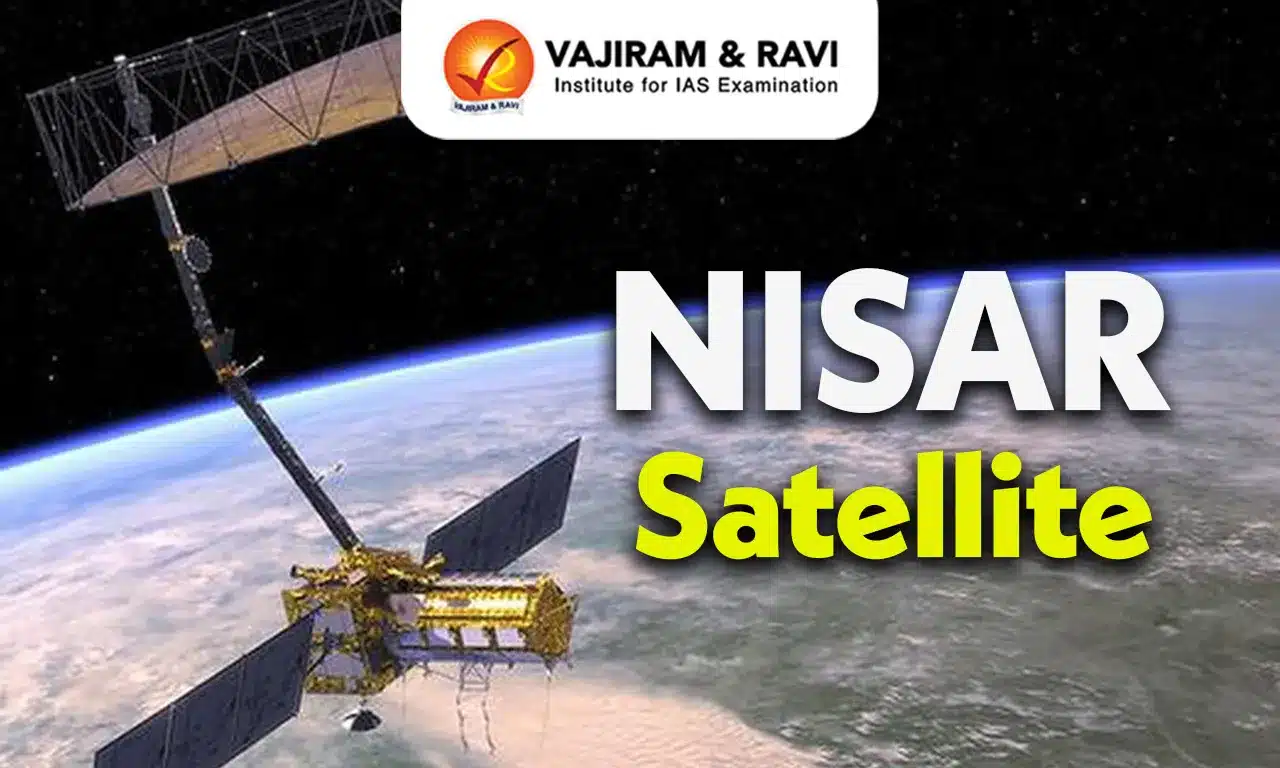
Nisar Satellite is an Earth observation satellite jointly developed by ISRO and NASA, built on ISRO’s I-3K satellite platform, it uses both L-band and S-band Synthetic Aperture Radar (SAR) systems, which allow it to see through clouds, smoke, and even vegetation, day or night, regardless of weather.
The L-band radar works like an X-ray, it can peer beneath forest canopies, track glacier movement, and detect subtle shifts in the Earth’s crust, which helps with things like earthquake forecasting. On the other hand, the S-band radar focuses on surface-level details. It’s great for monitoring crops, spotting snow cover changes, and measuring soil moisture.
Nisar Satellite Objectives
The Nisar Satellite not only clicks pictures from orbit, it’s about decoding Earth’s ongoing transformations. With its dual-band radar system, NISAR will give scientists the tools to monitor key environmental and geological changes over time. Key Objectives of the Nisar Satellite:
- Track land surface deformation caused by earthquakes, volcanic activity, and landslides.
- Monitor glaciers and polar ice sheets to study melting patterns and sea-level rise.
- Map subsidence and uplift due to groundwater depletion, mining, and hydrocarbon extraction.
- Measure forest biomass and detect changes in forest cover to support carbon accounting.
- Detect crop extent and changes to aid agricultural planning and food security.
- Observe the dynamics of wetlands to understand their ecological health and seasonal shifts.
- Study sea ice and selected ocean areas to monitor shifts in polar climates.
- Enable regular, high-resolution mapping of Earth’s land and ice-covered surfaces every 12 days.
Nisar Satellite Spacecraft Configuration
The Nisar Satellite is built on ISRO’s I-3K satellite bus and carries two core payloads: the L-band and S-band Synthetic Aperture Radars (SAR). These two radar systems work together to collect rich, high-resolution data on Earth’s surface and subsurface changes.
The mission is a true collaboration between ISRO and NASA, where both agencies bring their strengths, ISRO handles much of the spacecraft design and support, while NASA contributes key payload elements and mission planning.
| Nisar Satellite Spacecraft Configuration | |
|
Mainframe Bus |
I3K Structure with ~2400Kg Lift Off Mass 70V Bus 3-axis stabilized spacecraft |
|
Imaging Payload |
Free and open data policy |
|
Orbit |
Sun synchronous, Polar (6PM) |
|
Orbit altitude |
747 km – Circular |
|
Inclination |
98.405 deg |
|
Launcher |
GSLV Mk-II with 4m PLF |
|
Mission Life |
5 Years |


ISRO Responsibilities in Nisar Satellite
- Designed and built the spacecraft platform (I-3K structure).
- Developed the S-band radar system, used for imaging surface-level changes.
- Built the data handling system and high-speed downlink system for transmitting radar data to ground stations.
- Responsible for the launch vehicle and launch operations from Indian soil.
- Manages satellite commanding and control once NISAR is in orbit.
- Provides ground station support for receiving radar data and image downloads.
Also Check: Geosynchronous Satellite
NASA Responsibilities in Nisar Satellite
- Developed the L-band radar system, which can penetrate vegetation and soil for subsurface imaging.
- Supplied the 9-meter deployable boom that supports the large 12-meter radar reflector.
- Delivered the Solid-State Recorder, GPS receiver, and part of the high-speed downlink system.
- Provides the orbital maneuver plan and oversees the radar operations strategy.
- Supports the mission with its ground stations, working in sync with ISRO’s network.
Nisar Satellite Mission Phase
The Nisar Satellite Mission Phase is structured into four key phases, each critical for the satellite’s success in gathering and transmitting Earth observation data:
Launch Phase
Nisar Satellite is scheduled to launch on July 30, 2025, aboard the GSLV-F16 from ISRO’s Satish Dhawan Space Centre (SHAR) in Sriharikota. This marks the beginning of its journey into low-Earth orbit.
Deployment Phase
Once in orbit, a 12-meter diameter radar reflector will be deployed using a 9-meter boom developed by NASA’s Jet Propulsion Laboratory. This stage involves complex mechanical operations to ensure the radar system is correctly extended and aligned.
Commissioning Phase
The first 90 days post-launch focus on in-orbit testing and calibration. This includes verifying satellite subsystems, checking radar payloads, and ensuring that instruments are functioning as expected. Initial operations are led jointly by ISRO and JPL.
Science Operations Phase
This long-duration phase starts once commissioning ends. The satellite begins systematic Earth observations, including radar imaging, data collection, calibration, and orbit maintenance. Regular coordination between ISRO and NASA ensures smooth operations and data delivery throughout its mission life.

 Last updated on Sep, 2026
→ UPSC 2027 Notification will be released on 13 January 2027 at upsconline.nic.in.
→ Asian Games 2026 are being held in Aichi-Nagoya, Japan, from 19 September to 4 October.
→ Check out the latest UPSC Syllabus here.
→ Download UPSC Model Answers for Mains 2026
→ UPSC Mains Question Paper 2026 is out now for Essay & GS Paper 1, 2, 3 & 4.
→ UPSC Calendar 2027 has been released.
→ Enroll in Vajiram & Ravi’s UPSC Mains Test Series 2027 for structured answer writing practice, expert evaluation, and exam-oriented feedback.
→ Join Vajiram & Ravi’s UPSC Mentorship Program 2027 for personalized guidance, strategy planning, and one-to-one support from experienced mentors.
→ Go through the UPSC Mains Previous Year Papers to enhance your preparation.
→ UPSC has released UPSC Toppers List 2025 with the Civil Services final result on its official website.
→ Also check Best UPSC Coaching in India
Nisar Satellite FAQs
Q1. What is the NISAR mission?+
Q2. When and where was NISAR launched?+
Q3. What is NISAR’s orbital configuration?+
Q4. What payload does NISAR carry?+
Q5. How precise is NISAR?+
Tags: nisar satellite