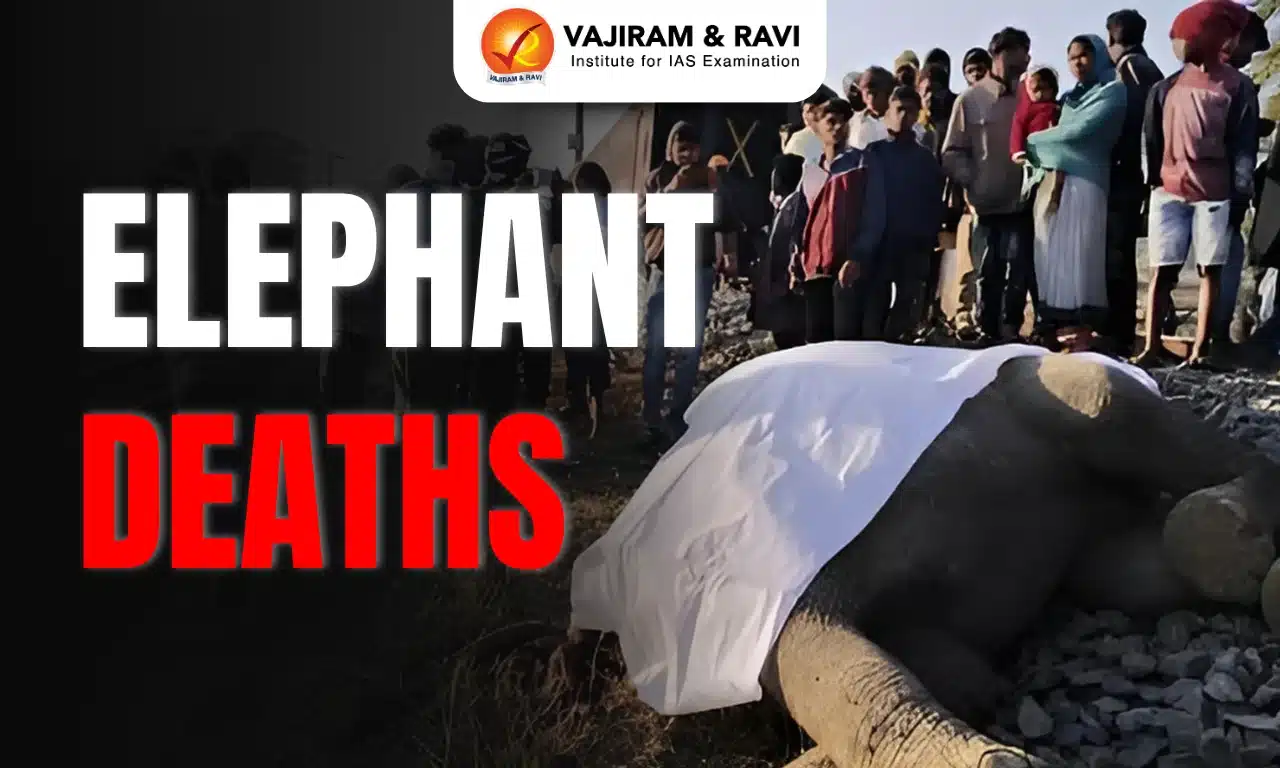
Elephant Deaths Latest News
- The Centre has identified 77 railway stretches across 14 states for urgent mitigation after 186 elephants were killed on railway tracks since 2009.
Introduction
- India’s expanding railway network has come under scrutiny for its increasing threat to wildlife, particularly elephants.
- A recent government survey revealed that 186 elephants were killed in train collisions between 2009-10 and 2024, prompting the Centre to map 77 railway stretches across 14 states for urgent mitigation.
- This move reflects a growing recognition of the ecological consequences of infrastructure development in biodiversity-rich regions.


Scope and Findings of the Joint Survey
- Conducted collaboratively by the Union Ministry of Environment, the Ministry of Railways, and state forest departments, the survey covered 127 railway stretches spanning 3,452 km.
- From this, 77 stretches were identified for immediate intervention based on historical data on elephant movements and fatalities.
- The survey marked a first-of-its-kind systematic assessment of railway-wildlife conflict zones.
- Using on-foot and trolley-based inspections, experts evaluated risk levels based on track elevation, vegetation cover, existing infrastructure, and drainage systems.
Proposed Mitigation Measures
- A total of 705 structures have been proposed to reduce wildlife mortality, with a major focus on elephants. These include:
- 503 ramps and level crossings
- 72 bridge extensions and modifications
- 65 underpasses
- 22 overpasses
- 39 fencing, barricading, or trenching structures
- 4 exit ramps
- These mitigation structures are designed to either allow elephants to cross safely or to divert them away from high-risk tracks.
- States with high elephant populations, such as Assam, Maharashtra, and Uttar Pradesh, have been prioritised. Assam alone will get 131 level crossings with ramps, followed by 125 in Maharashtra and 92 in Uttar Pradesh.
Regional Focus Based on Elephant Populations
- The 2017 elephant census revealed that Karnataka hosts the highest number of wild elephants (6,049), followed closely by Assam (5,719), Kerala (5,706), and Tamil Nadu (2,761).
- These states are crucial for targeted interventions as they combine dense forest habitats with active rail lines.
Evolution of Wildlife-Railway Safety Collaboration
- Discussions between the Environment and Railway Ministries began in August 2022, initially identifying 110 stretches across critical elephant and tiger landscapes. Although some mitigation structures already existed, this exercise aims to institutionalize and scale-up these efforts into a nationally coordinated framework.
- A notable innovation has been the training of railway personnel in elephant ecology at the Wildlife Institute of India.
- These master trainers now educate loco pilots and railway staff on best practices to avoid wildlife collisions.
Integration of Technology: Intrusion Detection Systems (IDS)
- To supplement physical infrastructure, the Indian Railways has started installing Artificial Intelligence-based Intrusion Detection Systems (IDS), especially in the Northeast Frontier Railway (NFR) zone.
- IDS technology alerts control rooms and train operators when elephants are detected near tracks. As of 2025:
- IDS has been commissioned over 141 km, with plans to expand to 1,158 km.
- The most significant stretch includes 207.8 km in Odisha across 20 stations in the Sambalpur division.
- The project spans nine railway zones, including NFR, East Coast Railway, Southern Railway, and Northern Railway.
- The total investment for IDS implementation is estimated at Rs. 208 crore.
Way Forward and Policy Implications
- This comprehensive mitigation plan signals a shift in infrastructure policy, recognizing the need to embed ecological sensitivity into transportation planning.
- With greenfield rail projects on the rise, these frameworks will also guide retrofitting and future-proofing of railways in wildlife corridors.
- The government’s move aligns with conservation goals and India’s obligations under international conventions like the Convention on Migratory Species (CMS) and the Convention on Biological Diversity (CBD).
Source : IE

 Last updated on Oct, 2026
→ UPSC 2027 Notification will be released on 13 January 2027 at upsconline.nic.in.
→ Asian Games 2026 are being held in Aichi-Nagoya, Japan, from 19 September to 4 October.
→ Check Nobel Prize 2026 Winners List here.
→ Download PIB PRiSM Monthly Magazine 2026 here.
→ Check UPSC Monthly Current Affairs Magazine The Recitals here.
→ Check out the latest UPSC Syllabus here.
→ Download UPSC Model Answers for Mains 2026
→ UPSC Mains Question Paper 2026 is out now for Essay & GS Paper 1, 2, 3 & 4.
→ UPSC Calendar 2027 has been released.
→ Enroll in Vajiram & Ravi’s UPSC Mains Test Series 2027 for structured answer writing practice, expert evaluation, and exam-oriented feedback.
→ Join Vajiram & Ravi’s UPSC Mentorship Program 2027 for personalized guidance, strategy planning, and one-to-one support from experienced mentors.
→ Go through the UPSC Mains Previous Year Papers to enhance your preparation.
→ UPSC has released UPSC Toppers List 2025 with the Civil Services final result on its official website.
→ Also check Best UPSC Coaching in India
Elephant Deaths FAQs
Q1. How many elephants have died due to train collisions in India since 2009?+
Q2. What are the key interventions proposed to prevent elephant deaths on tracks?+
Q3. Which states have been prioritized for mitigation structures?+
Q4. What technology is being used to detect elephant movement near tracks?+
Q5. What is the cost of implementing the IDS across Indian Railways?+
Tags: elephant deaths mains articles upsc current affairs upsc mains current affairs