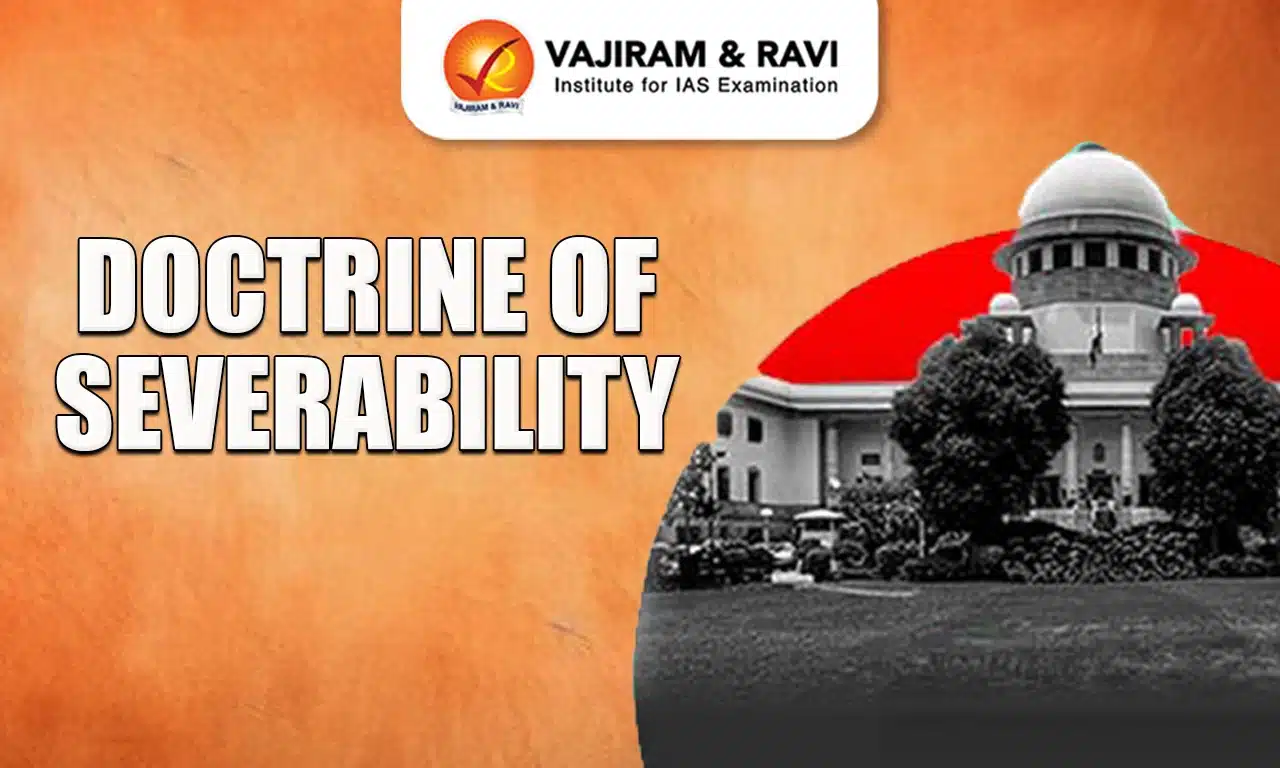
The Doctrine of Severability called the Separability Doctrine is a legal principle that comes into play when only part of a law or contract is found to be invalid or unconstitutional. Instead of tossing out the whole thing, the idea is simple: if one section doesn’t hold up, you can cut that part out, and the rest can still stand. It lets courts preserve the valid parts of a law while removing only what conflicts with the Constitution.
Doctrine of Severability
The application of Doctrine of Severability depends on the jurisdiction and the legal context in which it’s being used. Courts look at the original intent behind the law or contract before applying this doctrine. They assess how the invalid part is connected to the rest of the provisions. If there’s a severability clause, it makes it easier for courts to remove the flawed part. The potential effects of removing or retaining the invalid section are carefully evaluated.
The Doctrine of Severability helps maintain the balance between legal enforcement and constitutional compliance. Courts also use it to uphold legislative or contractual intent without discarding the entire document. It serves as a tool to fix legal defects without disrupting the entire framework.
In India, the Doctrine of Severability is mentioned in Article 13 of the Constitution.
- Article 13 states that any law inconsistent with fundamental rights is void to the extent of that inconsistency.
- This means that only the portion violating fundamental rights is struck down, not the whole law.
Courts apply Doctrine of Severability to decide whether the remaining provisions can still stand on their own. If the rest of the law is meaningful and functional, only the problematic section is removed. The Supreme Court has made it clear, if a part of a law violates the Constitution but can be separated, it can be struck out without affecting the rest.
The court looks at the objective behind the law and whether that purpose can still be achieved. The intent of the legislature plays a key role in deciding what stays and what goes. In civil law countries like France and Germany, severability is codified in statutes. These legal systems offer specific rules on when and how invalid provisions can be separated. Courts refer to these statutes to determine how much of a law or contract can be saved.
This ensures that only the flawed portion is removed, while the valid parts continue to operate.
Doctrine of Severability Characteristics
The Doctrine of Severability applies when only specific provisions of a law violate fundamental rights.
- Article 13 of the Indian Constitution supports this doctrine.
- According to it, any law inconsistent with fundamental rights is void only to the extent of that inconsistency.
- This means that only the offending portion is struck down, not the entire statute.
- For the court to declare a clause unconstitutional, it must be clearly separable from the rest of the law.
- If the remaining parts can function independently, they remain valid and enforceable.
- The basic idea is to preserve as much of the law as possible without violating constitutional rights.
- This allows courts to uphold legislative intent while ensuring that fundamental rights are protected.


Doctrine of Severability Rules
- In India, the Doctrine of Severability is shaped by constitutional, legislative, and judicial interpretations.
- Several key rules guide the courts when applying this theory.
- First is Constitutional Validity. If a particular section of a law violates the Constitution, courts check if the rest of the law can stand on its own.
- The Intent of the Legislature also plays a major role. Judges assess why the law was enacted to see whether its valid parts can be preserved.
- The Pith and Substance Doctrine helps courts focus on the law’s core objective. If the unconstitutional part is not central to the law’s main purpose, it can be removed without affecting the rest.
- Interpretation of Statutes is another tool. Courts study the language, structure, and legislative background to determine if different provisions are interlinked or can be separated.
- When a law includes a Severability Clause, courts refer to it for guidance. This clause often outlines how to handle situations where one part is struck down.
- Protection of Fundamental Rights is always the priority. If a provision is violated on core constitutional rights, its impact is carefully weighed to decide whether it must be removed entirely or in part.
Doctrine of Severability Cases
The table below highlights key court cases that have helped define and shape the Doctrine of Severability in India. Each case sets a precedent in how courts interpret and apply this principle.
| Doctrine of Severability Cases | ||
| Case | Year | Summary |
|
Association of Unified Telecom Service Providers of India v. Union of India |
2012 |
|
|
Navtej Singh Johar v. Union of India |
2018 |
|
|
Shayara Bano v. Union of India |
2017 |
|
Doctrine of Severability Criticism
Doctrine of Severability also faced some criticisms which are discussed below:
- The Doctrine of Severability requires courts to determine whether the legislature would have enacted a law even if the unconstitutional parts were removed. This is problematic, as legislatures rarely anticipate constitutional objections during enactment.
- Courts are often left to rely on hypothetical interpretations of legislative intent, as no actual guidance exists when parts of a statute are struck down.
- By severing certain provisions and retaining others, courts effectively modify the law, stepping into the domain of the legislature and raising concerns over separation of powers.
- A petitioner challenging a specific provision may inadvertently expose the entire statute to judicial scrutiny if one part is found unconstitutional.
- The Doctrine of Severability sometimes allows courts to review and potentially invalidate parts of the law that the petitioner is not directly contesting, thereby stretching the requirement of locus standi.

 Last updated on Oct, 2026
→ UPSC 2027 Notification will be released on 13 January 2027 at upsconline.nic.in.
→ Check Nobel Prize 2026 Winners List here.
→ Download PIB PRiSM Monthly Magazine 2026 here.
→ Check UPSC Monthly Current Affairs Magazine The Recitals here.
→ Check out the latest UPSC Syllabus here.
→ Download UPSC Model Answers for Mains 2026
→ UPSC Mains Question Paper 2026 is out now for Essay & GS Paper 1, 2, 3 & 4.
→ UPSC Calendar 2027 has been released.
→ Enroll in Vajiram & Ravi’s UPSC Mains Test Series 2027 for structured answer writing practice, expert evaluation, and exam-oriented feedback.
→ Join Vajiram & Ravi’s UPSC Mentorship Program 2027 for personalized guidance, strategy planning, and one-to-one support from experienced mentors.
→ Go through the UPSC Mains Previous Year Papers to enhance your preparation.
→ UPSC has released UPSC Toppers List 2025 with the Civil Services final result on its official website.
→ Also check Best UPSC Coaching in India
Doctrine of Severability FAQs
Q1. What is the Doctrine of Severability?+
Q2. Where is the doctrine applied?+
Q3. Which Article of the Constitution relates to this doctrine?+
Q4. What is the purpose of the Doctrine of Severability?+
Q5. How do courts decide what can be severed?+
Tags: doctrine of severability