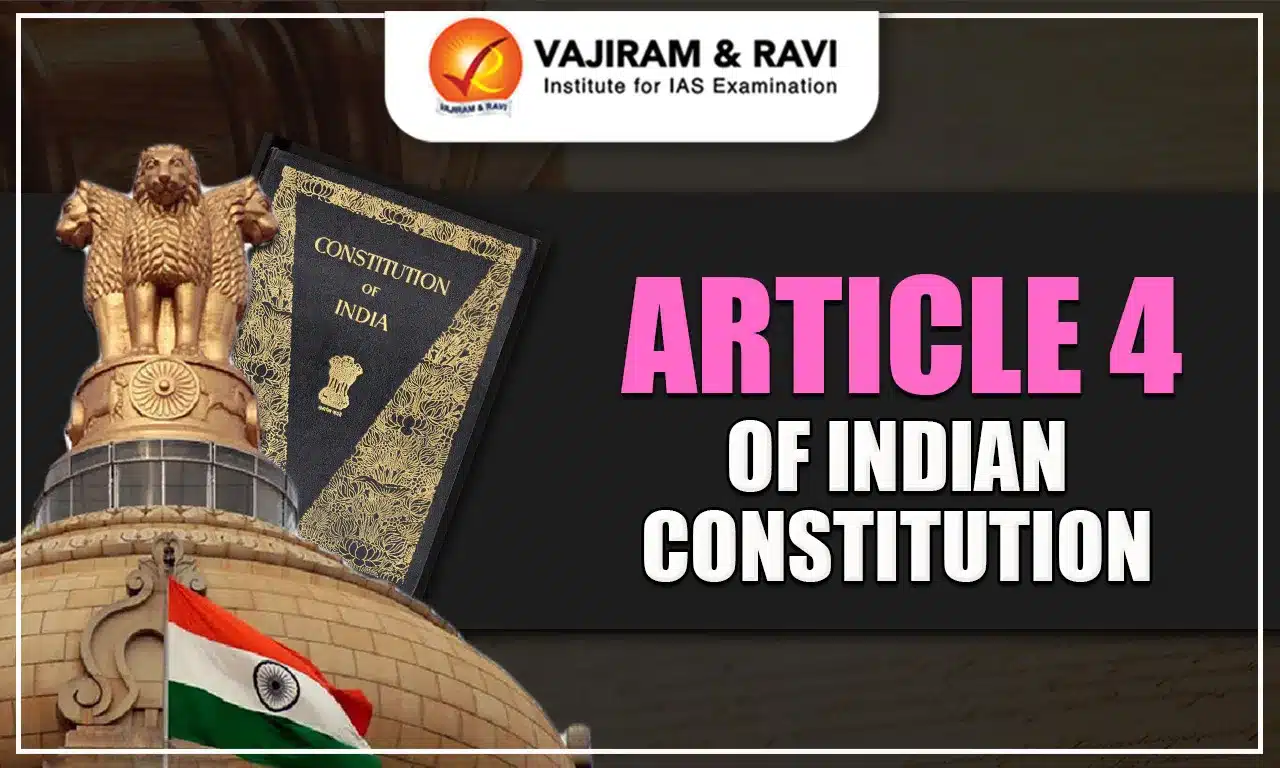
Article 4 of the Constitution of India empowers Parliament to enact laws for the formation of new states or alteration of existing ones. Historic developments like the linguistic reorganization of states in the 1950s or the creation of Telangana in 2014 were carried out using the framework laid down under Article 4. It ensures that such changes are not only legally valid but also uphold democratic processes, thereby reinforcing India’s flexible yet stable federal structure. In this article, we are going to cover Article 4 of the Constitution of India, its interpretation and its significance.
Article 4 of Indian Constitution History
On November 18, 1948, Article 4 was discussed for the first time in the Assembly. The article states that the laws passed by the Parliament under Article 2 and Article 3 will not be counted as constitutional amendments. These two articles can be implemented by just a majority vote instead of opting for a special procedure. Shibban Lal Saksena, a member of the Indian National Congress from the United Provinces, voiced serious concerns during the Constituent Assembly debates about the implications of altering state boundaries. He emphasized that such decisions carried substantial national importance and should not be left to the discretion of a simple majority in Parliament. Saksena cautioned against the instability that could arise if successive governments frequently altered state boundaries. While other members, including Pattabhi Sitaramayya from Madras, shared similar reservations, no formal amendments were introduced. As a result, Article 4 was adopted into the Constitution in its original form, without any changes.
Article 4 of Indian Constitution Interpretation
The constitution of India states the following about Article 4:
- “Any law referred to in article 2 or article 3 shall contain such provisions for the amendment of the First Schedule and the Fourth Schedule as may be necessary to give effect to the provisions of the law and may also contain such supplemental, incidental and consequential provisions (including provisions as to representation in Parliament and in the Legislature or Legislatures of the State or States affected by such law) as Parliament may deem necessary.”
- No such law as aforesaid shall be deemed to be an amendment of this Constitution for the purposes of article 368.
Article 4 of the Indian Constitution can be interpreted in the following manner:
The phrase “Any law referred to in Article 2 or Article 3” signifies that Article 4 of the Indian Constitution governs laws related to the admission of new states (Article 2) and the creation or alteration of states (Article 3).
- The clause “shall contain such provisions for the amendment of the First Schedule and the Fourth Schedule” makes it mandatory for such laws to appropriately update the First Schedule (which lists states and union territories) and the Fourth Schedule (which details Rajya Sabha seat allocation), ensuring constitutional alignment with the territorial changes.
- The expression “as may be necessary to give effect to the provisions of the law” underlines the need for all essential amendments that make the proposed changes legally and functionally effective.
- The provision that the law “may also contain such supplemental, incidental and consequential provisions” grants the authority to include additional provisions required for implementation such as adjustments in legislative representation, administrative arrangements, or jurisdictional boundaries—thus enabling smooth execution of the reorganisation.


Article 4 of Indian Constitution Significance
Article 4 of the Indian Constitution reflects the dynamic and adaptable nature of the Constitution by empowering Parliament to create new states or alter the boundaries of existing ones through a simple majority and ordinary legislative procedure, rather than a constitutional amendment.
- Parliament’s Legislative Competence: It grants Parliament the exclusive authority to reorganize states like changing their names, boundaries, or status and ensuring administrative efficiency and responsiveness to evolving regional demands.
- Not a Constitutional Amendment: Laws enacted under Article 4 are not treated as constitutional amendments under Article 368, which simplifies the process and avoids procedural rigidity in matters of state reorganization.
- Uphold Legal and Constitutional Coherence: Article 4 ensures that necessary adjustments such as to the First and Fourth Schedules are made seamlessly to maintain constitutional consistency, enabling smooth and effective implementation of reorganization laws.
Article 4 of Indian Constitution Impact
Article 4 of the Constitution of India has been used by the Parliament to enact important acts. In this table below, we show the states that are involved in the corresponding legislative acts:
| States Involved | Acts |
|
Assam |
Assam (Alteration of Boundaries) Act, 1951: Altered boundaries by ceding a strip of area from India to Bhutan. |
|
Andhra Pradesh |
Andhra State Act, 1953: Formed a new state by taking territory from Madras. |
|
Himachal Pradesh |
Himachal Pradesh and Bilaspur (New State) Act, 1954: Merged Part C states of Himachal Pradesh and Bilaspur into one state. |
|
West Bengal |
Bihar and West Bengal (Transfer of Territories) Act, 1956: Transferred certain territories from Bihar to West Bengal. |
|
Kerala |
States Reorganisation Act, 1956: Formed new state of Kerala; merged states like Madhya Bharat, Pepsi, Saurashtra, Travancore Cochin, etc. |
|
Madhya Pradesh |
Rajasthan and Madhya Pradesh (Transfer of Territories) Act, 1959: Transferred certain territories from Rajasthan to Madhya Pradesh. |
|
Andhra Pradesh |
Andhra Pradesh and Madras (Alteration of Boundaries) Act, 1959: Altered boundaries of Andhra Pradesh and Madras. |
|
Gujarat and Maharashtra |
Bombay Reorganisation Act, 1960: Partitioned Bombay into Gujarat and Maharashtra. |
|
Assam, Punjab, and West Bengal |
Acquired Territories (Merger) Act, 1960: Merged territories acquired from Pakistan into Assam, West Bengal, and Punjab. |
|
Nagaland |
State of Nagaland Act, 1962: Formed a new state of Nagaland from the Naga Hills-Tuensang Area. |
|
Punjab and Haryana |
Punjab Reorganisation Act, 1966: Split Punjab into Punjab, Haryana, and union territory of Chandigarh. |
|
Andhra Pradesh and Mysore |
Andhra Pradesh and Mysore (Transfer of Territory) Act, 1968: Transferred territory from Mysore to Andhra Pradesh. |
|
Bihar and Uttar Pradesh |
Bihar and Uttar Pradesh (Alteration of Boundaries) Act, 1968: Altered boundaries between Bihar and Uttar Pradesh. |
|
Meghalaya |
Assam Reorganisation (Meghalaya) Act, 1969: Created autonomous sub-state Meghalaya within Assam. |
|
Himachal Pradesh |
State of Himachal Pradesh Act, 1970: Upgraded Himachal Pradesh from Union Territory to state status. |
|
Mizoram, Arunachal Pradesh |
North Eastern Areas (Reorganisation) Act, 1971: Upgraded Manipur, Tripura, Meghalaya to states; Mizoram and Arunachal Pradesh to Union Territories. |
|
Sikkim |
35th Amendment Act, 1974: Admitted Sikkim as a state; 36th Amendment Act, 1975: Introduced Article 371F for special protections. |
|
Haryana and Uttar Pradesh |
Haryana and Uttar Pradesh (Alteration of Boundaries) Act, 1979: Altered boundaries between Haryana and Uttar Pradesh. |
|
Mizoram |
State of Mizoram Act, 1986: Elevated Mizoram from Union Territory to state status. |
|
Arunachal Pradesh |
State of Arunachal Pradesh Act, 1986: Upgraded Arunachal Pradesh from Union Territory to state status. |
|
Goa |
Goa, Daman, and Diu Reorganisation Act, 1987: Formed the state of Goa, separating it from Daman and Diu. |
|
Chhattisgarh |
Madhya Pradesh Reorganisation Act, 2000: Created new state of Chhattisgarh from Madhya Pradesh. |
|
Uttaranchal |
Uttar Pradesh Reorganisation Act, 2000: Separated Uttaranchal from Uttar Pradesh. |
|
Jharkhand |
Bihar Reorganisation Act, 2000: Created a new state of Jharkhand from Bihar. |
|
Telangana |
Andhra Pradesh Reorganisation Act, 2014: Separated Telangana from Andhra Pradesh. |

 Last updated on Oct, 2026
→ UPSC 2027 Notification will be released on 13 January 2027 at upsconline.nic.in.
→ Asian Games 2026 are being held in Aichi-Nagoya, Japan, from 19 September to 4 October.
→ Check Nobel Prize 2026 Winners List here.
→ Download PIB PRiSM Monthly Magazine 2026 here.
→ Check UPSC Monthly Current Affairs Magazine The Recitals here.
→ Check out the latest UPSC Syllabus here.
→ Download UPSC Model Answers for Mains 2026
→ UPSC Mains Question Paper 2026 is out now for Essay & GS Paper 1, 2, 3 & 4.
→ UPSC Calendar 2027 has been released.
→ Enroll in Vajiram & Ravi’s UPSC Mains Test Series 2027 for structured answer writing practice, expert evaluation, and exam-oriented feedback.
→ Join Vajiram & Ravi’s UPSC Mentorship Program 2027 for personalized guidance, strategy planning, and one-to-one support from experienced mentors.
→ Go through the UPSC Mains Previous Year Papers to enhance your preparation.
→ UPSC has released UPSC Toppers List 2025 with the Civil Services final result on its official website.
→ Also check Best UPSC Coaching in India
Article 4 of Indian Constitution FAQs
Q1. What is Article 4 of the Indian Constitution?+
Q2. What is Article Part 4 of the Indian Constitution?+
Q3. What is the difference between Article 3 and Article 4?+
Q4. What is Article 2 of the Indian Constitution?+
Q5. How to amend the Constitution of India?+
Tags: article 4 of indian constitution