Ethanol Blending Latest News
- Amid the nationwide rollout of E20 fuel, concerns over reduced mileage and vehicle damage due to ethanol’s corrosive nature and lower energy content have emerged.
Introduction
- India’s transition toward energy self-reliance and carbon reduction has achieved a landmark with the nationwide rollout of E20 fuel, petrol blended with 20% ethanol.
- The target, initially set for 2030, has been met five years ahead of schedule in 2025.
- While the move bolsters energy security, supports sugarcane farmers, and cuts crude oil imports, it has raised concerns among vehicle owners and experts regarding its effects on fuel efficiency, engine health, and long-term maintenance.


Ethanol Blending and Its Policy Context
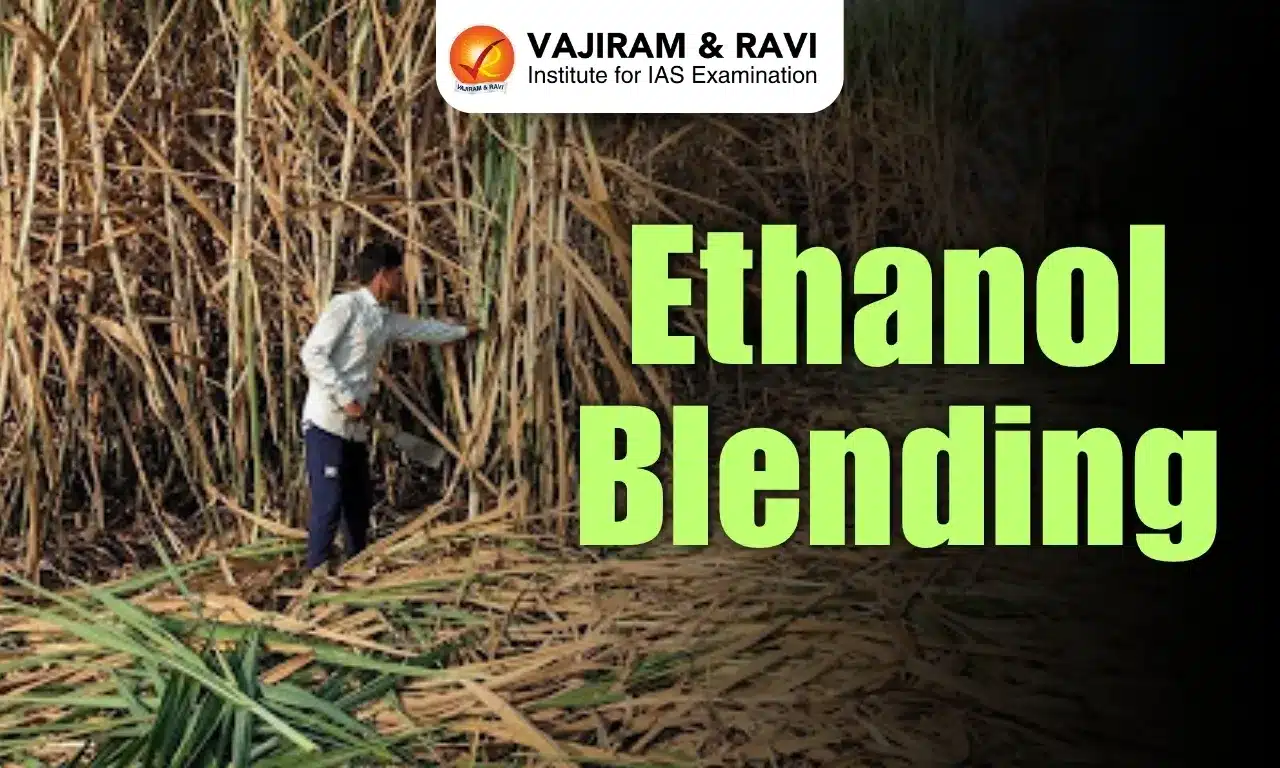
- Ethanol is an alcohol-based biofuel typically derived from sugarcane, maize, or other biomass sources.
- It’s blending with petrol reduces carbon emissions and helps India reduce dependency on imported fossil fuels.
- The government’s Ethanol Blended Petrol (EBP) Programme, launched in 2003 and accelerated over the past decade, first achieved a 10% ethanol blending (E10) milestone in 2022.
- In 2025, the E20 rollout was declared complete nationwide.
- The achievement aligns with India’s broader renewable energy and energy security ambitions under the National Bio-Energy Programme.
Environmental and Economic Gains
- The E20 programme is estimated to reduce India’s crude oil import bill by over Rs. 50,000 crore annually and reduce carbon dioxide emissions significantly.
- It also provides economic support to farmers by increasing the demand for sugarcane and other feedstock crops.
- However, while macroeconomic and environmental benefits are substantial, E20’s implications for individual vehicle performance and user costs present a complex trade-off.
Impact on Fuel Efficiency
- One of the most debated impacts of ethanol blending is the drop in mileage.
- Ethanol contains about 30% less energy per litre than petrol. This energy deficit translates into increased fuel consumption per kilometre driven.
- Central Govt’s View: The Ministry of Petroleum and Natural Gas (MoPNG) has clarified that the mileage loss is “marginal”, around 1-2% for E10-designed vehicles calibrated for E20 and 3-6% for others. With proper engine tuning, the Ministry says efficiency losses can be minimised.
- Expert Opinion: Independent automotive experts, however, estimate that real-world mileage loss could be as high as 6-7%, particularly for vehicles not optimised for E20. This would mean more frequent refuelling and higher running costs for users.
Corrosion and Compatibility Issues
- The more serious concern relates to vehicle maintenance. Ethanol is hygroscopic, meaning it absorbs moisture from the atmosphere. This can lead to:
- Corrosion of metal components such as fuel tanks, fuel lines, injectors, and exhausts.
- Degradation of rubber and plastic components like seals, gaskets, and hoses.
- Alteration of air-fuel ratio, affecting combustion and performance, especially in engines without calibrated ECUs.
- Experts from firms like Primus Partners and FADA (Federation of Automobile Dealers Associations) have warned that older vehicles not designed for E20 may suffer from increased wear and tear, leading to higher maintenance costs.
Industry Response
- Major automobile manufacturers have responded by:
- Hero MotoCorp stated that vehicles manufactured before April 2023 may require engine modifications and replacement of rubber components to safely run on E20.
- TVS Motor Company acknowledges that ethanol’s corrosive nature requires re-engineered components to prevent premature wear and compatibility issues.
- To support the transition, manufacturers are now producing E20-compatible models and updating service advisories for older vehicles.
Future Outlook and Higher Blends
- While the E20 transition is already posing technical challenges, discussions have begun on potential future blends like E30 or E40. Experts caution that higher blends will necessitate:
- Dual fuel dispensing infrastructure at petrol pumps.
- Retrofitting of older vehicles or phase-outs.
- Regulatory clarity and greater consumer awareness.
- Until such safeguards are in place, expanding beyond E20 may increase the burden on both consumers and service providers.

 Last updated on Sep, 2026
→ UPSC 2027 Notification will be released on 13 January 2027 at upsconline.nic.in.
→ Asian Games 2026 are being held in Aichi-Nagoya, Japan, from 19 September to 4 October.
→ Check out the latest UPSC Syllabus here.
→ Download UPSC Model Answers for Mains 2026
→ UPSC Mains Question Paper 2026 is out now for Essay & GS Paper 1, 2, 3 & 4.
→ UPSC Calendar 2027 has been released.
→ Enroll in Vajiram & Ravi’s UPSC Mains Test Series 2027 for structured answer writing practice, expert evaluation, and exam-oriented feedback.
→ Join Vajiram & Ravi’s UPSC Mentorship Program 2027 for personalized guidance, strategy planning, and one-to-one support from experienced mentors.
→ Go through the UPSC Mains Previous Year Papers to enhance your preparation.
→ UPSC has released UPSC Toppers List 2025 with the Civil Services final result on its official website.
→ Also check Best UPSC Coaching in India
Ethanol Blending FAQs
Q1. What is E20 fuel?+
Q2. How does ethanol blending affect vehicle mileage?+
Q3. Are all vehicles compatible with E20 fuel?+
Q4. What maintenance issues can arise from E20 use?+
Q5. Will higher ethanol blends be introduced in the future?+
Tags: ethanol blending mains articles upsc current affairs upsc mains current affairs