Tackling Money Laundering Latest News
- Since 2015, the Enforcement Directorate (ED) has taken up 5,892 cases under the Prevention of Money Laundering Act (PMLA), 2002, but only 15 convictions have been secured so far, according to a report presented by the Finance Minister in the Rajya Sabha.
- While the government asserts that investigations and Enforcement Case Information Reports (ECIRs) have been initiated in almost all cases, the low conviction rate highlights the inefficacy in securing prosecutions.
- Additionally, the continuous rise in money laundering cases suggests the government’s inability to effectively curb such financial crimes.
Laundromats: Financial Vehicles for Money Laundering and Illicit Activities
- The term “laundromat” originated from organised crime syndicates in the U.S. using laundromats as fronts to disguise illegal earnings.
- In financial terms, a laundromat refers to an all-purpose financial vehicle, often set up by banks or financial service companies, which facilitates laundering proceeds of crime.
- It does so by hiding asset ownership, embezzling funds, evading taxes, bypassing currency restrictions, and moving money offshore.
- These entities are used to obscure the true source and ownership of illicit funds under the guise of legitimate financial operations.


The Process and Impact of Money Laundering
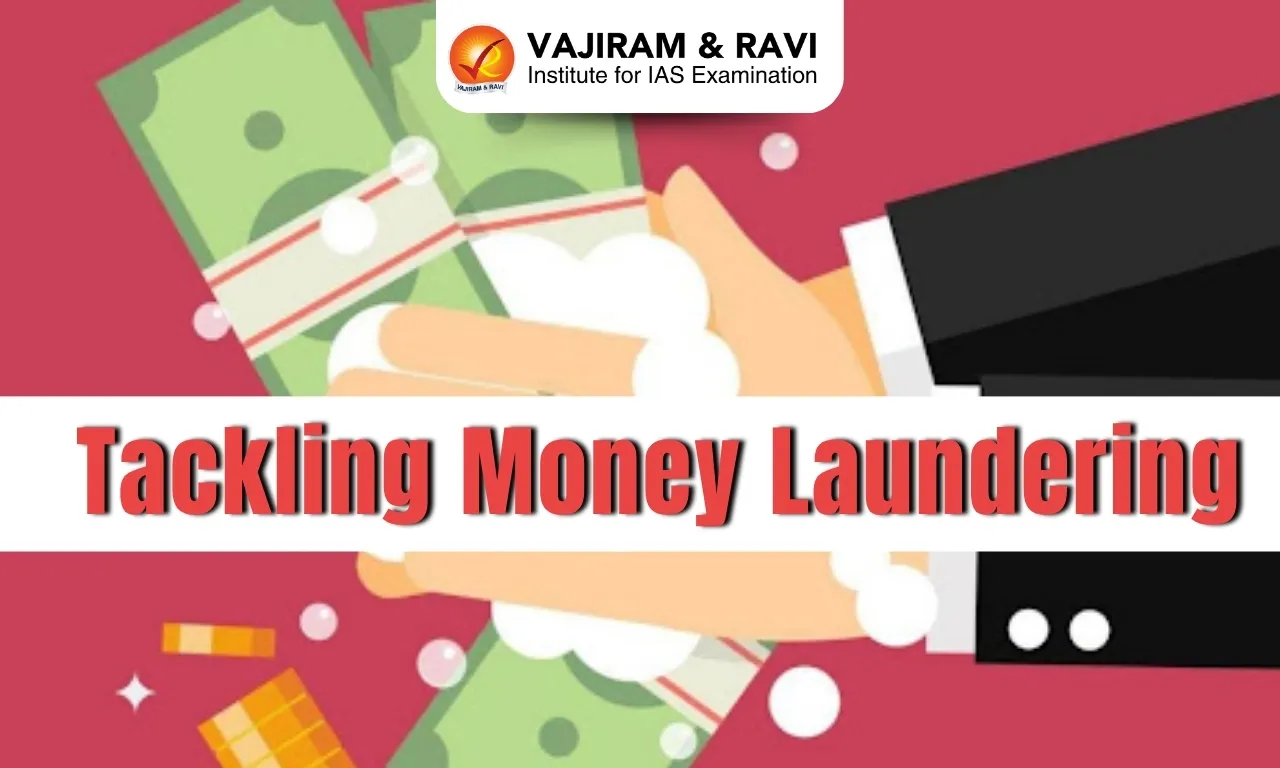
- Money laundering, as defined under Section 3 of the Prevention of Money Laundering Act (PMLA), involves concealing, possessing, acquiring, or using proceeds of crime and projecting them as untainted property.
- The laundering process typically unfolds in three stages:
- Placement, where illicit money is introduced into the financial system, often broken into smaller sums through “smurfing”;
- Layering, where funds are moved through investments and transactions to obscure their origin; and
- Integration, where the laundered money re-enters the economy via real estate, businesses, or asset formation.
- The Supreme Court, in P. Chidambaram vs. Enforcement Directorate (2019), noted that laundering conceals illegal sources, undermining the financial system and national sovereignty.
- Additionally, it disrupts monetary stability, fuels inflation, and distorts trade, as highlighted by the Financial Action Task Force (FATF).
Key Provisions and Challenges of the Prevention of Money Laundering Act (PMLA)
- The Prevention of Money Laundering Act (PMLA) was enacted in line with the UN Political Declaration and Global Programme of Action (1990) to prevent money laundering and confiscate properties derived from criminal activities.
- A notable aspect of the Act is that it shifts the burden of proof onto the accused.
- Additionally, an Enforcement Case Information Report (ECIR) is sufficient to initiate proceedings, without the necessity of a First Information Report (FIR).
- This was upheld by the Supreme Court in Vir Bhadra Singh vs. ED (2017).
- The only prerequisite is the commission of a scheduled offence, considered an offence against the state.
- However, despite the Act’s stringent provisions, money laundering remains widespread, posing a serious challenge to law enforcement.
Addressing Implementation Challenges and Misuse of PMLA
- The rapid rise in money laundering cases raises concerns about the effective implementation and misuse of the Prevention of Money Laundering Act (PMLA).
- The Supreme Court, in Vijay Madanlal Chaudhury vs. Union of India (2022), clarified that while prosecution under Section 3 requires a registered scheduled offence, authorities can attach properties under Section 5 without a pre-registered case.
- This loophole has often been exploited for politically motivated actions.
- To curb such misuse, authorities must adhere to the Financial Action Task Force (FATF) guidelines and handle cases with greater diligence and transparency.
- Money laundering’s direct link to terror financing necessitates its serious and impartial enforcement.
- Additionally, India’s Double Taxation Avoidance Agreements (DTAA) with around 85 countries facilitate international cooperation in tackling money laundering, but stronger efforts are needed to ensure their effective utilization.

 Last updated on Oct, 2026
→ UPSC 2027 Notification will be released on 13 January 2027 at upsconline.nic.in.
→ Asian Games 2026 are being held in Aichi-Nagoya, Japan, from 19 September to 4 October.
→ Check Nobel Prize 2026 Winners List here.
→ Download PIB PRiSM Monthly Magazine 2026 here.
→ Check UPSC Monthly Current Affairs Magazine The Recitals here.
→ Check out the latest UPSC Syllabus here.
→ Download UPSC Model Answers for Mains 2026
→ UPSC Mains Question Paper 2026 is out now for Essay & GS Paper 1, 2, 3 & 4.
→ UPSC Calendar 2027 has been released.
→ Enroll in Vajiram & Ravi’s UPSC Mains Test Series 2027 for structured answer writing practice, expert evaluation, and exam-oriented feedback.
→ Join Vajiram & Ravi’s UPSC Mentorship Program 2027 for personalized guidance, strategy planning, and one-to-one support from experienced mentors.
→ Go through the UPSC Mains Previous Year Papers to enhance your preparation.
→ UPSC has released UPSC Toppers List 2025 with the Civil Services final result on its official website.
→ Also check Best UPSC Coaching in India
Tackling Money Laundering FAQs
Q1. What is money laundering under PMLA?+
Q2. How do laundromats operate in financial crimes?+
Q3. What are the three stages of money laundering?+
Q4. Why is PMLA criticised for misuse?+
Q5. How can India strengthen money laundering enforcement?+
Tags: mains articles tackling money laundering upsc current affairs upsc mains current affairs