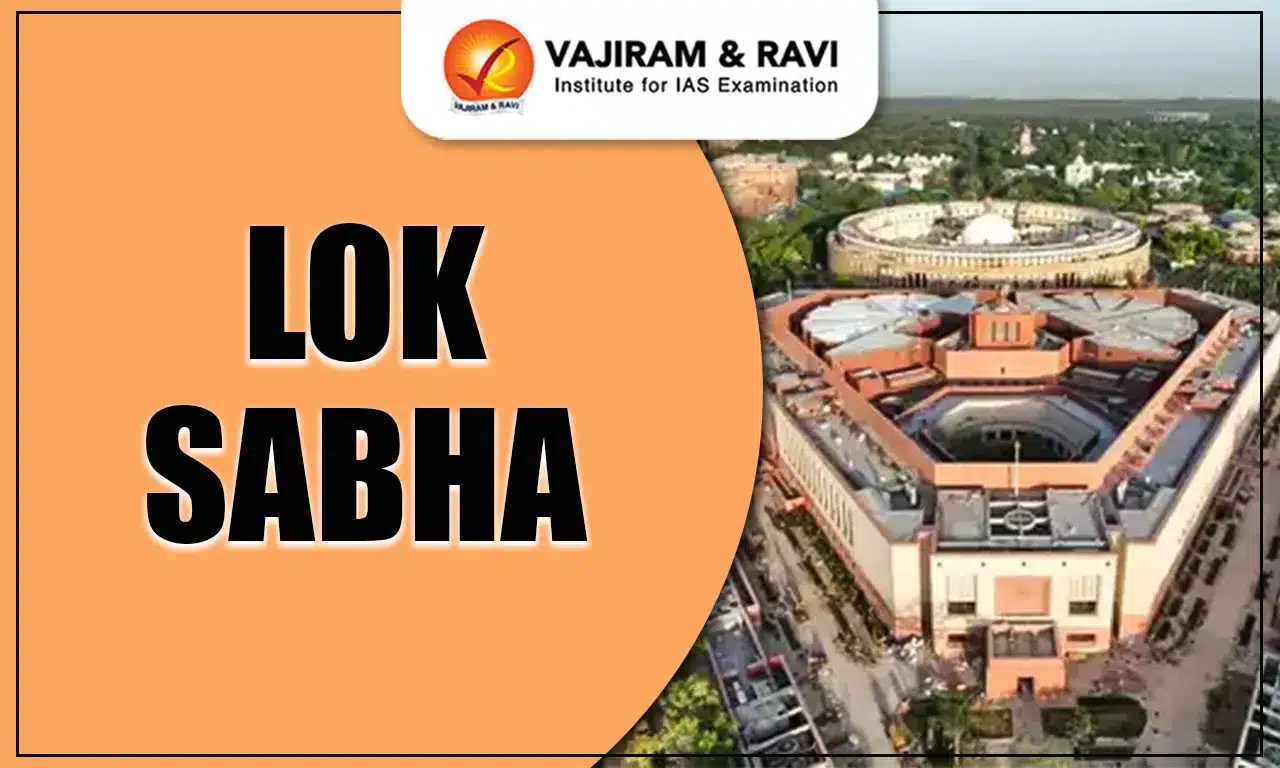
The Lok Sabha represents the people of India, helping in shaping national policies, enacting laws and representing the interests of citizens of India. This lower house of parliament plays an important role in the democratic governance of India. In this article, we are going to cover all about Lok Sabha, its structure, composition, systems of elections of members and other cases.
What is the Lok Sabha?
The Lok Sabha is also known as the Lower House of the Parliament of India or the House of People. The house consists of people directly elected representatives of India. According to the Constitution of India, the Lok Sabha plays an important role in making laws, formulating the Union Budget and articulating the democratic will of people.
Lok Sabha Total Member Composition
The Lok Sabha is composed of 550 members, including:
- 530 members are representatives of the States
- 20 members are representatives of the Union Territories
- Currently, the Lok Sabha consists of 543 members, including:
- 524 members are representatives of the State
- 19 members are representatives of Union Territories
Also Read: Difference between Lok Sabha and Rajya Sabha


Representation of States in the Lok Sabha
Members representing states in the Lok Sabha are directly elected by the people through territorial constituencies.
The elections are conducted based on the Universal Adult Franchise, meaning:
- Every Indian citizen aged 18 and above
- Not disqualified by law or the Constitution
is eligible to vote.
Note: The voting age was lowered from 21 to 18 by the 61st Constitutional Amendment Act, 1988.
Representation of Union Territories in the Lok Sabha
The Constitution empowers Parliament to decide how Union Territories are represented in the Lok Sabha.
Under the Union Territories (Direct Election to the House of the People) Act, 1965, members from UTs are also chosen by direct elections.
Representation of Nominated Members in Lok Sabha
Currently, no members are nominated to the Lok Sabha.
Earlier, the President could nominate 2 members from the Anglo-Indian community if they were underrepresented.
This provision was abolished by the 104th Constitutional Amendment Act 2019, and ceased on 25th January 2020.
Lok Sabha Duration
- The duration of Lok Sabha is five years starting from the date when it starts for the first time after the general elections.
- The President of India has the power to dissolve the Lok Sabha at any time before the completion of five years and this decision cannot be challenged in court.
- The term of Lok Sabha can also be extended by the law to Parliament during the National Emergency , one year at a time, as many times. However, this extension cannot continue beyond a period of six months after the emergency has ceased to be in effect.
Also Read: Functions of Parliament
Lok Sabha Election Process
One needs to cover multiple aspects to conduct the Lok Sabha Elections:
- Territorial Constituencies,
- Readjustment after each Census,
- Reservation of seats for SCs and STs, and
- First-Past-The-Post System.
Territorial Constituencies and Representation in the Lok Sabha
Division of States into Territorial Constituencies
For the purpose of direct elections to the Lok Sabha, each State is divided into territorial constituencies. To ensure uniformity of representation both:
- Among States, and
- Within constituencies of the same State,
the Constitution makes the following provisions:
- Allocation of Seats to States
- Seats are allotted to each State in such a manner that the ratio between the population of the State and the number of seats allotted is the same for all States.
- This provision, however, does not apply to States with a population less than six million.
- Division into Territorial Constituencies
- Within each State, constituencies are demarcated in a way that the ratio between the population of each constituency and the number of seats remains the same throughout the State.
Readjustment After Each Census
The Constitution mandates that after every Census, a readjustment must be done in:
- The allocation of Lok Sabha seats to States, and
- The division of States into territorial constituencies.
- Parliament is empowered to determine the authority and procedure for this readjustment.
For this purpose, the Delimitation Commission Act is enacted as needed. - So far, the Delimitation Acts were passed in the years: 1952, 1962, 1972, and 2002.
Freeze on Readjustment of Lok Sabha Seats
Although the Constitution originally required seat readjustment after each Census, certain amendments have frozen this process:
- 42nd Amendment Act (1976)
- Froze the allocation of seats and delimitation of constituencies at the 1971 Census level till the year 2000.
- 84th Amendment Act (2001)
- Extended the freeze till 2026, but allowed rationalisation of territorial constituencies based on 1991 Census figures.
- 87th Amendment Act (2003)
- Modified the basis to 2001 Census for delimiting constituencies, without altering the total number of seats.
Reservation of Seats for SCs and STs in Lok Sabha
The Constitution provides for reservation of seats for Scheduled Castes (SCs) and Scheduled Tribes (STs) in the Lok Sabha based on their population proportion:
- Formula:
(SC/ST seats in a State / Total seats of the State) = (SC/ST population in that State / Total population of the State)
- These reserved seats are not elected by separate electorates. All voters in the constituency elect the candidate.
- SC/ST candidates can also contest from general (non-reserved) constituencies.
Reservation Period
- Initially meant to last only 10 years (till 1960).
- The reservation has been periodically extended by constitutional amendments.
- 104th Amendment Act (2019) extended the reservation up to 2030.
Basis of Reservation
- 84th Amendment Act (2001): Basis was 1991 Census.
- 87th Amendment Act (2003): Revised the basis to 2001 Census.
Thus, currently, the number of reserved seats for SCs and STs is based on the 2001 Census figures.
Electoral System: First-Past-The-Post (FPTP)
- System of Territorial Representation: Each constituency elects one Lok Sabha member who represents that geographic area.
- Single-Member Constituencies: Each constituency returns only one representative.
- First-Past-The-Post: The candidate with the highest number of votes is declared elected, regardless of whether they secure a majority.
Also Read: Rajya Sabha
Lok Sabha Members Qualifications
The Constitution of India and the Representation of People’s Act of 1951 provides a list of qualifications that must be met to become a Member of Lok Sabha. These qualifications are both constitutional and statutory in nature. These qualifications are :
Constitutional Qualifications in the Lok Sabha
As per the Constitution of India, a person must meet the following criteria to be elected as a Member of the Lok Sabha:
- Must be a citizen of India
- Must make and subscribe to an oath or affirmation before a person authorised by the Election Commission
- Must be at least 25 years of age
- Must possess any other qualifications as prescribed by Parliament
Statutory Qualifications in the Lok Sabha
Under the Representation of the People Act, 1951, the following additional qualifications apply:
- Must be registered as an elector in a parliamentary constituency from where the person intends to contest
- For seats reserved for Scheduled Castes (SC) or Scheduled Tribes (ST), the candidate must belong to the respective community in any State or Union Territory
Note: A candidate from SC or ST can also contest from a general (non-reserved) seat.
Lok Sabha Members Disqualifications
The Constitution of India and the Representatives of People’s Act 1951 give many guidelines for the disqualifications of the Members of Lok Sabha. These disqualifications are both constitutional and statutory in nature. The disqualifications include:
Constitutional Disqualifications for Members of Lok Sabha
As per the Indian Constitution, a person shall be disqualified from being elected as a Member of Lok Sabha:
- if he/she holds any office of profit under the Union or State Government (except that of a Minister or any other office exempted by Parliament).
- if he/she is of unsound mind and stands so declared by a court.
- if he/she is an undischarged insolvent.
- if he/she is not a citizen of India or has voluntarily acquired the citizenship of a foreign state or is under any acknowledgement of allegiance to a foreign state.
- if he/she is so disqualified under any law made by Parliament.
Statutory Disqualifications for Members of Lok Sabha
The Indian Parliament has laid down the following additional disqualifications for the Members of Lok Sabha in the Representation of People Act (1951).
- He/she must not have been found guilty of certain electoral offences or corrupt practices in the elections.
- He/she must not have been convicted for any offence resulting in imprisonment for two or more years.
- But, the detention of a person under a preventive detention law is not a disqualification.
- He/she must not have failed to lodge an account of his/her election expenses within the time.
- He/she must not have any interest in government contracts, works or services.
- He/she must not be a Director or Managing agent nor hold an office of profit in a corporation in which the government has a share of at least 25 per cent.
- He/she must not have been dismissed from government service for corruption or disloyalty to the State.
- He/she must not have been convicted for promoting enmity between different groups or for the offence of bribery.
- He/she must not have been punished for preaching and practising social crimes such as untouchability, dowry and sati.
Lok Sabha Oath or Affirmation of Members
The members of Lok Sabha have to make and subscribe to an Oath or Affirmation in front of the President or any person appointed by him/her.
- In his/her Oath or Affirmation, a Member of Lok Sabha swears:
- to bear true faith and allegiance to the Constitution of India,
- to uphold the sovereignty and integrity of India,
- to faithfully discharge the duty upon which he/she is about to enter.
- Without taking the oath, the Member of Lok Sabha is not allowed to vote or participate in the proceedings of the house or use any parliamentary privileges.
- A person is liable to a penalty of Rs. 500 for each day he/she sits or votes as a Member in a House in the following conditions:
- Before taking and subscribing to the prescribed Oath or Affirmation,
- When he/she knows that he/she is not qualified or that he/she is disqualified for membership in Lok Sabha,
- When he/she knows that he/she is prohibited from sitting or voting in the House by virtue of any parliamentary law.
Lok Sabha Members Salaries and Allowances
- The salaries and allowances of Lok Sabha members are determined by the Parliament.
- The constitution of India does not give any provision of pension for the Members of Lok Sabha.
- However, in 1976, the Parliament provided the provision of pension to the Members of the Lok Sabha.
- Moreover, the Members of Lok Sabha are also given travelling facilities, free accommodation, telephone, vehicle advance, medical facilities and so on.
Lok Sabha Members Vacating of Seats
A Member of Lok Sabha vacates his/her seat in the following cases:
- Double Membership,
- Disqualification,
- Resignation,
- Absence, and
- Other Cases
1. Double Membership
- A person cannot simultaneously be a member of both Houses of Parliament: Lok Sabha and Rajya Sabha.
- As per the Representation of the People Act 1951:
- If elected to both Houses, the individual must choose one within 10 days; otherwise, the Rajya Sabha seat is vacated.
- If a sitting member of one House is elected to the other, their original seat is vacated.
- If elected to two seats in the same House, the individual must retain one; failure to choose leads to both seats being vacated.
- Similarly, one cannot be a member of both Parliament and a State Legislature at the same time. If so elected, the parliamentary seat is vacated unless the state seat is resigned within 14 days.
2. Disqualification
- A member’s seat becomes vacant if they incur any constitutional disqualification, including defection under the Tenth Schedule.
3. Resignation
- A Lok Sabha member may resign by writing to the Speaker.
- The seat is vacated upon acceptance of the resignation.
- However, the Speaker may reject the resignation if it is found to be involuntary or not genuine.
4. Absence
- If a member is absent from all Lok Sabha meetings for 60 days without permission, the House may declare their seat vacant.
- Periods when the House is prorogued or adjourned for over four consecutive days are excluded from this count.
5. Other Cases
A Lok Sabha member must vacate their seat if:
- Their election is declared void by a court,
- They are expelled by the House,
- They are elected as President or Vice-President of India,
- They are appointed as the Governor of a State.

 Last updated on Sep, 2026
→ UPSC Mains Question Paper 2026 is out now for Essay & GS Paper 1, 2, 3 & 4.
→ UPSC Mains GS Paper 1 2026 is out now.
→ UPSC Mains GS Paper 2 2026 is out now.
→ UPSC Mains GS Paper 3 2026 is out now.
→ UPSC Mains GS Paper 4 2026 is out now.
→ UPSC Mains Indian Language Paper & English Compulsory Paper are out now.
→ Check out the latest UPSC Syllabus 2026 here.
→ UPSC Mains Admit Card 2026 is now out.
→ Enroll in Vajiram & Ravi’s UPSC Mains Test Series 2027 for structured answer writing practice, expert evaluation, and exam-oriented feedback.
→ Join Vajiram & Ravi’s UPSC Mentorship Program 2027 for personalized guidance, strategy planning, and one-to-one support from experienced mentors.
→ Go through the UPSC Mains Previous Year Papers to enhance your preparation.
→ Download UPSC Mains Essay Paper 2025, UPSC Mains GS Paper-I 2025, UPSC Mains GS Paper-II 2025, UPSC Mains GS Paper-III 2025, UPSC Mains GS Paper-IV 2025, UPSC Mains English (Compulsory) Paper 2025, UPSC Mains Hindi (Qualifying) Paper 2025 here.
→ UPSC has released UPSC Toppers List 2025 with the Civil Services final result on its official website.
→ UPSC Calendar 2027 has been released.
→ Also check Best UPSC Coaching in India
Lok Sabha FAQs
Q1. How many members are there in Lok Sabha?+
Q2. Who is qualified to join Lok Sabha?+
Q3. Are there any reserved seats in Lok Sabha?+
Q4. When can a member of Lok Sabha vacate the seat?+
Q5. How are members of Lok Sabha elected?+
Tags: governance indian polity lok sabha parliament