Groundwater Contamination Latest News
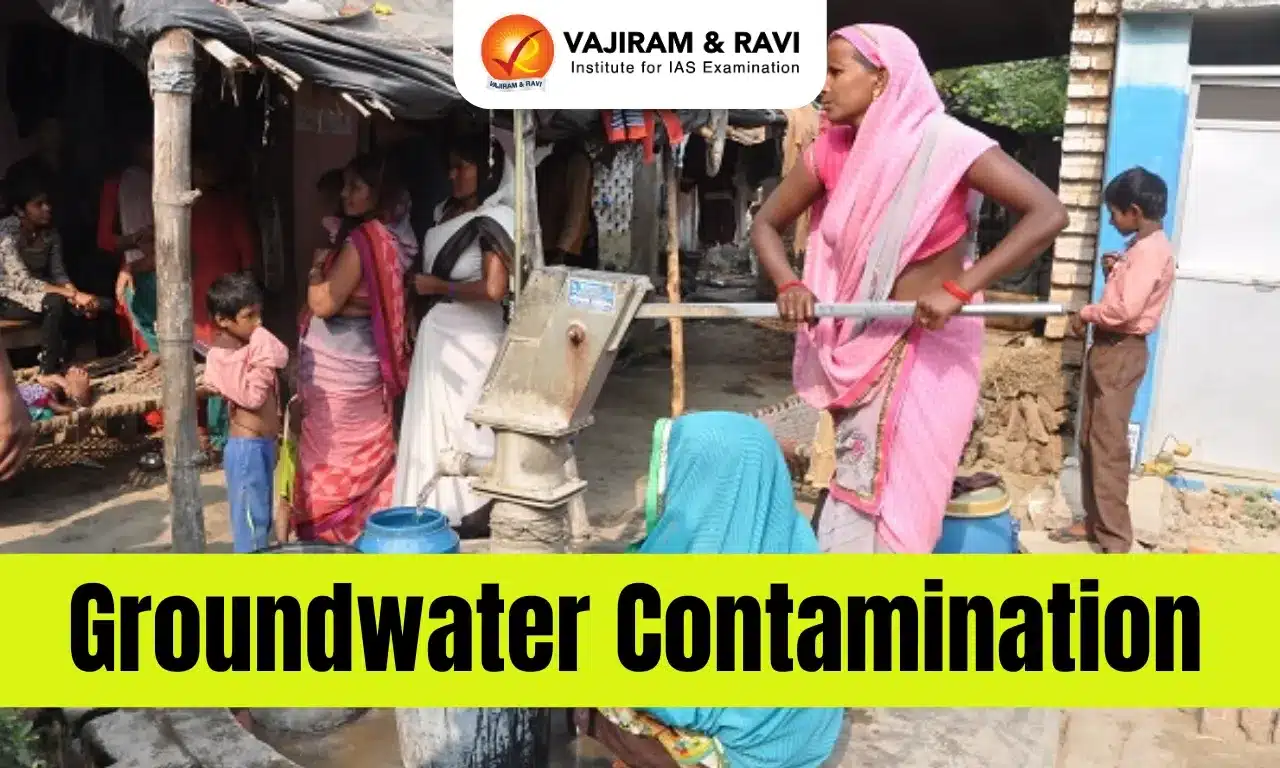
- India’s worsening groundwater contamination crisis has emerged as a major public health threat, with toxic pollutants linked to chronic illnesses across several states.
Introduction
- Groundwater is the lifeline of India, meeting over 85% of rural drinking water and 65% of irrigation needs.
- Once considered pure, it is now increasingly tainted by nitrates, heavy metals, industrial pollutants, and pathogenic microbes.
- The 2024 Annual Groundwater Quality Report by the Central Ground Water Board (CGWB) has revealed alarming contamination levels across the country, underscoring the urgent need for systemic reform.
- This crisis is no longer limited to environmental concerns; it is a nationwide public health emergency.


Scale and Nature of Groundwater Contamination
- Groundwater samples from over 440 districts show dangerous levels of contaminants:
- Nitrates: Found in more than 20% of samples, mainly due to excessive fertiliser use and septic tank leakage.
- Fluoride: Excess levels in over 9% of samples, causing dental and skeletal fluorosis in states like Rajasthan, Andhra Pradesh, and Telangana.
- Arsenic: Detected at unsafe levels in parts of Punjab, Bihar, and the Gangetic belt, posing severe cancer and neurological risks.
- Uranium: Recorded above 100 ppb in districts of Punjab, Andhra Pradesh, and Rajasthan, linked to phosphate fertilisers and over-extraction.
- Iron and Heavy Metals: Over 13% of samples exceeded safe iron limits; lead, cadmium, and mercury have been traced to industrial discharges.
Documented Health Impacts
- The health effects of groundwater contamination are severe and widespread:
- Fluorosis: Affecting over 66 million people in 230 districts; leads to joint pain, deformities, and stunted growth in children.
- Arsenicosis: Causes skin lesions, cancers, gangrene, and respiratory illnesses; prevalent in West Bengal, Bihar, and Uttar Pradesh.
- Nitrate Poisoning: Responsible for “blue baby syndrome” in infants; 56% of districts exceed safe nitrate limits.
- Uranium Toxicity: Causes chronic organ damage and kidney disorders; children are particularly at risk.
- Waterborne Diseases: Outbreaks of cholera, dysentery, and hepatitis due to sewage infiltration into aquifers.
Case Studies of Groundwater “Death Zones”
- Baghpat, Uttar Pradesh: 13 deaths in two weeks from kidney failure linked to industrial effluents in borewells.
- Jalaun, Uttar Pradesh: Petroleum-like fluids found in handpumps due to suspected underground fuel leaks.
- Paikarapur, Bhubaneswar: Hundreds fell ill from sewage-contaminated groundwater due to a faulty treatment plant.
Root Causes of the Crisis
- Fragmented Governance: Multiple agencies like CGWB, CPCB, SPCBs, and the Ministry of Jal Shakti work in silos, reducing policy coherence.
- Weak Legal Framework: The Water Act, 1974 barely addresses groundwater; enforcement is lax.
- Inadequate Monitoring: Lack of real-time, public data prevents early detection.
- Over-Extraction: Falling water tables concentrate pollutants and mobilise geogenic toxins.
- Industrial Negligence: Minimal oversight allows illegal discharges and untreated effluent disposal.
Pathways to Reform
- To safeguard groundwater, a multi-pronged approach is essential:
- National Groundwater Pollution Control Framework: Assign clear responsibilities and empower CGWB with enforcement powers.
- Technology-Driven Monitoring: Real-time sensors, satellite imaging, and public data access.
- Health-Centric Interventions: Community-based defluoridation and arsenic removal units, piped safe water supply.
- Zero Liquid Discharge Mandates: Strict regulation for industrial effluent and landfill leachate.
- Agrochemical Management: Shift towards organic and balanced fertilisation practices.
- Citizen Participation: Empower panchayats, schools, and local monitoring groups to test and report water quality.
Source: TH

 Last updated on Oct, 2026
→ UPSC 2027 Notification will be released on 13 January 2027 at upsconline.nic.in.
→ Asian Games 2026 are being held in Aichi-Nagoya, Japan, from 19 September to 4 October.
→ Check Nobel Prize 2026 Winners List here.
→ Download PIB PRiSM Monthly Magazine 2026 here.
→ Check UPSC Monthly Current Affairs Magazine The Recitals here.
→ Check out the latest UPSC Syllabus here.
→ Download UPSC Model Answers for Mains 2026
→ UPSC Mains Question Paper 2026 is out now for Essay & GS Paper 1, 2, 3 & 4.
→ UPSC Calendar 2027 has been released.
→ Enroll in Vajiram & Ravi’s UPSC Mains Test Series 2027 for structured answer writing practice, expert evaluation, and exam-oriented feedback.
→ Join Vajiram & Ravi’s UPSC Mentorship Program 2027 for personalized guidance, strategy planning, and one-to-one support from experienced mentors.
→ Go through the UPSC Mains Previous Year Papers to enhance your preparation.
→ UPSC has released UPSC Toppers List 2025 with the Civil Services final result on its official website.
→ Also check Best UPSC Coaching in India
Groundwater Contamination FAQs
Q1. How much of India’s drinking water comes from groundwater?+
Q2. What are the main contaminants found in India’s groundwater?+
Q3. Which regions are worst affected by arsenic contamination?+
Q4. What health problems are caused by fluoride in groundwater?+
Q5. What measures are recommended to tackle groundwater contamination?+
Tags: groundwater contamination mains article upsc current affairs upsc mains current affairs