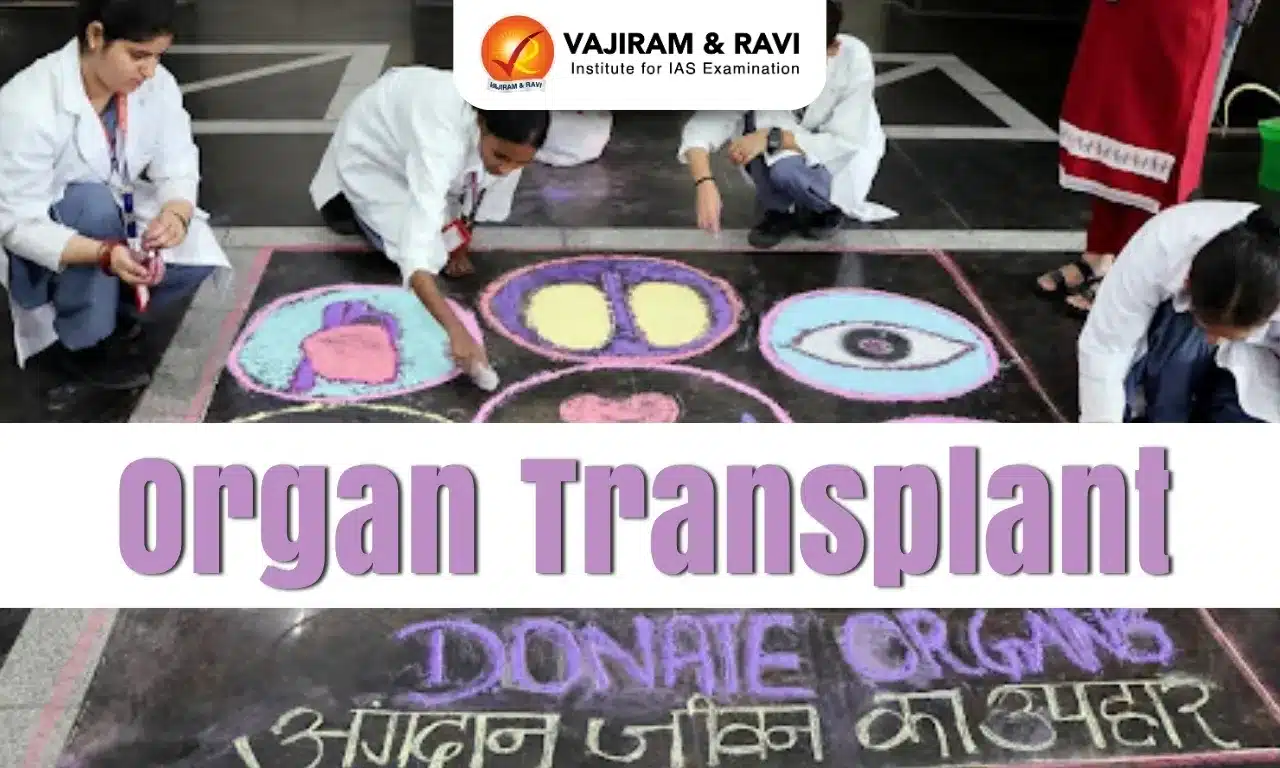
Organ Transplant Latest News
- The Union Government has revised the organ transplant allocation policy, giving priority to women patients and relatives of deceased donors to address gender disparity and boost donations.
Introduction
- The National Organ & Tissue Transplant Organisation (NOTTO) has issued a new 10-point advisory aimed at improving transparency, equity, and inclusivity in India’s organ transplant system.
- A key highlight of the revised allocation criteria is the provision of priority status to women patients and relatives of deceased donors awaiting organ transplants.
- This landmark decision is part of a broader effort to address gender imbalances in organ transplant recipients and to encourage more citizens to pledge organ donation.


Organ Transplant Allocation in India
- Organ allocation in India is governed by guidelines formulated by NOTTO under the Ministry of Health and Family Welfare. The allocation criteria already prioritise recipients based on:
- Medical urgency (severity of illness)
- Duration of wait time on the transplant list
- Matching parameters such as blood group, organ size, and age
- Special cases, such as children or patients whose living donor had previously donated an organ but now requires a transplant themselves
- Geographical proximity for optimal organ viability
- The allocation system ensures that organs are distributed fairly and transparently, with the goal of achieving the best medical outcomes.
New Priority Criteria for Women and Donor Families
- The revised guidelines introduce “additional points in allocation criteria” for:
- Women patients on the national waiting list
- Immediate relatives of deceased donors
- Rationale
- Gender Disparity: Historically, women have had lower representation among organ transplant recipients, often due to socio-economic and cultural factors that lead to delayed diagnosis or treatment.
- Encouraging Donations: By offering priority to donor families, the policy aims to increase deceased organ donations, addressing the chronic shortage of organs in India.
National Registry and Data Compliance
- NOTTO maintains a digital national registry of both donors and recipients. Hospitals performing transplants must register patients through this system.
- Key compliance measures:
- All transplant centres must mandatorily submit data for each donor and recipient to the national registry.
- Non-compliance could result in legal action against hospitals.
Organ Donation Milestones in India
- India has seen a remarkable growth in organ donation and transplant numbers:
- 2023: Launch of Aadhaar-based NOTTO online pledge portal.
- 2024: Over 3.3 lakh citizens pledged to donate their organs.
- 2024: A record 18,900 organ transplants were performed, a sharp rise from fewer than 5,000 in 2013.
- These figures indicate growing public participation and improved medical infrastructure in the organ transplantation ecosystem.
Strengthening Transplant Infrastructure
- The advisory also calls for:
- Permanent posts for transplant coordinators in hospitals performing organ retrieval and transplantation.
- Development of organ retrieval centres in all trauma centres and registration of these facilities with NOTTO.
- Encouraging medical colleges to develop retrieval facilities in a phased manner.
- Training emergency responders and ambulance staff to identify potential deceased donors early, especially in cases of road accidents or strokes.
Broader Impact and Future Outlook
- The new allocation rules mark a significant shift in India’s approach to organ transplantation by integrating social equity considerations into medical prioritisation.
- By tackling gender disparity and recognising the contribution of donor families, NOTTO aims to create a more balanced, transparent, and humane system.
- In the long term, these changes are expected to:
- Increase deceased organ donations
- Improve gender balance in transplants
- Enhance trust in the allocation process
- Strengthen national transplant capacity
Source: TH

 Last updated on Oct, 2026
→ UPSC 2027 Notification will be released on 13 January 2027 at upsconline.nic.in.
→ Check Nobel Prize 2026 Winners List here.
→ Download PIB PRiSM Monthly Magazine 2026 here.
→ Check UPSC Monthly Current Affairs Magazine The Recitals here.
→ Check out the latest UPSC Syllabus here.
→ Download UPSC Model Answers for Mains 2026
→ UPSC Mains Question Paper 2026 is out now for Essay & GS Paper 1, 2, 3 & 4.
→ UPSC Calendar 2027 has been released.
→ Enroll in Vajiram & Ravi’s UPSC Mains Test Series 2027 for structured answer writing practice, expert evaluation, and exam-oriented feedback.
→ Join Vajiram & Ravi’s UPSC Mentorship Program 2027 for personalized guidance, strategy planning, and one-to-one support from experienced mentors.
→ Go through the UPSC Mains Previous Year Papers to enhance your preparation.
→ UPSC has released UPSC Toppers List 2025 with the Civil Services final result on its official website.
→ Also check Best UPSC Coaching in India
Organ Transplant FAQs
Q1. What is the new priority rule in India’s organ transplant allocation?+
Q2. Why has priority been given to women in organ transplants?+
Q3. How will donor families benefit from the new rules?+
Q4. What compliance measures must hospitals follow?+
Q5. How many organ transplants were performed in India in 2024?+
Tags: mains articles organ transplant upsc current affairs upsc mains current affairs