Decline of Maoists in India Latest News
- Maoist insurgency, once dominant across the Red Corridor, is now limited to 18 districts.
- Experts attribute this decline to targeted development initiatives, continuous counterinsurgency efforts, internal divisions, rigid ideology, leadership crises, and loss of local support.
Overview of LWE
- Left Wing Extremism (LWE), or Naxalism, is among India’s most serious internal security challenges.
- Rooted in socio-economic inequalities and guided by Maoist ideology, it has historically targeted security forces, infrastructure, and democratic institutions.
- Emerging from the Naxalbari movement in 1967, it spread across the “Red Corridor,” affecting states like Chhattisgarh, Jharkhand, Odisha, Maharashtra, and parts of Andhra Pradesh, Telangana, and others.
- While claiming to fight for marginalized tribal communities, Maoists have engaged in armed violence, extortion, infrastructure destruction, and recruitment of civilians, including children.


Decline of Maoist Influence in India
- Once a formidable internal security threat, the Maoist insurgency has shrunk from nearly 180 districts in the late 2000s to just 18 today.
- Incidents of Left-Wing Extremism have fallen by over 50% between 2004–14 and 2014–23, with fatalities dropping nearly 70%.
- Naxal violence peaked in 2010 with 1,936 incidents and 1,005 deaths but declined to 374 incidents and 150 deaths by 2024.
Key Reasons Behind the Decline
- Targeted Development and Security Operations
- Government-led development schemes, along with sustained counterinsurgency efforts, have weakened Maoist control in their former strongholds.
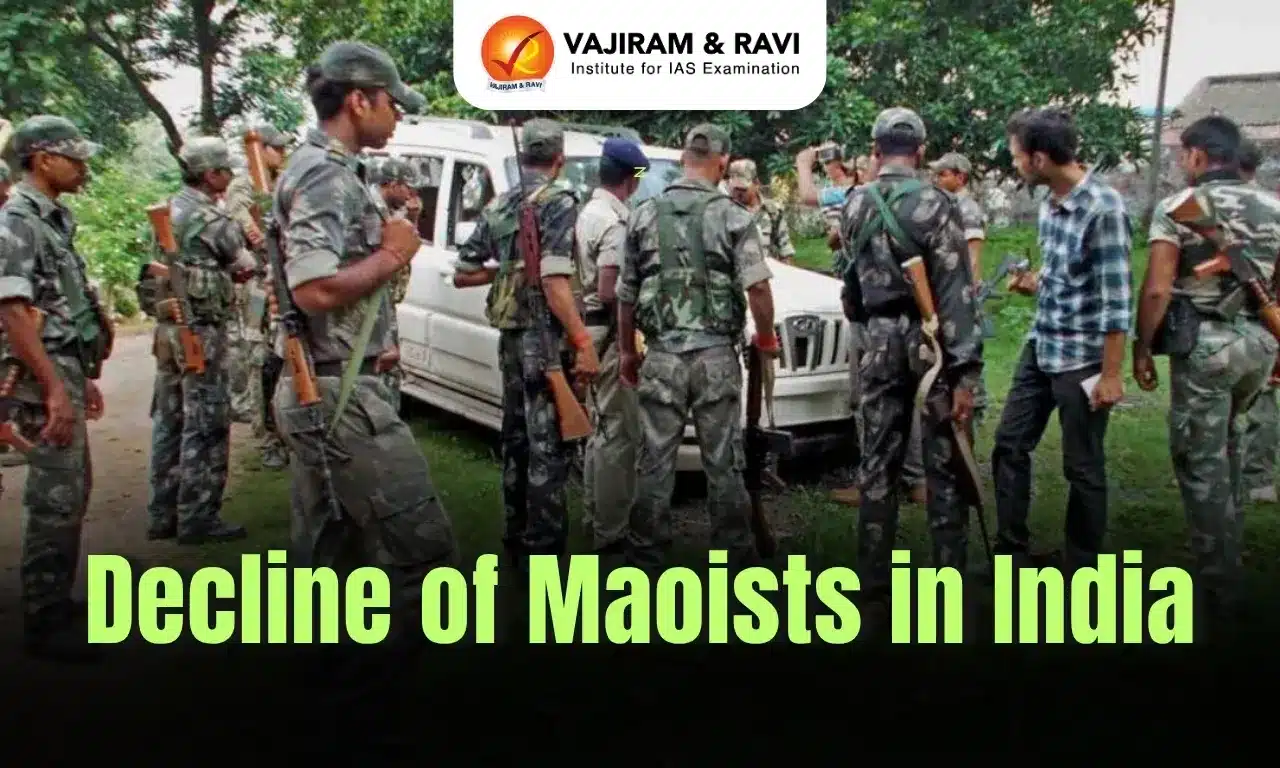
- Landmark security operations, such as the 21-day offensive in Narayanpur, have significantly reduced their operational capacity.
- Leadership Crisis and Strategic Missteps
- The resignation of long-time leader Muppala Lakshmana Rao (Ganapathy) in 2018 marked a turning point.
- His successor, Basava Raju, relied heavily on military offensives over political outreach, alienating the support base.
- Raju’s death in 2025, reportedly due to internal betrayal, deepened the leadership vacuum.
- Internal Rifts and Political Isolation
- Internal divisions, highlighted by surrendered members, have fragmented the organisation.
- The CPI (Maoist) Politburo is now believed to have only four active members, further eroding decision-making strength.
- Loss of Public Support
- In areas like Dandakaranya, Maoists prioritised military preparedness over local development, causing the very communities they claimed to protect to suffer.
- Younger tribals and peasants increasingly favour education, jobs, and mainstream integration over armed struggle.
Changing Social Outlook
- Former insurgents, such as Ginugu Narsimha Reddy, now advocate peaceful solutions.
- Initiatives like fish farming in Gumla, Jharkhand, have inspired many to abandon violence, with over 150 families in Basia block joining such ventures.
- This shift reflects the waning ideological appeal of Maoism and the rise of alternative livelihoods in once Naxal-affected regions.
Challenges Ahead
- Critics claim that the persistence of Naxalism is the result of a systemic “protection ecosystem”:
- political patronage enabled its rise;
- state inaction allowed entrenchment, and
- intellectual advocacy granted moral cover.
- Reducing it to a fight for tribal rights concealed its violence, coercion, and extortion, allowing political forces to appear humanitarian while enabling terror.
- As the Centre targets elimination of the insurgency by 31 March 2026, the real challenge lies in confronting those in politics, academia, and activism who enabled and legitimised Naxalism.
- Without this reckoning, security forces may win operational battles, but the war of narratives will remain unresolved.

 Last updated on Oct, 2026
→ UPSC 2027 Notification will be released on 13 January 2027 at upsconline.nic.in.
→ Check Nobel Prize 2026 Winners List here.
→ Download PIB PRiSM Monthly Magazine 2026 here.
→ Check UPSC Monthly Current Affairs Magazine The Recitals here.
→ Check out the latest UPSC Syllabus here.
→ Download UPSC Model Answers for Mains 2026
→ UPSC Mains Question Paper 2026 is out now for Essay & GS Paper 1, 2, 3 & 4.
→ UPSC Calendar 2027 has been released.
→ Enroll in Vajiram & Ravi’s UPSC Mains Test Series 2027 for structured answer writing practice, expert evaluation, and exam-oriented feedback.
→ Join Vajiram & Ravi’s UPSC Mentorship Program 2027 for personalized guidance, strategy planning, and one-to-one support from experienced mentors.
→ Go through the UPSC Mains Previous Year Papers to enhance your preparation.
→ UPSC has released UPSC Toppers List 2025 with the Civil Services final result on its official website.
→ Also check Best UPSC Coaching in India
Decline of Maoists in India FAQs
Q1. What caused the decline of Maoists in India?+
Q2. How many districts are currently Maoist-affected?+
Q3. What role did leadership changes play in Maoist decline?+
Q4. How has public opinion shifted in Maoist areas? +
Q5. What is the government’s target for eliminating Maoism?+
Tags: decline of maoists in India mains articles upsc current affairs upsc mains current affair