Biosafety Levels Latest News
Nehru Zoological Park, Hyderabad, will soon establish a Biosafety Level-3 (BSL-3) laboratory, the first of its kind in southern India, enabling rapid diagnosis, post-mortem analysis, and research on zoonotic diseases.
About Biosafety levels
- Biosafety levels (BSL), also known as biological safety levels or biohazard levels, define the necessary containment precautions for handling infectious agents in laboratory settings.
- They’re a mandatory requirement in any biological research facility.
- Biosafety levels contribute to the isolation of dangerous organisms and lethal agents.
- The levels of containment range from the lowest biosafety level 1 (BSL-1), to the highest at level 4 (BSL-4).
- Each BSL lab level builds upon the previous level—thereby creating layer upon layer of constraints and barriers.
- These lab levels are determined by the following:
- Risks related to containment
- Severity of infection
- Transmissibility
- Nature of the work conducted
- Origin of the microbe
- Agent in question
- Route of exposure
- BSL-1: It applies to laboratory settings in which personnel work with low-risk microbes that pose little to no threat of infection in healthy adults. Because of this, BSL-1 labs typically do not need to be isolated from surrounding facilities.
- BSL-2: It covers all laboratories that work with agents associated with human diseases — that is, pathogenic or infectious organisms — that pose a moderate health hazard if inhaled, ingested, or exposed to the skin.
- BSL-3: BSL-3 laboratory typically conducts research into or work on microbes that are either indigenous or exotic and can cause serious or potentially lethal disease through inhalation.
- BSL-4: BSL-4 labs are rare. As the highest level of biological safety, BSL-4 labs work with highly dangerous and exotic microbes. Infections caused by these types of microbes are often fatal and come without treatment or vaccines.
- At the lowest level of biosafety, precautions may consist of regular hand-washing and minimal protective equipment.
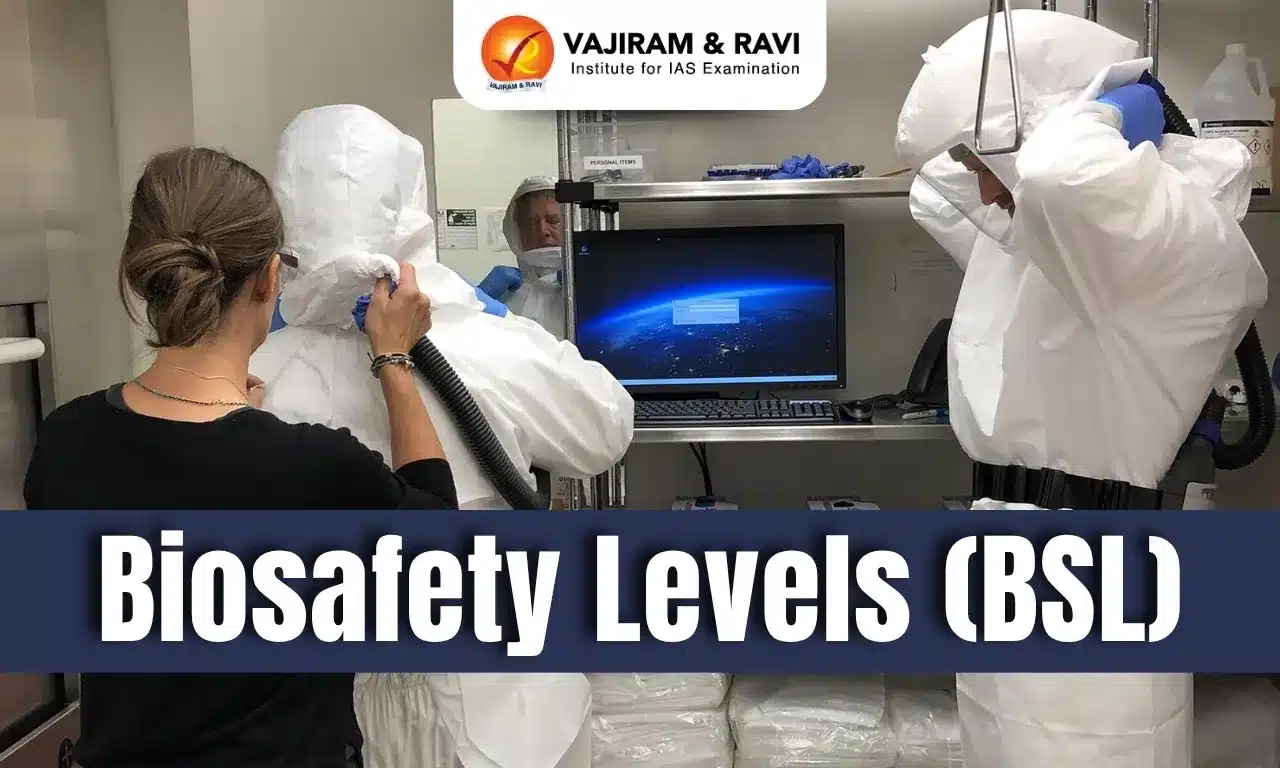
- At higher biosafety levels, precautions may include airflow systems, multiple containment rooms, sealed containers, positive pressure personnel suits, established protocols for all procedures, extensive personnel training, and high levels of security to control access to the facility.
Source: TT


 Last updated on Oct, 2026
→ UPSC 2027 Notification will be released on 13 January 2027 at upsconline.nic.in.
→ Check Nobel Prize 2026 Winners List here.
→ Download PIB PRiSM Monthly Magazine 2026 here.
→ Check UPSC Monthly Current Affairs Magazine The Recitals here.
→ Check out the latest UPSC Syllabus here.
→ Download UPSC Model Answers for Mains 2026
→ UPSC Mains Question Paper 2026 is out now for Essay & GS Paper 1, 2, 3 & 4.
→ UPSC Calendar 2027 has been released.
→ Enroll in Vajiram & Ravi’s UPSC Mains Test Series 2027 for structured answer writing practice, expert evaluation, and exam-oriented feedback.
→ Join Vajiram & Ravi’s UPSC Mentorship Program 2027 for personalized guidance, strategy planning, and one-to-one support from experienced mentors.
→ Go through the UPSC Mains Previous Year Papers to enhance your preparation.
→ UPSC has released UPSC Toppers List 2025 with the Civil Services final result on its official website.
→ Also check Best UPSC Coaching in India
Biosafety Levels FAQs
Q1. What are Biosafety levels (BSL)?+
Q2. Which biosafety level deals with low-risk microbes that pose little to no threat to healthy adults?+
Q3. Which of the following is the highest level of biological safety used for handling the most dangerous pathogens?+
Tags: biosafety levels prelims pointers upsc current affairs upsc prelims current affairs