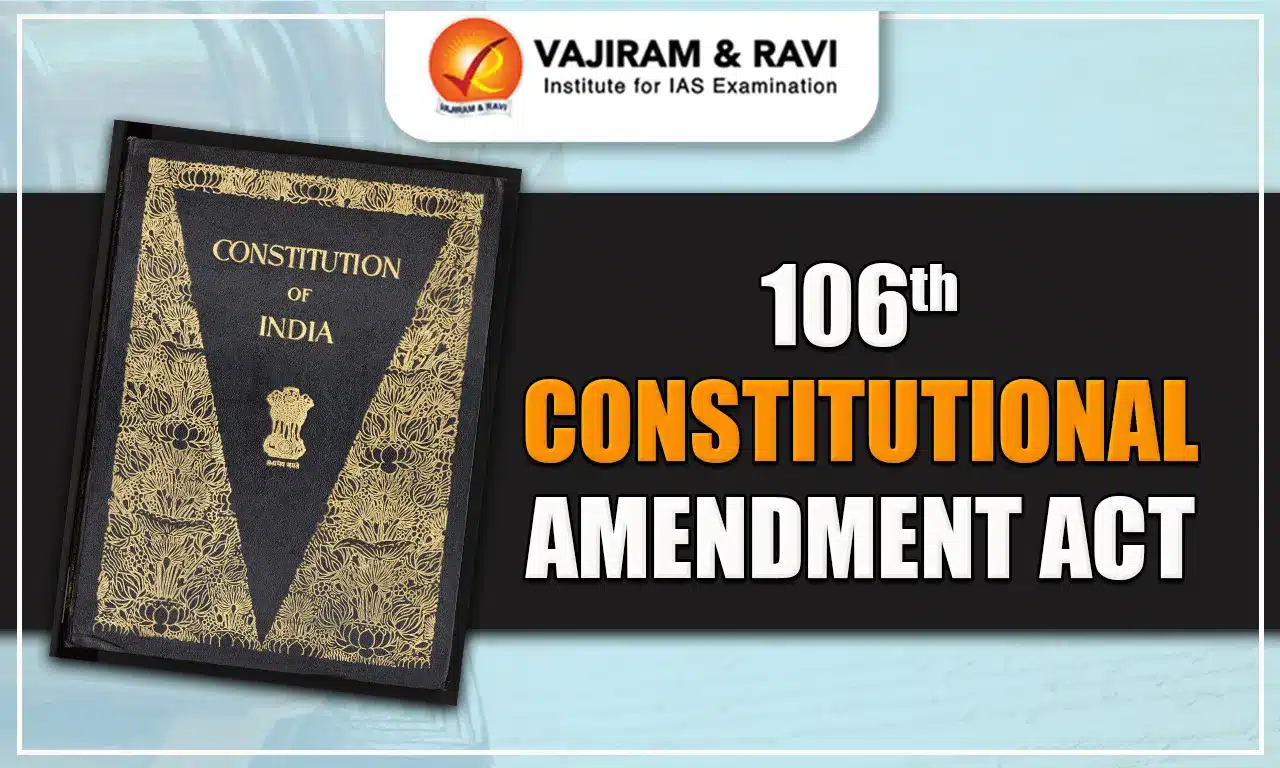
The 106th Amendment Act, 2023 provided for one-third reservation of seats in the Lok Sabha and State assemblies. The goal was to increase women participation in politics and work on overcoming the challenges associated with the patriarchal political landscape. In this article, we are going to cover the 106th Constitutional Amendment Act 2023.
106th Constitutional Amendment Act 2023
The key highlights of the 106th Constitutional Amendment Act has been listed below:
- The Women’s reservation bill has faced many challenges since its introduction.
- The bill was introduced multiple times in both the parliament as well as the state assembly in 1996, 1998, 1999 and 2008.
- The bill lapsed the first three times due to dissolution of assemblies in the Lok Sabha.
- The bill finally got passed in 2008 in the Rajya Sabha but again got lapsed in the Lok Sabha due to dissolution.
- In 2023, the Women Reservation Bill, also known as the Nari Shakti Vandan Adhiniyam bill got strong support from both the Lok Sabha as well as the Rajya Sabha.
- The bill makes sure that women receive one-third reservation in the Lok Sabha, state assemblies and the Legislative Assembly of Delhi.
- However, the bill will only be implemented after the completion of the decennial census and delimitation of seats.
Women Reservation Act 2023
The Women Reservation Act was introduced for the first time in 1996 in the Lok Sabha. The Bill can be traced on the following timeline:
- The bill has passed by the Parliament in India to provide one-third reservation for women in the Lok Sabha, State Assemblies and the Legislative Assembly of Delhi.
- The bill will be implemented after the delimitation has been conducted.


106th Amendment Act Provisions
The 106th Constitutional Amendment Act has the following key provisions:
- Article 239AA – One-third reservation for women in Delhi Legislative Assembly.
- Article 330A – One-third reservation for women in Lok Sabha, including SC/ST seats.
- Article 332A – One-third reservation for women in State Assemblies, including SC/ST seats.
- Article 334A – Implementation post-delimitation, 15-year sunset clause, with provisions for extension and rotation.
106th Constitutional Amendment Act Concerns
There have been a few concerns related to 106th Constitutional Amendment Act 2023:
- Equality vs. Reservation: Some critics argue that reserving seats for women may conflict with the principle of merit-based competition and equality, as enshrined in the Constitution.
- Restriction on Voter Choice: By mandating the reservation of certain seats for women, the Act may limit the voters’ ability to choose candidates freely from the entire pool of eligible contestants.
- Lack of Homogeneity: Women, unlike caste groups, do not form a homogeneous category. Therefore, a uniform reservation policy may not address the diverse challenges faced by women from different socio-economic backgrounds.
- Risk of Proxy Representation: Without deeper political reforms, there is a possibility that women representatives might act as nominal heads, with real political power being exercised by male relatives, as seen in the Sarpanch Pati phenomenon at the Panchayat level.
- Uneven State Impact: The rotation of reserved seats and differences in state-wise implementation could lead to uneven representation and unpredictable political outcomes.
- Exclusion of Upper Houses: The Act does not provide for any reservation in the Rajya Sabha (Upper House of Parliament) or in State Legislative Councils, which means women’s representation will remain limited to directly elected lower houses.

 Last updated on Sep, 2026
→ UPSC 2027 Notification will be released on 13 January 2027 at upsconline.nic.in.
→ Asian Games 2026 are being held in Aichi-Nagoya, Japan, from 19 September to 4 October.
→ Check out the latest UPSC Syllabus here.
→ Download UPSC Model Answers for Mains 2026
→ UPSC Mains Question Paper 2026 is out now for Essay & GS Paper 1, 2, 3 & 4.
→ UPSC Calendar 2027 has been released.
→ Enroll in Vajiram & Ravi’s UPSC Mains Test Series 2027 for structured answer writing practice, expert evaluation, and exam-oriented feedback.
→ Join Vajiram & Ravi’s UPSC Mentorship Program 2027 for personalized guidance, strategy planning, and one-to-one support from experienced mentors.
→ Go through the UPSC Mains Previous Year Papers to enhance your preparation.
→ UPSC has released UPSC Toppers List 2025 with the Civil Services final result on its official website.
→ Also check Best UPSC Coaching in India
106th Constitutional Amendment Act FAQs
Q1. What is the 106th amendment of the Indian Constitution?+
Q2. What is the 107th Constitutional Amendment?+
Q3. What is the 106th amendment Nari Shakti?+
Q4. When was the 106th Constitutional Amendment Act implemented?+
Q5. What is the Women’s Reservation Bill 2023?+
Tags: 106th constitutional amendment act constitutional amendments in india indian polity