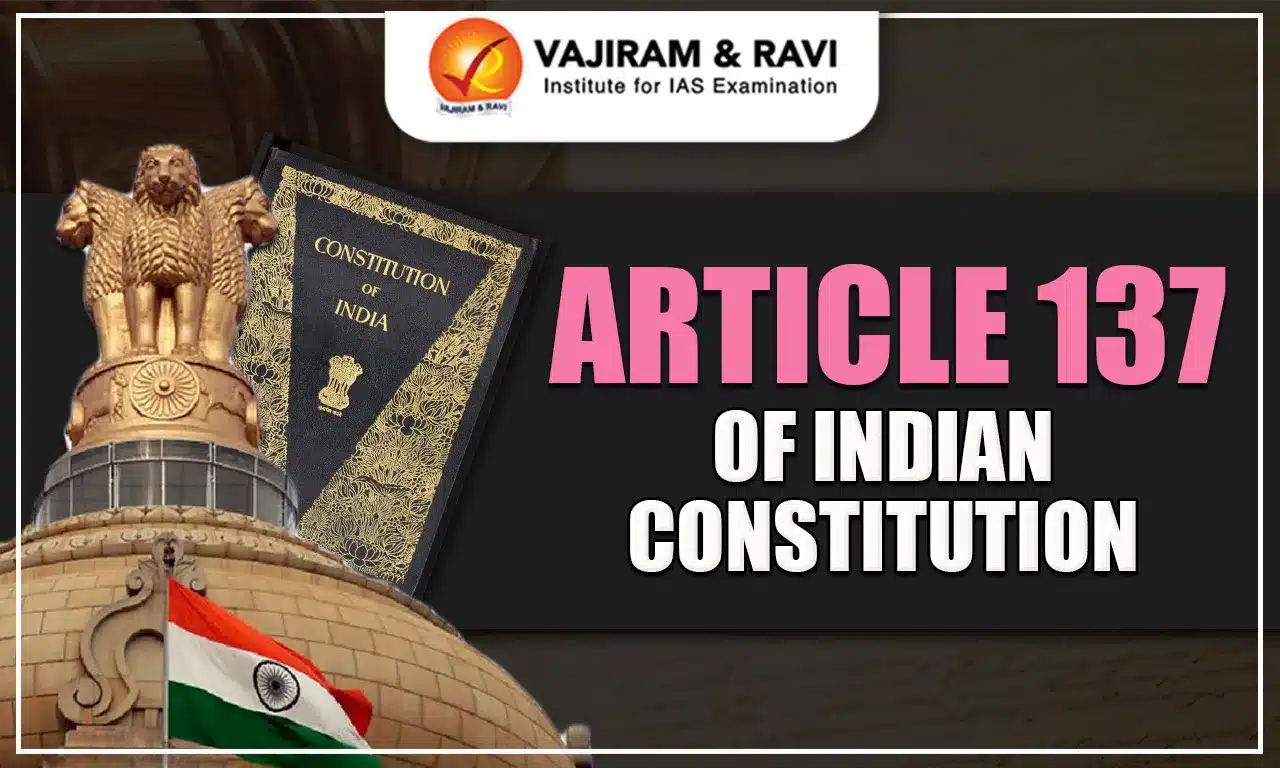
Article 137 of Indian Constitution is discussed in Part V which grants the Supreme Court the authority to review its own judgments or orders. This power acts as a safeguard to ensure justice is served and to correct errors that may have occurred in earlier decisions. It reinforces judicial accountability and provides litigants with a limited avenue to seek reconsideration without approaching another forum. The review power is exercised under Article 137 of the Constitution, Order XLVII of the Supreme Court Rules, 2013 and Provisions of the Civil Procedure Code (CPC), 1908, where applicable.
Article 137 of Indian Constitution Interpretation
Article 137 of Indian Constitution provides that, subject to any law made by Parliament or rules framed under Article 145, the Supreme Court has the power to review any judgment pronounced or order made by it. This review jurisdiction ensures that the Court can correct its own errors in the interest of justice, but it is exercised only in rare and exceptional circumstances. The review power is guided by the principles laid out in Order 47 Rule 1 of the Civil Procedure Code, which allows review in three situations:
- Discovery of new and important evidence not available earlier despite due diligence
- An apparent error on the face of the record
- Any other sufficient reason of comparable gravity
In R. D. Sagar vs V. Nagary (1976), the Supreme Court emphasized that while its judgments are final, they are open to review only on well-established grounds such as a grave or glaring error. The petitioner in this case contended that certain observations in the judgment portrayed him as guilty of abetting forgery and perjury. While the Court refused to entirely delete the remarks, it mitigated their impact by making specific modifications, illustrating its cautious and limited approach to the review power.


 Last updated on Oct, 2026
→ UPSC 2027 Notification will be released on 13 January 2027 at upsconline.nic.in.
→ Asian Games 2026 are being held in Aichi-Nagoya, Japan, from 19 September to 4 October.
→ Check Nobel Prize 2026 Winners List here.
→ Download PIB PRiSM Monthly Magazine 2026 here.
→ Check UPSC Monthly Current Affairs Magazine The Recitals here.
→ Check out the latest UPSC Syllabus here.
→ Download UPSC Model Answers for Mains 2026
→ UPSC Mains Question Paper 2026 is out now for Essay & GS Paper 1, 2, 3 & 4.
→ UPSC Calendar 2027 has been released.
→ Enroll in Vajiram & Ravi’s UPSC Mains Test Series 2027 for structured answer writing practice, expert evaluation, and exam-oriented feedback.
→ Join Vajiram & Ravi’s UPSC Mentorship Program 2027 for personalized guidance, strategy planning, and one-to-one support from experienced mentors.
→ Go through the UPSC Mains Previous Year Papers to enhance your preparation.
→ UPSC has released UPSC Toppers List 2025 with the Civil Services final result on its official website.
→ Also check Best UPSC Coaching in India
Article 137 of Indian Constitution FAQs
Q1. What does Article 137 deal with?+
Q2. What is the main purpose of Article 137?+
Q3. Is the power of review under Article 137 unlimited?+
Q4. Can any judgment of the Supreme Court be reviewed under Article 137?+
Q5. Who can file a review petition under Article 137?+
Tags: article 137 of indian constitution