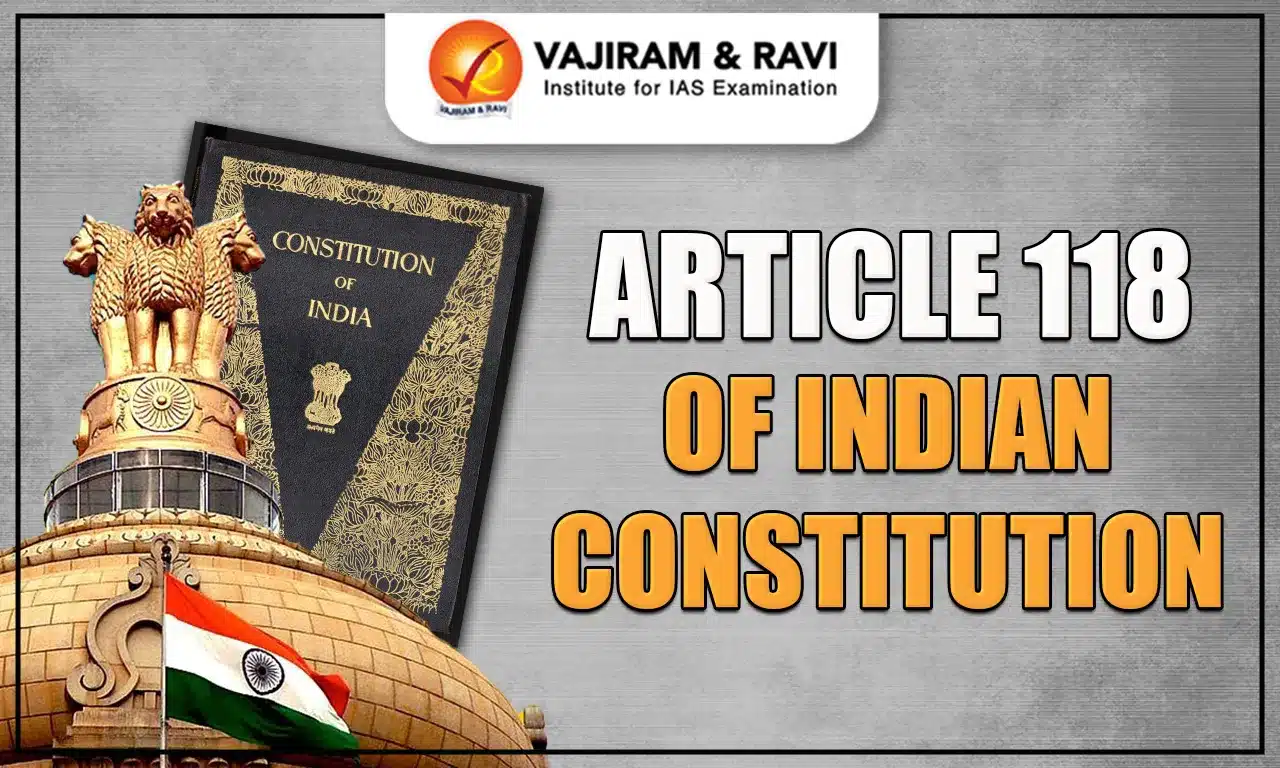
The Constitution of India, which came into force on 26 January 1950, lays down a detailed framework for governance, defining the powers and functions of each organ of the State and the rights and duties of citizens. Within this framework, Article 118 of Indian Constitution deals specifically with the rules of procedure for the Houses of Parliament.
By granting each House autonomy to decide its own working methods while allowing for joint procedures where necessary, Article 118 of Indian Constitution ensures flexibility, parliamentary independence, and smooth legislative functioning within the constitutional framework of India.
Article 118 of Indian Constitution
- Each House of Parliament may make rules for regulating, subject to the provisions of this Constitution, its procedure and the conduct of its business.
- Until rules are made under clause (1), the rules of procedure and standing orders in force immediately before the commencement of this Constitution with respect to the Legislature of the Dominion of India shall have effect in relation to Parliament subject to such modifications and adaptations as may be made therein by the Chairman of the Council of States or the Speaker of the House of the People, as the case may be.
- The President, after consultation with the Chairman of the Council of States and the Speaker of the House of the People, may make rules as to the procedure with respect to joint sittings of, and communications between, the two Houses.
- At a joint sitting of the two Houses the Speaker of the House of the People, or in his absence such a person as may be determined by rules of procedure made under clause (3), shall preside.
Article 118 of Indian Constitution Interpretation
Article 118 of Indian Constitution gives both the Lok Sabha (House of the People) and the Rajya Sabha (Council of States) the authority to frame their own rules for regulating procedures and conducting sessions. This ensures that each House has autonomy in deciding how its legislative work is carried out.
Until such rules are formally adopted, the procedures and business conduct that were in force before the Constitution came into effect on 26 January 1950 continue to apply, provided they are consistent with the new constitutional framework.
The Article 118 also empowers the President of India, in consultation with the Chairman of the Rajya Sabha or the Speaker of the Lok Sabha, to frame procedural rules when a House has not yet established its own.
Each House maintains a Committee on Rules, responsible for reviewing existing rules, considering amendments, and recommending changes to ensure that parliamentary functioning remains efficient and in line with evolving legislative needs.
Through these provisions, Article 118 of Indian Constitution safeguards both flexibility and order in parliamentary proceedings, balancing tradition with the ability to adapt.


 Last updated on Oct, 2026
→ UPSC 2027 Notification will be released on 13 January 2027 at upsconline.nic.in.
→ Asian Games 2026 are being held in Aichi-Nagoya, Japan, from 19 September to 4 October.
→ Check Nobel Prize 2026 Winners List here.
→ Download PIB PRiSM Monthly Magazine 2026 here.
→ Check UPSC Monthly Current Affairs Magazine The Recitals here.
→ Check out the latest UPSC Syllabus here.
→ Download UPSC Model Answers for Mains 2026
→ UPSC Mains Question Paper 2026 is out now for Essay & GS Paper 1, 2, 3 & 4.
→ UPSC Calendar 2027 has been released.
→ Enroll in Vajiram & Ravi’s UPSC Mains Test Series 2027 for structured answer writing practice, expert evaluation, and exam-oriented feedback.
→ Join Vajiram & Ravi’s UPSC Mentorship Program 2027 for personalized guidance, strategy planning, and one-to-one support from experienced mentors.
→ Go through the UPSC Mains Previous Year Papers to enhance your preparation.
→ UPSC has released UPSC Toppers List 2025 with the Civil Services final result on its official website.
→ Also check Best UPSC Coaching in India
Article 118 of Indian Constitution FAQs
Q1. What does Article 118 deal with?+
Q2. Does Article 118 give autonomy to each House of Parliament?+
Q3. Can the President intervene in rules made under Article 118?+
Q4. What is the purpose of Article 118?+
Q5. Are rules made under Article 118 legally binding?+
Tags: article 118 of indian constitution