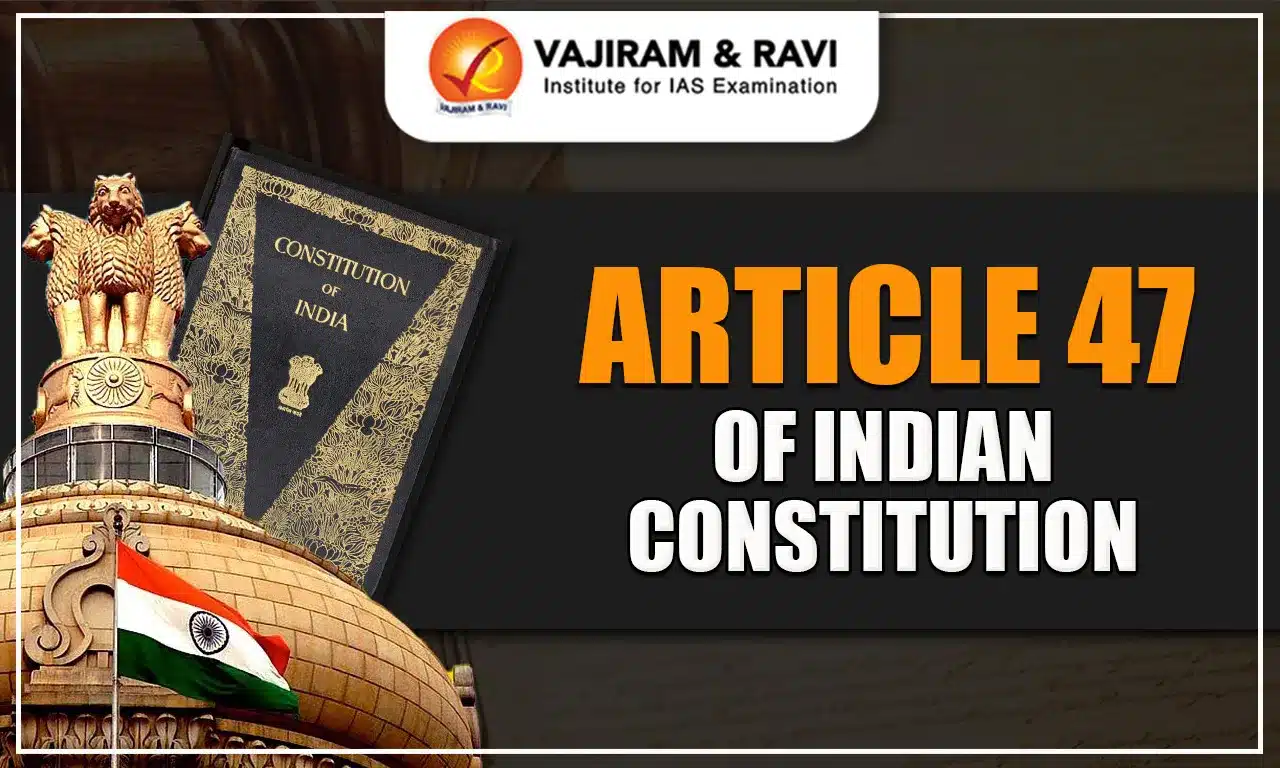
Article 47 of Indian Constitution, falling under the Directive Principles of State Policy, places a responsibility on the State to work towards improving public health, raising nutritional standards, and enhancing the overall standard of living. It further directs the State to take measures to prohibit the consumption of intoxicating drinks and harmful drugs, except when required for medicinal purposes. This provision reflects the constitutional vision of promoting a healthier society and underscores the State’s role in safeguarding public well-being.
Article 47 of Indian Constitution
The State shall regard the raising of the level of nutrition and the standard of living of its people and the improvement of public health as among its primary duties and, in particular, the State shall endeavour to bring about prohibition of the consumption except for medicinal purposes of intoxicating drinks and of drugs which are injurious to health.
Article 47 of Indian Constitution Interpretation
The core aim of Article 47 of Indian Constitution is to ensure that the State actively advances public welfare by improving nutrition, raising living standards, and strengthening public health, while regulating the use of harmful substances.
In line with this directive, the State is expected to formulate and implement policies that:
-
Enhance the nutritional intake of the population
-
Promote food security
-
Improve living conditions to ensure a better quality of life
-
Strengthen preventive healthcare, disease control, and public health infrastructure
-
Ensure equitable access to medical services
Article 47 calls upon the State to restrict the production, sale, and consumption of intoxicating drinks and drugs, except when required for medicinal purposes.


Article 47 of Indian Constitution Judicial Pronouncements
The Supreme Court, in State of Kerala v. N. M. Thomas (1976), emphasized the importance of the Directive Principles of State Policy (DPSPs) in guiding the State’s governance objectives. The judgment underscored their role in promoting public welfare and shaping the policy framework of the nation.
In Vincent Panikurlangara v. Union of India (1987), the Court reaffirmed the State’s responsibility under Article 47 to safeguard public health. It stressed the necessity of adopting regulatory measures to control the production, distribution, and consumption of substances harmful to health.

 Last updated on Oct, 2026
→ UPSC 2027 Notification will be released on 13 January 2027 at upsconline.nic.in.
→ Asian Games 2026 are being held in Aichi-Nagoya, Japan, from 19 September to 4 October.
→ Check Nobel Prize 2026 Winners List here.
→ Download PIB PRiSM Monthly Magazine 2026 here.
→ Check UPSC Monthly Current Affairs Magazine The Recitals here.
→ Check out the latest UPSC Syllabus here.
→ Download UPSC Model Answers for Mains 2026
→ UPSC Mains Question Paper 2026 is out now for Essay & GS Paper 1, 2, 3 & 4.
→ UPSC Calendar 2027 has been released.
→ Enroll in Vajiram & Ravi’s UPSC Mains Test Series 2027 for structured answer writing practice, expert evaluation, and exam-oriented feedback.
→ Join Vajiram & Ravi’s UPSC Mentorship Program 2027 for personalized guidance, strategy planning, and one-to-one support from experienced mentors.
→ Go through the UPSC Mains Previous Year Papers to enhance your preparation.
→ UPSC has released UPSC Toppers List 2025 with the Civil Services final result on its official website.
→ Also check Best UPSC Coaching in India
Article 47 of Indian Constitution FAQs
Q1. What does Article 47 state?+
Q2. Is Article 47 enforceable by law?+
Q3. What is the main prohibition mentioned in Article 47?+
Q4. Why is Article 47 important?+
Q5. Does Article 47 ban alcohol in India?+
Tags: article 47 of 1ndian constitution