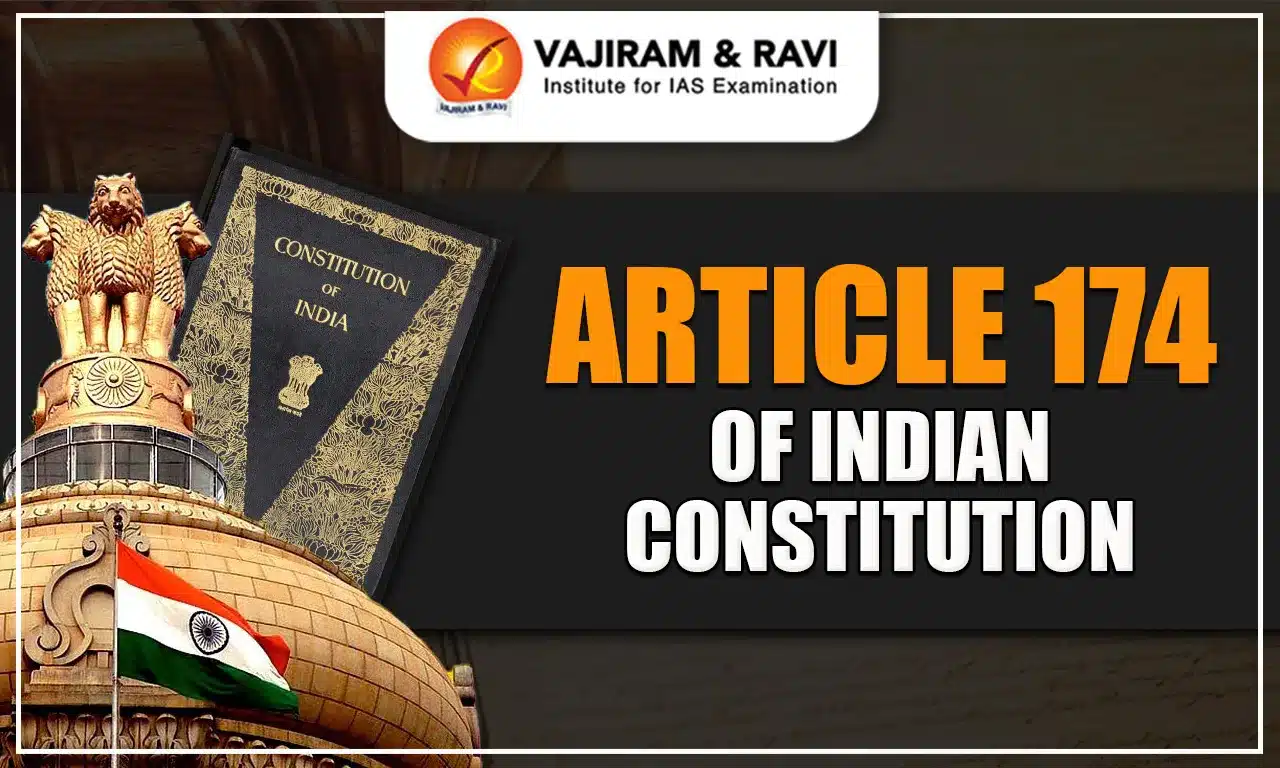
Article 174 of Indian Constitution is discussed in Part IV which discloses the conduct of sessions of the state legislature. It also mentions the authority of a Governor in summoning the legislature, proroguing its sessions, and dissolving the Legislative Assembly. The provision ensures that State Legislatures meet at regular intervals, thereby maintaining legislative continuity and accountability in governance.
Article 174 of Indian Constitution
(1) The Governor shall from time to time summon the House or each House of the Legislature of the State to meet at such time and place as he thinks fit, but six months shall not intervene between its last sitting in one session and the date appointed for its first sitting in the next session.
(2) The Governor may from time to time—
(a) prorogue the House or either House;
(b) dissolve the Legislative Assembly.
Article 174 of Indian Constitution Interpretation
Since its adoption, Article 174 of Indian Constitution has remained unamended, reflecting the intent to establish a stable framework for the conduct of State Legislature sessions. The provision ensures that legislative bodies summon at regular intervals while laying the Governor with the authority to summon, prorogue, and, when required, dissolve the legislature to facilitate the smooth functioning of the State’s legislative process.


Article 174 of Indian Constitution Background
The Indian Constitution establishes a federal framework by distributing powers between the Union and the States. Every state has its own legislature, which may be either unicameral or bicameral, entrusted with making laws on matters within the State List. The Governor, as the constitutional head of the state, plays a pivotal role in ensuring the effective functioning of the legislature. Article 174 of Indian Constitution specifically defines the Governor’s authority with respect to summoning, proroguing, and dissolving the sessions of the State Legislature, thereby ensuring legislative continuity and accountability.
Article 174 of Indian Constitution Landmark Cases
The judiciary has played a key role in interpreting Article 174 of Indian Constitution, particularly in defining the scope of the Governor’s authority to summon, prorogue, and dissolve State Legislatures, thereby maintaining a balance between the executive and the legislature. Notable cases include:
- Nabam Rebia and Bamang Felix v. Deputy Speaker, Arunachal Pradesh (2016) – The Supreme Court held that the Governor’s discretion under Article 174(1) must be exercised in accordance with constitutional norms and the advice of the Council of Ministers.
- State of Punjab v. Satya Pal Dang (1969) – The Court upheld the Governor’s discretionary power to dissolve the Legislative Assembly, provided such action remains within the constitutional framework.
Article 174 of Indian Constitution Significance
Article 174 of Indian Constitution plays a crucial role in maintaining and regulating the democratic framework at the state level. Its significance can be understood through the following aspects:
- Ensuring Regular Legislative Sessions – Article 174 mandates that no more than six months may elapse between two sessions of the State Legislature. This provision ensures continuity in legislative functioning, timely passage of laws, discussion of public issues, and consistent oversight of the executive.
- Balancing Executive and Legislative Powers – While the Governor holds the authority to summon, prorogue, and dissolve the Legislature, these powers are generally exercised on the advice of the Council of Ministers. This arrangement maintains a constitutional balance between the executive and the legislature, preventing overreach by either side.
- Facilitating Democratic Renewal – The dissolution of the Legislative Assembly enables the conduct of fresh elections, giving the electorate the opportunity to choose new representatives. Such dissolution may be necessary when the existing Assembly becomes ineffective due to political instability or loss of majority.
Flexibility in Legislative Management – The Governor’s power to postpone the Legislature provides a mechanism to manage legislative business efficiently. It allows sessions to conclude when business is complete or a recess is needed, without triggering dissolution of the Assembly.

 Last updated on Oct, 2026
→ UPSC 2027 Notification will be released on 13 January 2027 at upsconline.nic.in.
→ Asian Games 2026 are being held in Aichi-Nagoya, Japan, from 19 September to 4 October.
→ Check Nobel Prize 2026 Winners List here.
→ Download PIB PRiSM Monthly Magazine 2026 here.
→ Check UPSC Monthly Current Affairs Magazine The Recitals here.
→ Check out the latest UPSC Syllabus here.
→ Download UPSC Model Answers for Mains 2026
→ UPSC Mains Question Paper 2026 is out now for Essay & GS Paper 1, 2, 3 & 4.
→ UPSC Calendar 2027 has been released.
→ Enroll in Vajiram & Ravi’s UPSC Mains Test Series 2027 for structured answer writing practice, expert evaluation, and exam-oriented feedback.
→ Join Vajiram & Ravi’s UPSC Mentorship Program 2027 for personalized guidance, strategy planning, and one-to-one support from experienced mentors.
→ Go through the UPSC Mains Previous Year Papers to enhance your preparation.
→ UPSC has released UPSC Toppers List 2025 with the Civil Services final result on its official website.
→ Also check Best UPSC Coaching in India
Article 174 Of Indian Constitution FAQs
Q1. What does Article 174 deal with?+
Q2. Who has the authority to summon a state legislature under Article 174?+
Q3. How many times must a state legislature meet in a year as per Article 174?+
Q4. What does 'proroguing' mean in Article 174?+
Q5. Who can dissolve the State Legislative Assembly under Article 174?+
Tags: article 174 Of indian constitution