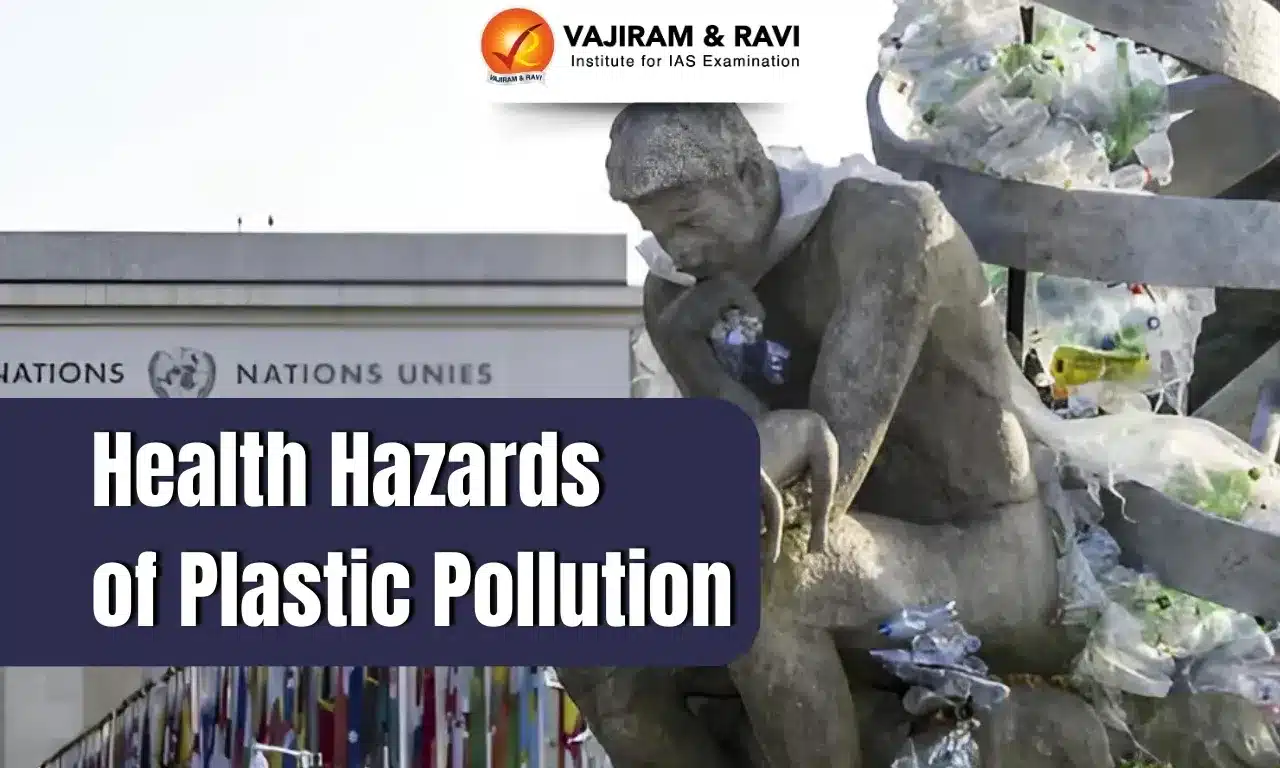
Health Hazards of Plastic Pollution Latest News
- Negotiations among nearly 180 countries in Geneva failed to yield consensus on a binding international treaty to curb plastic pollution.
- While the United Nations Environment Programme (UNEP) has already adopted a resolution recognising the urgency of the issue, only a legally binding pact would compel nations to act.
- However, deep divisions persist: some countries argue that the treaty should focus narrowly on plastic waste management, while others insist it must also tackle plastic production itself.
- Another key dispute lies in whether developed countries should provide financial support to developing nations for implementing plastic curbs.
- The most contentious point, however, is the recognition of plastics’ role in human health — a divide that has stalled meaningful progress on drafting the agreement.
Increased Use of Plastic
- Plastic has become the ultimate symbol of the industrialised, consumption-driven economy due to its versatility, durability, and low production cost.
- Derived largely from fossil fuels, plastic can be moulded into a vast array of products — from essential items such as aircraft and medical equipment to disposable packaging and cosmetic decorations.
- Its affordability compared to alternatives like glass or aluminium has accelerated its global spread.


Challenges from Plastic
- Ubiquitous nature of plastic has turned it into the primary source of litter, exposing weaknesses in waste management systems worldwide.
- A major challenge arises from plastic’s persistence in the environment. Plastics are complex mixtures of polymers, monomers, and chemical additives, with more than 16,000 chemicals potentially present in various plastic products.
- Alarmingly, little is known about the health or environmental impacts of over 10,000 of these substances.
- Studies have found that over 4,000 hazardous chemicals exist in major plastic types such as PVC, PET, polyethylene, and polyurethanes.
- Being synthetic and non-biodegradable, these chemicals are nearly indestructible and can migrate into ecosystems — contaminating rivers, oceans, soil, and ultimately entering the human body.
- Thus, while public debates often focus on recycling or waste management, the deeper concern lies in the toxic chemical load plastics carry.
- Their resilience and indestructibility make them long-term threats to human health and environmental safety, posing challenges that go far beyond visible waste.
Evidence That Plastic Harms Health
- Plastics are made from petrochemical derivatives such as ethylene, propylene, and styrene.
- Common variants include polypropylene (PP), polyethylene (LDPE, LLDPE, HDPE), and polyethylene terephthalate (PET).
- To manufacture these, several other chemicals are used — including bisphenols, phthalates, PCBs, PBDEs, and PFAS.
- These substances are widely present in everyday items such as food containers, drink bottles, toys, polyester fabrics, cosmetics, paints, adhesives, medical bags, and electronic components.
Health Risks Identified by Studies
- Over the years, medical researchers have investigated the effects of exposure to these chemicals through daily-use products.
- These studies have linked plastic-related chemical exposure to:
- Thyroid dysfunction
- Hypertension
- Kidney and testicular cancer
- Gestational diabetes
- Most of these studies were conducted in developed countries, highlighting the need for wider global research.
Microplastics and Human Health
- Microplastics are plastic fragments smaller than five millimetres, originating either as breakdown products of larger plastic items or as additives in manufactured goods.
- They are widely present in the environment due to the pervasive use of plastics.
- With recent advances in detection technology, microplastics have been discovered in several critical parts of the human body, including: Blood; Breast milk; Placenta; Bone marrow.
- This shows that microplastics are not just environmental pollutants but can penetrate and circulate within human biological systems.
Impact on Human Health
- Although the exact health consequences of microplastics are still under investigation, early evidence suggests links to a wide range of disorders.
- Their persistence and potential to carry toxic chemicals raise concerns about long-term risks to human health, especially in sensitive stages such as pregnancy and early development.
India’s Approach to Plastic Management
- Production and use of single-use plastics are banned in nearly 20 States, as these items are the least reusable and most difficult to recycle.
- To address the waste management challenge, the government has also put in place administrative mechanisms requiring companies to collect back a share of the plastics they use.
- However, these measures have had limited success due to weak enforcement.
- Importantly, India does not yet recognise the health risks posed by plastics and associated chemicals, treating the issue largely as a waste management problem.
- In global negotiations on a plastics treaty, India — along with some other countries — has opposed including health impacts in the agreement, instead suggesting that such concerns should be addressed by the World Health Organization (WHO).

 Last updated on Oct, 2026
→ UPSC 2027 Notification will be released on 13 January 2027 at upsconline.nic.in.
→ Check Nobel Prize 2026 Winners List here.
→ Download PIB PRiSM Monthly Magazine 2026 here.
→ Check UPSC Monthly Current Affairs Magazine The Recitals here.
→ Check out the latest UPSC Syllabus here.
→ Download UPSC Model Answers for Mains 2026
→ UPSC Mains Question Paper 2026 is out now for Essay & GS Paper 1, 2, 3 & 4.
→ UPSC Calendar 2027 has been released.
→ Enroll in Vajiram & Ravi’s UPSC Mains Test Series 2027 for structured answer writing practice, expert evaluation, and exam-oriented feedback.
→ Join Vajiram & Ravi’s UPSC Mentorship Program 2027 for personalized guidance, strategy planning, and one-to-one support from experienced mentors.
→ Go through the UPSC Mains Previous Year Papers to enhance your preparation.
→ UPSC has released UPSC Toppers List 2025 with the Civil Services final result on its official website.
→ Also check Best UPSC Coaching in India
Health Hazards of Plastic Pollution FAQs
Q1. What are health hazards of plastic pollution?+
Q2. Why are plastics harmful to human health?+
Q3. What is the impact of microplastics on humans?+
Q4. How does plastic pollution affect the environment?+
Q5. What is India’s response to plastic pollution?+
Tags: health hazards of plastic pollution mains articles upsc current affairs upsc mains current affairs