Highway Toll Collection Reform Latest News
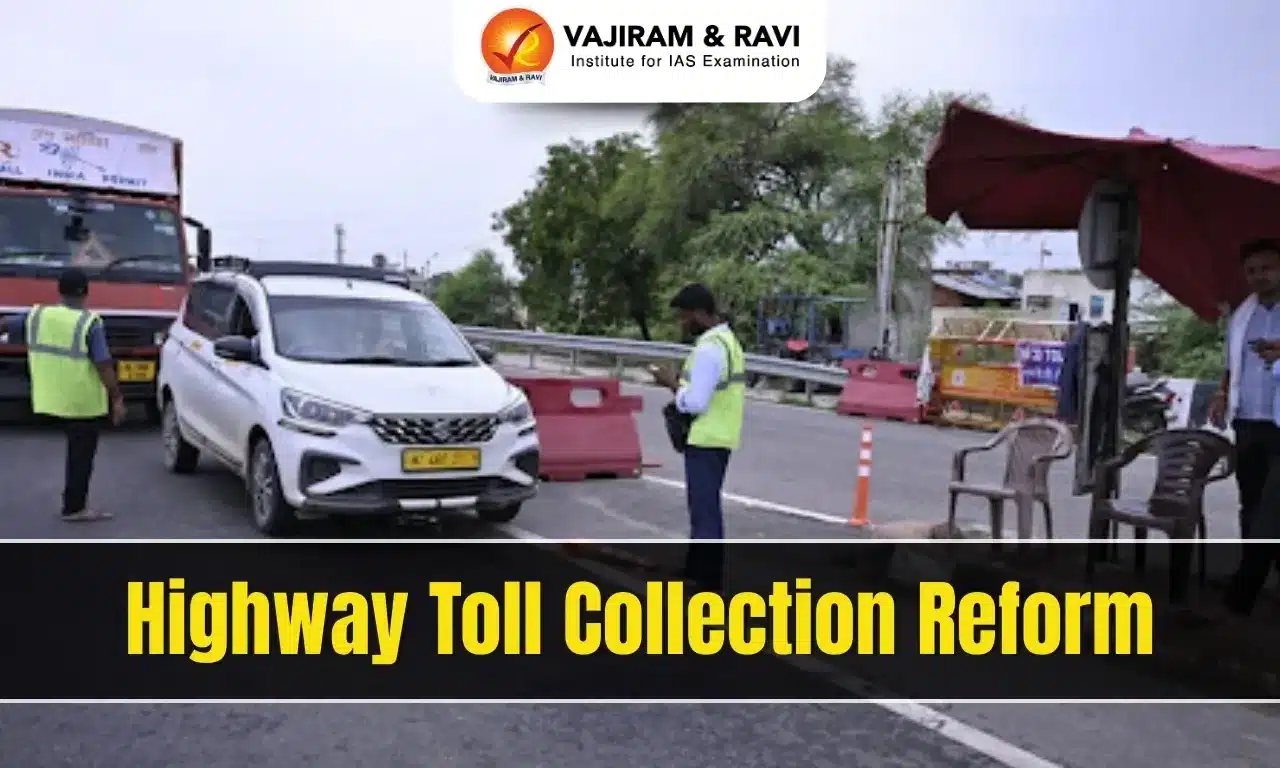
- The Public Accounts Committee (PAC) of Parliament has recommended major reforms to toll collection practices on national highways.
- A key proposal is to end the system of perpetual tolling, where tolls continue indefinitely even after the full recovery of construction and maintenance costs.
- The PAC submitted its report to Parliament recently, highlighting the need for fairness, transparency, and rationalisation in toll collection, ensuring that road users are not overburdened.
Key Recommendations of the PAC on Toll Collection
- The Public Accounts Committee (PAC) has recommended a major overhaul of toll collection practices.
- It suggests that toll charges on national highways should be discontinued or reduced once construction costs and maintenance expenses have been fully recovered, ending the practice of perpetual tolling.
- The committee raised concerns that current practices allow indefinite toll collection regardless of road quality, traffic volume, or affordability.
- It proposed the establishment of a specialised regulatory authority to ensure transparency and fairness in toll determination, collection, and regulation.
- PAC also pointed out that toll charges currently increase annually by a fixed 3% plus partial indexation to the Wholesale Price Index (WPI).
- However, there is no independent mechanism to verify whether these hikes are justified in relation to actual operational or maintenance costs.
- It further recommended that commuters should be reimbursed when road construction disrupts usage.
- On FASTags, while acknowledging their widespread use, the committee noted that traffic bottlenecks persist due to scanner malfunctions at toll plazas.
- It recommended setting up on-site services for motorists to top up, buy, or replace FASTags, ensuring smoother traffic movement.


How Toll is Determined
- Under Section 7 of the National Highways Act, 1956, the government is empowered to levy fees for services or benefits on national highways, while Section 9 authorises it to frame rules.
- Based on this, toll collection is governed by the National Highways Fee (Determination of Rates and Collection) Rules, 2008.
- The user fee is based on base rates fixed under these rules, and not directly linked to the cost of highway construction or recovery.
- Toll rates increase annually by 3% since April 1, 2008, along with an additional adjustment of 40% of the Wholesale Price Index (WPI) rise to cover variable costs of operation and maintenance.
- Tolls are collected either by the Union government (for publicly funded highways) or by private concessionaires under models like Build-Operate-Transfer (BoT), Toll-Operate-Transfer (ToT), or Infrastructure Investment Trusts (InvITs).
- A 2008 amendment allowed toll collection to continue in perpetuity, even after concession periods end, with revenues directed to the Consolidated Fund of India if NHAI manages the highway.
- Toll revenues have grown significantly, from ₹1,046 crore in 2005-06 to about ₹55,000 crore in 2023-24, of which ₹25,000 crore is transferred to the Consolidated Fund of India, while the rest remains with concessionaires at toll plazas.
Ministry’s Response
- The Ministry of Road Transport and Highways acknowledged the Public Accounts Committee’s concerns.
- It confirmed that a comprehensive study with NITI Aayog has been initiated to revise the user fee determination framework.
- The scope of the study has already been finalised and will consider key factors such as:
- Vehicle operating costs
- Damage to highways caused by vehicle use
- Users’ willingness to pay
- This reflects the Ministry’s intent to create a fairer and more transparent toll policy aligned with actual costs and user affordability.
Source: TH

 Last updated on Sep, 2026
→ UPSC 2027 Notification will be released on 13 January 2027 at upsconline.nic.in.
→ Check out the latest UPSC Syllabus here.
→ Download UPSC Model Answers for Mains 2026
→ UPSC Mains Question Paper 2026 is out now for Essay & GS Paper 1, 2, 3 & 4.
→ UPSC Calendar 2027 has been released.
→ Enroll in Vajiram & Ravi’s UPSC Mains Test Series 2027 for structured answer writing practice, expert evaluation, and exam-oriented feedback.
→ Join Vajiram & Ravi’s UPSC Mentorship Program 2027 for personalized guidance, strategy planning, and one-to-one support from experienced mentors.
→ Go through the UPSC Mains Previous Year Papers to enhance your preparation.
→ UPSC has released UPSC Toppers List 2025 with the Civil Services final result on its official website.
→ Also check Best UPSC Coaching in India
Highway Toll Collection Reform FAQs
Q1. Why did PAC review India’s toll collection system?+
Q2. What major reform did PAC propose for toll collection?+
Q3. What role will a new toll authority play?+
Q4. What issues did PAC highlight with FASTags?+
Q5. How is toll currently determined in India?+
Tags: highway toll collection reform mains articles upsc current affairs upsc mains current affairs