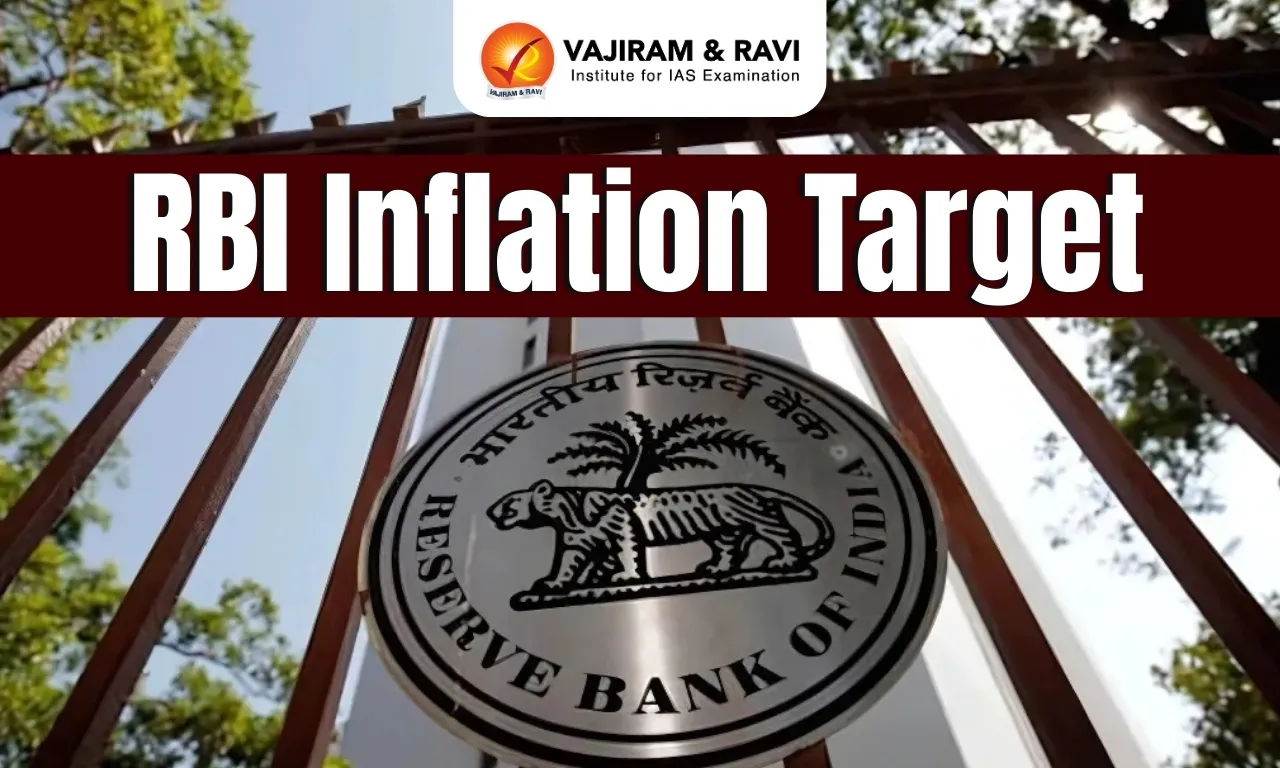
RBI Inflation Target Latest News
- The RBI, in its new discussion paper on the monetary policy framework, cautioned that raising India’s 4% inflation target now would undermine the credibility of the framework and risk reversing the macroeconomic stability gains achieved over the past decade.
RBI’s Discussion Paper on Monetary Policy
- The Reserve Bank of India (RBI) has released its long-awaited discussion paper on the country’s monetary policy framework.
- It warns that raising the current 4% inflation target could undermine the credibility of the framework and undo the policy and institutional gains achieved over the last decade.
Key Questions for Feedback
- The central bank has invited public feedback on four crucial issues:
- Whether monetary policy should target headline or core inflation.
- If the 4% inflation target remains optimal for balancing growth and stability.
- Whether the 2–6% tolerance band needs revision or removal.
- Whether the explicit 4% target should be dropped in favour of only a range.
Risks of Raising or Lowering the Target
- The paper highlights that raising the target in today’s environment of global geopolitical and economic uncertainty could be interpreted as a dilution of the inflation targeting framework, weakening investor confidence.
- Conversely, lowering the target below 4% would not suit India’s current economic conditions.
- Recently, S&P Global Ratings upgraded India’s rating to BBB, praising the RBI’s strong record in inflation management.
- Stable inflation within the 2–6% range has been crucial for investor confidence, growth prospects, and currency stability.
Background
- India adopted the flexible inflation targeting framework in 2016, with a medium-term CPI target of 4% and a tolerance band of 2–6%.
- The present target is valid till March 2026, after which it must be reset for the next five years.


Headline vs. Core Inflation in Monetary Policy
- The Economic Survey 2023-24 suggested that India’s inflation targeting framework should consider focusing on core inflation (excluding food and fuel).
- Core inflation – A measure of inflation that excludes highly volatile components, typically food and energy prices.
- Headline inflation – The total inflation rate in an economy, encompassing the prices of all goods and services within the representative basket.
- This was due to the fact that the food prices in India often rise due to supply shocks rather than demand pressures—making them less responsive to monetary policy tools.
- The RBI, under former Governor Shaktikanta Das, rejected this idea, stressing that food prices cannot be ignored.
- In its latest discussion paper, the RBI reiterated that nearly all inflation-targeting countries, regardless of their development stage, target headline CPI inflation.
- Uganda is the only exception, focusing on core inflation.
Spillover Effects of Food Prices
- The RBI highlighted that persistent food inflation eventually spills over into core inflation through higher wages, rents, and business markups.
- Empirical evidence from India shows that while core prices remain stable, non-core (food and fuel) prices tend to converge with them over the long run.
- Hence, ignoring food inflation could weaken monetary policy effectiveness.
Recent Trends
- In July 2024, headline CPI inflation fell to 1.55%, an eight-year low, while core inflation stood at 4.1%.
- Historically, headline inflation has fluctuated widely between 1.5% and 8.6% since 2014 due to food price swings, whereas core inflation has been more stable.
- The RBI concluded that monetary policy must ensure both credibility and certainty, especially during global uncertainty.
- Therefore, it emphasised the importance of continuing with headline CPI as the target, since it better reflects the inflation experienced by households and investors.

 Last updated on August, 2026
→ UPSC Mains Question Paper 2026 is out now for Essay & GS Paper 1, 2, 3 & 4.
→ UPSC Mains GS Paper 1 2026 is out now.
→ UPSC Mains GS Paper 2 2026 is out now.
→ UPSC Mains GS Paper 3 2026 is out now.
→ UPSC Mains GS Paper 4 2026 is out now.
→ UPSC Mains Indian Language Paper & English Compulsory Paper are out now.
→ Check out the latest UPSC Syllabus 2026 here.
→ UPSC Mains Admit Card 2026 is now out.
→ Enroll in Vajiram & Ravi’s UPSC Mains Test Series 2027 for structured answer writing practice, expert evaluation, and exam-oriented feedback.
→ Join Vajiram & Ravi’s UPSC Mentorship Program 2027 for personalized guidance, strategy planning, and one-to-one support from experienced mentors.
→ Go through the UPSC Mains Previous Year Papers to enhance your preparation.
→ Download UPSC Mains Essay Paper 2025, UPSC Mains GS Paper-I 2025, UPSC Mains GS Paper-II 2025, UPSC Mains GS Paper-III 2025, UPSC Mains GS Paper-IV 2025, UPSC Mains English (Compulsory) Paper 2025, UPSC Mains Hindi (Qualifying) Paper 2025 here.
→ UPSC has released UPSC Toppers List 2025 with the Civil Services final result on its official website.
→ UPSC Calendar 2027 has been released.
→ Also check Best UPSC Coaching in India
RBI Inflation Target FAQs
Q1. What did the RBI caution in its discussion paper?+
Q2. What key issues is the RBI seeking feedback on?+
Q3. Why is raising the inflation target risky now?+
Q4. What has been India’s inflation targeting framework?+
Q5. What is RBI’s stance on headline vs. core inflation?+
Tags: mains articles RBI inflation target upsc current affairs upsc mains current affairs