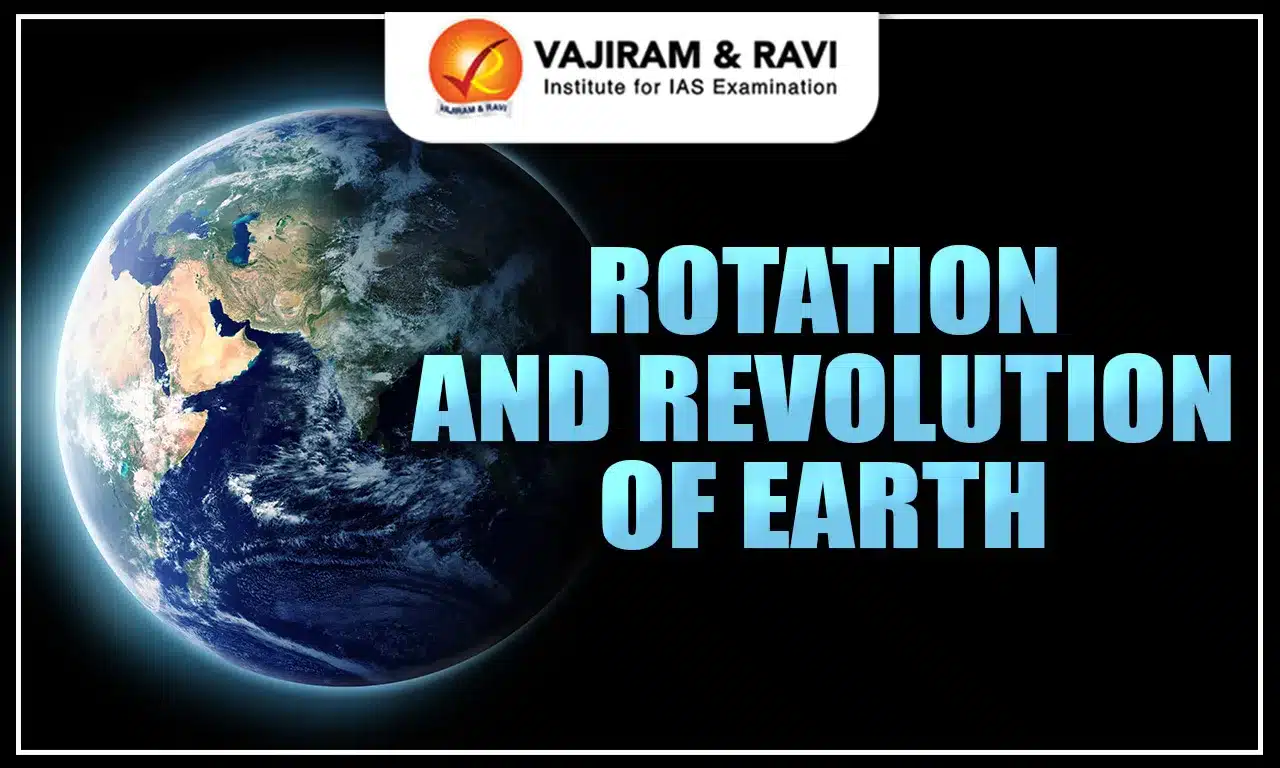
Rotation and Revolution of Earth are two different movements. Rotation of Earth that refers to the spinning of our planet around its axis. The process gets completed in 24 hours from day to night. Revolution means Earth’s trip around the Sun which takes 365 days and is responsible for the changes in the seasons. In this article, we are going to cover the rotation and revolution of Earth.
Rotation and Revolution of Earth
- Rotation and Revolution of Earth are two astronomical phenomena.
- Rotation of Earth means when the Earth rotates on its own axis. The axis is an imaginary line going from the North to the South Pole. The Earth completes one full rotation in approximately 24 hours, which establishes the day-night cycle. It is due to this rotation that we see the sun rise from the east and set in the west.
- Revolution refers to the Earth’s orbital motion around the Sun along an elliptical path. A complete revolution takes 365.25 days, which constitutes a solar year. The additional 0.25 days are adjusted by introducing a leap year every four years.
Rotation and Revolution of Earth Causes
Earth continues to rotate and revolve because of natural forces formed during the birth of the Solar System about 4.6 billion years ago.
- Formation of the Solar System: About 4.6 billion years ago, a huge cloud of gas and dust collapsed under gravity. As it shrank, it started spinning, and Earth formed while keeping this spinning motion.
- Conservation of Angular Momentum: Earth keeps rotating because angular momentum is conserved. Once an object starts spinning, it continues to spin unless a strong external force acts to stop or change its motion.
- Very Little External Force: There are no major external forces or torques acting on Earth to stop its movement. This allows Earth to continue rotating on its axis and revolving around the Sun.
- Gravity Keeps Earth in Orbit: The Sun’s strong gravitational pull keeps Earth moving in its elliptical orbit. This continuous balance between gravity and Earth’s forward motion causes its yearly revolution.


Rotation of Earth Effects
The Rotation of Earth has the following impact:
- Day and Night : The side facing the Sun experiences daylight, while the opposite side experiences night.
- Coriolis Effect : Due to rotation, winds and ocean currents are deflected: to the right in the Northern Hemisphere and to the left in the Southern Hemisphere, shaping global weather systems.
- Timekeeping: The division of the day into 24 hours and the creation of time zones are derived from the Earth’s rotation.
- Equatorial Bulge: Rotation causes centrifugal force, slightly flattening the Earth at the poles and creating an oblate spheroid shape.
- Weather Influence: Rotation directs atmospheric circulation and precipitation patterns, playing a role in climate regulation.
Revolution of Earth Effects
The revolution of Earth has the following impact:
- Seasons: Due to the 23.5° tilt of Earth’s axis, different hemispheres receive varying sunlight during revolution, leading to spring, summer, autumn, and winter.
- Length of the Year: Revolution defines the calendar year and seasonal cycles.
- Solar Energy Distribution: The angle at which sunlight strikes the Earth varies with revolution, affecting ecosystems, agriculture, and climatic zones.
- Eclipses: Revolution, combined with the Earth-Moon system, results in solar and lunar eclipses depending on relative alignments.
- Tides: While primarily influenced by the Moon, the Sun’s position relative to the Earth (during revolution) intensifies tides, creating spring and neap tides.
Rotation and Revolution of The Earth Significance
The process of rotation and revolution of Earth has the following significance:
- The rotation of Earth causes day and night rhythm governing the human biological clocks and natural activity patterns.
- The rotation of earth defines the daily time and revolution of earth establishes the yearly calendar.
- The rotation and revolution of Earth influences atmospheric circulation, rainfall distribution and wind systems.
- Seasonal cycles caused by the revolution of Earth regulates crop patterns, biodiversity and ecological balance.
- The rotation and revolution of Earth maintains the equilibrium of temperature, energy flow and environmental conditions necessary for sustaining life.
Rotation and Revolution of Earth Differences
Following is the difference in between rotation and revolution of Earth:
| Rotation and Revolution of Earth Differences | ||
| Aspect | Rotation | Revolution |
|
Definition |
Spinning of Earth on its axis |
Movement of Earth around the Sun |
|
Time Taken |
~24 hours (1 day) |
~365¼ days (1 year) |
|
Axis/Path |
Axis: Imaginary line joining North & South Poles |
Path: Elliptical orbit around the Sun |
|
Speed |
~1670 km/hr at equator |
~30 km/sec in orbit |
|
Major Outcome |
Causes day and night |
Causes seasons |
|
Impact on Time |
Defines day length and time zones |
Defines year length and calendar |
|
Effect on Earth |
Creates equatorial bulge, Coriolis force, wind/ocean current deflection |
Causes variation in solar energy distribution |
|
Weather/Climate Role |
Influences wind systems, rainfall patterns, ocean currents |
Influences seasonal changes, agriculture cycles, ecosystems |
|
Other Effects |
Circadian rhythms, jet streams, Earth’s shape |
Eclipses (solar/lunar), tidal variations |

 Last updated on Oct, 2026
→ UPSC 2027 Notification will be released on 13 January 2027 at upsconline.nic.in.
→ Check Nobel Prize 2026 Winners List here.
→ Download PIB PRiSM Monthly Magazine 2026 here.
→ Check UPSC Monthly Current Affairs Magazine The Recitals here.
→ Check out the latest UPSC Syllabus here.
→ Download UPSC Model Answers for Mains 2026
→ UPSC Mains Question Paper 2026 is out now for Essay & GS Paper 1, 2, 3 & 4.
→ UPSC Calendar 2027 has been released.
→ Enroll in Vajiram & Ravi’s UPSC Mains Test Series 2027 for structured answer writing practice, expert evaluation, and exam-oriented feedback.
→ Join Vajiram & Ravi’s UPSC Mentorship Program 2027 for personalized guidance, strategy planning, and one-to-one support from experienced mentors.
→ Go through the UPSC Mains Previous Year Papers to enhance your preparation.
→ UPSC has released UPSC Toppers List 2025 with the Civil Services final result on its official website.
→ Also check Best UPSC Coaching in India
Rotation and Revolution of Earth FAQs
Q1. What is the rotation and revolution of the Earth?+
Q2. What are 5 differences between rotation and revolution?+
Q3. What is the impact of rotation of Earth?+
Q4. What are the impacts of the revolution of the Earth?+
Q5. What is the Coriolis force?+
Tags: rotation and revolution of earth