RTE Exemption Latest News
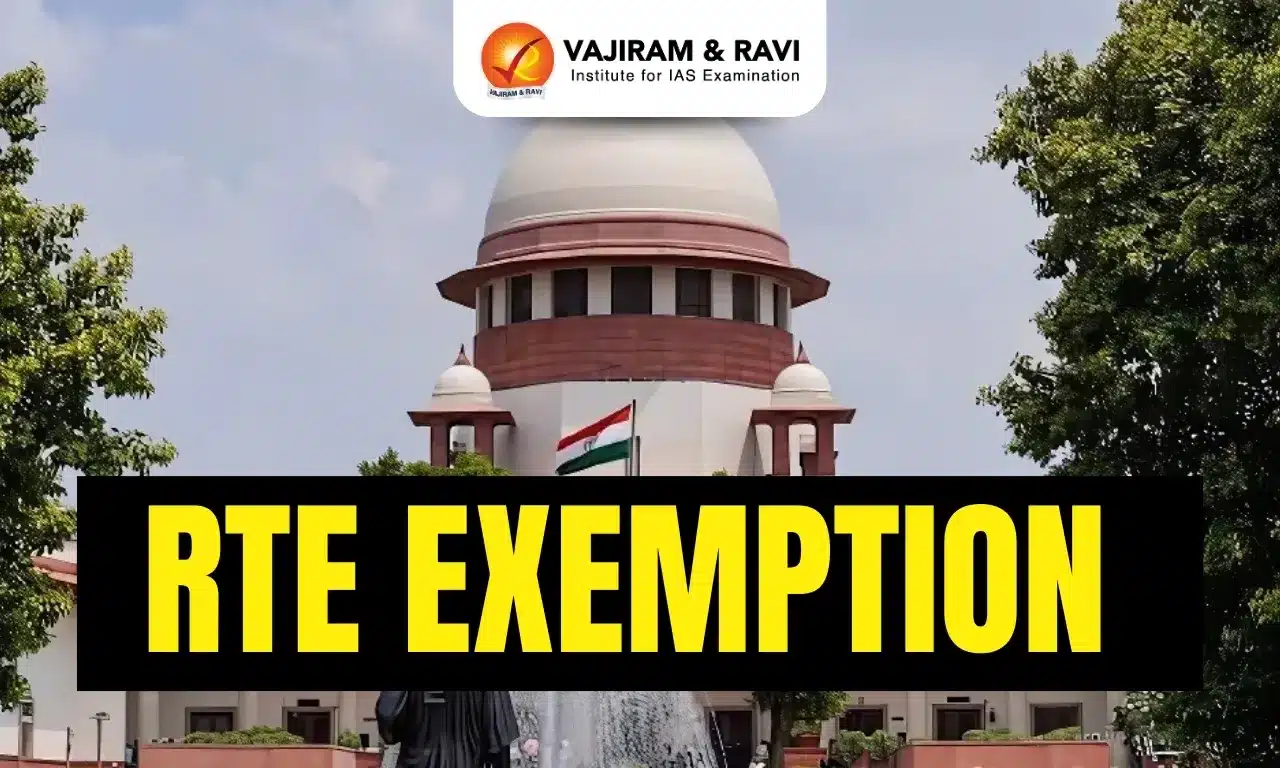
- The Supreme Court has referred the issue of RTE exemption for minority institutions to a larger Bench, questioning its 2014 ruling that granted them blanket exemption.
Introduction
- The Right of Children to Free and Compulsory Education (RTE) Act, 2009, is a cornerstone of India’s commitment to universal elementary education.
- However, a contentious legal question persists: should minority educational institutions, protected under Article 30 of the Constitution, be exempt from the provisions of the RTE Act?
- This debate resurfaced after the Supreme Court, on September 1, 2025, referred the issue to a larger Bench, signalling that its 2014 ruling in the Pramati Educational and Cultural Trust v. Union of India case may require reconsideration.


Debate on RTE Exemption to Minority Institutions
- The heart of the debate lies in balancing two constitutional guarantees, Article 21A, which ensures free and compulsory education for children aged 6 to 14, and Article 30(1), which grants minorities the right to establish and administer educational institutions of their choice.
- The 2014 Constitution Bench had ruled that Section 12(1)(c) of the RTE Act, which mandates 25% reservation for children from disadvantaged groups in all private schools, would infringe upon the autonomy of minority institutions.
- This judgment effectively excluded all minority institutions, aided or unaided, from the purview of the RTE Act.
- Critics argue that such blanket exemption dilutes inclusivity, fragments the common schooling system, and enables institutions to misuse minority status to avoid regulatory obligations.
- Proponents, however, stress that autonomy is essential for preserving the unique cultural and linguistic character of minority-run schools.
Background of the Case
- The reference arose from appeals challenging the insistence of state education departments that teachers in minority institutions clear the Teacher Eligibility Test (TET), a minimum qualification prescribed under Section 23 of the RTE Act.
- The two-judge Bench of the Supreme Court observed that the 2014 ruling had “unknowingly jeopardised the very foundation of universal elementary education.”
- The court noted that exempting minority institutions from the RTE framework weakens the vision of inclusivity, reinforcing divides instead of creating shared spaces for learning.
Supreme Court’s Observations and Summary
- The Supreme Court, while referring the matter to a larger Bench, underlined several critical points:
- Need for Reconsideration of 2014 Ruling: The Bench held serious doubts over the justification of granting blanket exemption, stating that applying the RTE Act “does not erode, let alone annihilate, the minority character” of institutions.
- Social Inclusion and Section 12(1)(c): The judges emphasised that the 25% reservation under Section 12(1)(c) serves a vital purpose of social inclusion.
- Admitting disadvantaged children under a transparent, state-guided framework does not inherently compromise minority identity.
- Financial Neutrality: The RTE Act includes reimbursement provisions for private schools implementing Section 12(1)(c), ensuring that the financial burden does not fall solely on institutions.
- Inclusivity and Equality: The Bench highlighted that the larger purpose of the Act is to create integrated classrooms where children of different backgrounds learn together, aligning with the transformative goals of Article 21A.
- Misuse of Minority Status: The court also flagged that some institutions have sought minority recognition primarily to bypass obligations under the RTE Act, creating “enclaves of privilege” at the cost of national development goals.
- The matter will now be placed before the Chief Justice of India, who may constitute a larger Bench to examine whether minority institutions should continue to enjoy a blanket exemption from the RTE Act or whether a nuanced, fact-specific approach should be adopted.
Conclusion
- The Supreme Court’s move to revisit the exemption of minority institutions from the RTE Act marks a crucial moment in India’s education and constitutional jurisprudence.
- It raises fundamental questions about equality, inclusivity, and autonomy.
- If the larger Bench revises the 2014 judgment, minority institutions may need to comply with provisions such as the 25% reservation under Section 12(1)(c), thereby reinforcing the idea of a common schooling system.
- Striking the right balance between minority rights and the universal right to education will be key to shaping the future of India’s education policy.

 Last updated on Sep, 2026
→ UPSC 2027 Notification will be released on 13 January 2027 at upsconline.nic.in.
→ Check out the latest UPSC Syllabus here.
→ Download UPSC Model Answers for Mains 2026
→ UPSC Mains Question Paper 2026 is out now for Essay & GS Paper 1, 2, 3 & 4.
→ UPSC Calendar 2027 has been released.
→ Enroll in Vajiram & Ravi’s UPSC Mains Test Series 2027 for structured answer writing practice, expert evaluation, and exam-oriented feedback.
→ Join Vajiram & Ravi’s UPSC Mentorship Program 2027 for personalized guidance, strategy planning, and one-to-one support from experienced mentors.
→ Go through the UPSC Mains Previous Year Papers to enhance your preparation.
→ UPSC has released UPSC Toppers List 2025 with the Civil Services final result on its official website.
→ Also check Best UPSC Coaching in India
RTE Exemption FAQs
Q1. What did the 2014 Supreme Court ruling on RTE and minority institutions state?+
Q2. Why has the Supreme Court referred the matter to a larger Bench in 2025?+
Q3. What is Section 12(1)(c) of the RTE Act?+
Q4. How does the Supreme Court view the impact of RTE on minority character?+
Q5. What concerns has the court raised about minority status?+
Tags: mains articles rte exemptions upsc current affairs upsc mains current affairs