Equity Derivatives Latest News
SEBI has come out with a new framework for monitoring intraday positions in equity index derivatives, a move aimed at preventing risks caused by large exposures.
What are Derivatives?
- Derivatives are financial contracts that derive value from an underlying asset.
- Derivatives allow traders to bid on the direction of the underlying asset’s price change without owning them.
- They allow investors to speculate on price movements, hedge against risks, or enhance portfolio returns.


About Equity Derivatives
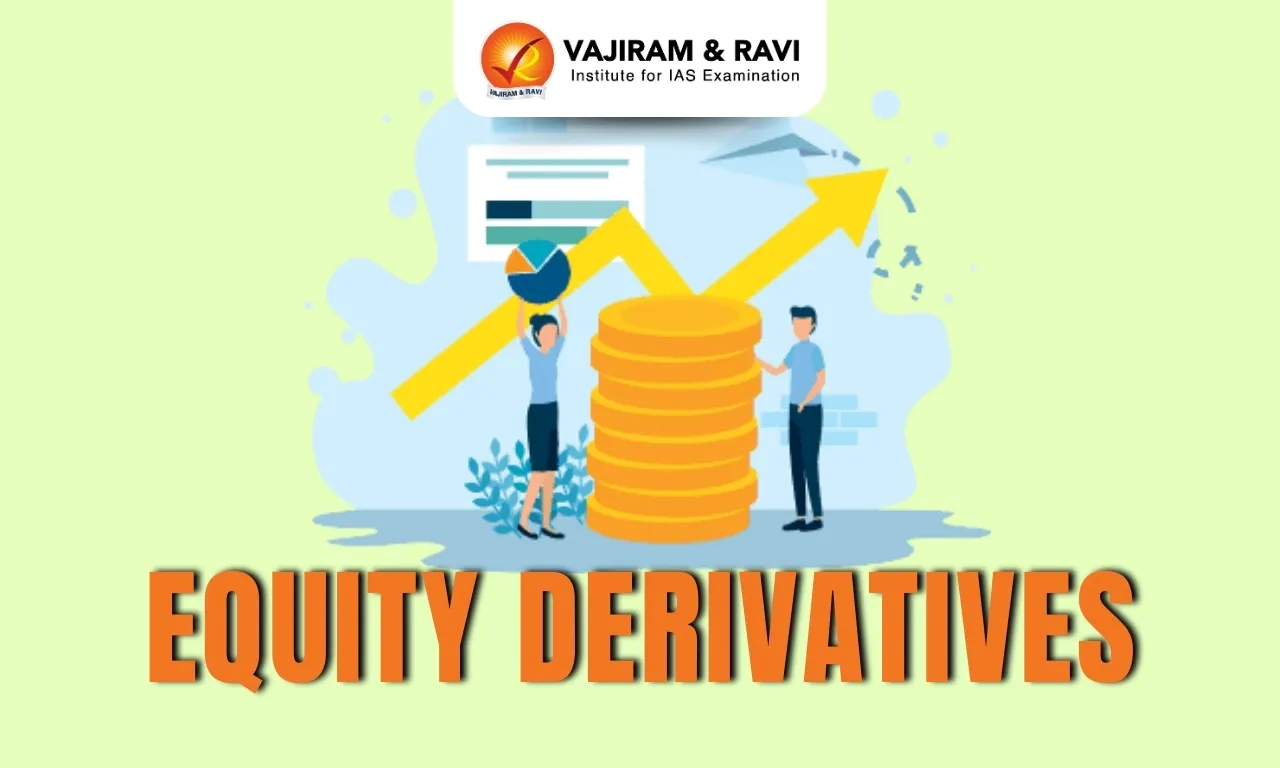
- Equity derivatives are financial instruments whose value is derived from the movements of a stock or a stock index.
- Equity derivatives serve various purposes for investors and traders, including risk management, speculation, and portfolio optimisation.
Equity Derivative Types
- Futures Contracts: These obligate the buyer to purchase and the seller to sell an underlying equity asset at a predetermined price and future date. Equity index futures, like the BSE S&P and Nifty IT, are popular examples.
- Options: Equity options give the holder the right, but not the obligation, to buy (call option) or sell (put option) an underlying stock or index at a specified price before or on a specific expiration date.
- Swaps: Equity swaps involve exchanging cash flows based on the return of an underlying equity asset. These can be used for hedging or investment purposes.
- Forwards: Forwards are the same as futures, where the parties are obligated to perform the contract. But forwards are non-standardised, over-the-counter contracts that don’t trade on the stock exchanges.
Advantages of Equity Derivatives
- Leverage: Equity derivatives typically require a smaller upfront investment compared to buying the underlying assets directly.This allow investors to control a larger position in the underlying asset with a smaller investment, magnifying potential gains (but also losses).
- Hedging against price volatility: They provide a means to protect against adverse price movements in the stock market, reducing the risk of financial losses.
- Access to premium assets: By investing in these derivatives, investors can gain exposure to high-value, unaffordable or inaccessible assets.
- Cost efficiency: Trading equity derivatives typically requires lower transaction costs than directly investing in the underlying assets, making it a cost-effective choice.
- Arbitrage opportunities: They can be utilised to exploit price discrepancies between different markets, enabling investors to profit from market inefficiencies.
- Portfolio diversification: Including these derivatives in an investment portfolio can diversify risk by adding different asset classes and strategies.
- Flexibility: They offer various strategies and contract types, allowing investors to adapt their positions based on market conditions and investment objectives.
- Liquidity: The derivatives market tends to have high liquidity, ensuring ease of buying and selling positions without significant market impact.
- Risk management: They provide tools for managing risk exposure, allowing investors to mitigate losses and protect their portfolios.
- Income generation: Through option writing or other derivative strategies, investors can generate income from their equity positions, enhancing overall returns.
Source: TH

 Last updated on August, 2026
→ UPSC Mains 2026 commenced on 21st August 2026 and will continue through 30th August 2026, as per the official examination schedule.
→ UPSC Mains Question Paper 2026 is out now for Essay & GS Paper 1, 2, 3 & 4.
→ UPSC Mains GS Paper 1 2026 is out now.
→ UPSC Mains GS Paper 2 2026 is out now.
→ UPSC Mains GS Paper 3 2026 is out now.
→ UPSC Mains GS Paper 4 2026 is out now.
→ UPSC Mains Indian Language Paper & English Compulsory Paper are out now.
→ Check out the latest UPSC Syllabus 2026 here.
→ UPSC Mains Admit Card 2026 is now out.
→ Enroll in Vajiram & Ravi’s UPSC Mains Test Series 2027 for structured answer writing practice, expert evaluation, and exam-oriented feedback.
→ Join Vajiram & Ravi’s UPSC Mentorship Program 2027 for personalized guidance, strategy planning, and one-to-one support from experienced mentors.
→ Go through the UPSC Mains Previous Year Papers to enhance your preparation.
→ Download UPSC Mains Essay Paper 2025, UPSC Mains GS Paper-I 2025, UPSC Mains GS Paper-II 2025, UPSC Mains GS Paper-III 2025, UPSC Mains GS Paper-IV 2025, UPSC Mains English (Compulsory) Paper 2025, UPSC Mains Hindi (Qualifying) Paper 2025 here.
→ UPSC has released UPSC Toppers List 2025 with the Civil Services final result on its official website.
→ UPSC Calendar 2027 has been released.
→ Also check Best UPSC Coaching in India
Equity Derivatives FAQs
Q1. What is the key difference between futures and forwards?+
Q2. Which type of equity derivative gives the holder the right, but not the obligation, to buy or sell an asset?+
Q3. What are the 4 types of derivatives?+
Tags: equity derivatives prelims pointers upsc current affairs upsc prelims current affairs