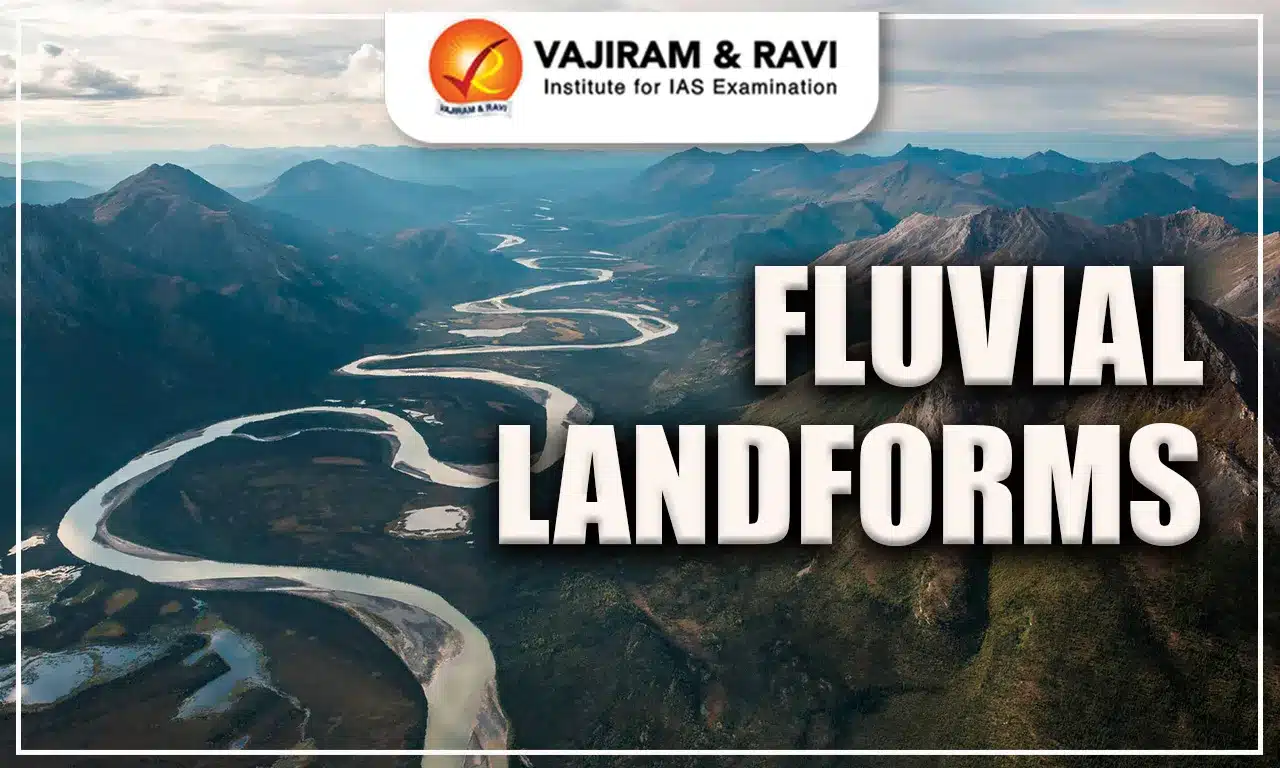
Fluvial Landforms are shaped by the work of rivers and streams, including valleys, meanders, floodplains, deltas and levees. These landforms result from erosion, deposition and sediment transportation, playing an important role in landscape formation and sustaining ecosystems. In this article, we are going to cover the fluvial landforms, its types, significance, process and challenges.
Fluvial Landforms
Fluvial landforms are natural features sculpted by rivers and streams through erosion, transport, and deposition of sediments. Examples include valleys, meanders, floodplains, deltas, and levees, each formed by the dynamic flow of running water.
- Valleys: Created by continuous river erosion, forming V-shaped or U-shaped profiles.
- Meanders: Curved bends in rivers due to lateral erosion and deposition.
- Floodplains: Broad flat surfaces near rivers formed by sediment deposits during floods.
- Deltas: Triangular landforms at river mouths, built by sediment deposition as water slows.
- Levees: Raised embankments along riverbanks, built by sediment deposits from floods.
- These features sustain agriculture, human settlement, and ecosystems, though vulnerable to natural and human-driven changes like erosion, floods, and development.
Fluvial Landforms Types
Fluvial Landforms can be divided into eight types. These types include:
- Valleys
Valleys are stretched depressions created by rivers as they cut through the land. Their shape and form depend on the nature of erosion and surrounding topography.- V-shaped Valleys: These valleys are formed by the vertical erosion of rivers, especially in their youthful stage. The river cuts deeply into the landscape, creating steep slopes and narrow bottoms, resulting in a characteristic “V” profile.
- U-shaped Valleys: These are wider and deeper than V-shaped valleys, with a flat valley floor, shaped by glacial erosion and later modified by rivers.
- Meanders
Meanders are sweeping curves or bends in a river that develop in its middle or mature stage. They occur due to the lateral erosion on the outer banks and deposition on the inner banks of a river channel. Oxbow lakes may form when a meander loop gets cut off from the main channel. - Floodplains
Floodplains are broad, flat areas of land adjacent to rivers, created mainly through deposition during flood events. When rivers overflow their banks, they spread water and sediments across the surrounding land. - Deltas
Deltas are low-lying, triangular or fan-shaped landforms formed at the mouth of rivers where they enter larger bodies of water like seas or lakes. Examples include the Nile Delta and the Ganga-Brahmaputra Delta. - Levees
Levees are natural embankments formed along the sides of a river channel. During floods, a river overflows its banks, depositing heavier sediments near the channel and finer materials further away. - Braided Streams
Braided streams consist of multiple shallow, interconnected channels separated by bars or islands of sediments. They usually develop in regions where rivers carry a heavy sediment load, and the flow is variable or fluctuating. - Alluvial Fans
Alluvial fans are fan- or cone-shaped deposits of sediments formed when rivers exit a narrow valley or canyon and spread onto a flatter plain. The sudden reduction in gradient causes the river to lose energy, depositing coarse sediments like gravel and sand at the mouth. - Terraces
River terraces are step-like landforms representing former riverbeds or floodplains at higher levels. They form due to alternating phases of erosion and deposition as the river cuts downwards into its valley.


Fluvial Landforms Significance
Fluvial landforms are important for the environment due to their contribution in supporting ecosystem, agriculture and water supply. Fluvial landforms are important due to:
- Ecosystem Support
Fluvial landforms such as rivers, floodplains, and deltas serve as vital ecosystems, providing habitats for diverse species of plants, fish, birds, and mammals. They support both aquatic and terrestrial biodiversity, enabling food chains and maintaining ecological balance.
- Agricultural Land
Floodplains and deltas are among the most fertile regions in the world due to the nutrient-rich alluvial soils deposited by rivers during floods. This natural replenishment of soil fertility sustains agriculture, enabling high crop yields.
- Water Supply and Management
Rivers and their associated landforms provide freshwater resources crucial for human survival. They supply drinking water, support irrigation for agriculture, and serve industrial needs.
- Flood Control
Fluvial features like natural levees, floodplains, and river channels help in flood management by absorbing excess water during heavy rains. These natural buffers reduce the impact of flooding on human settlements, farmlands, and infrastructure, although excessive human interference can weaken these protective functions.
- Geomorphological Studies
Fluvial landforms provide valuable insights into Earth’s geomorphological history. By studying valleys, terraces, and river deposits, scientists can reconstruct past climatic conditions, sediment transport processes, and landscape evolution.
- Transport and Navigation
Since ancient times, rivers have served as natural highways, facilitating transportation, commerce, and trade. Navigable rivers and their landforms support inland navigation systems, reducing transportation costs and linking hinterlands with coastal areas.
- Recreation and Tourism
Scenic fluvial landscapes such as meandering rivers, deep valleys, deltas, and waterfalls attract tourists worldwide. Activities like rafting, fishing, boating, and sightseeing generate revenue, provide recreational opportunities, and boost local economies.
- Climate Regulation
River systems contribute to regulating regional climates by redistributing water across landscapes. The ecosystems supported by rivers absorb carbon dioxide, mitigating global warming.
Fluvial Landforms Formation Process
Fluvial Landforms are formed by many types of processes including:
- Erosion: Rivers erode the landscape through vertical (downcutting) and lateral (sideward) erosion, forming valleys, gorges, and meanders.
- Transport: Eroded sediments are carried downstream by the river’s flow, influencing the creation of depositional features.
- Deposition: As river velocity decreases, sediments are deposited, forming floodplains, levees, and deltas.
- Meandering: Continuous erosion and deposition along riverbanks create bends, which over time evolve into sinuous meanders.
- Terracing: Shifting river courses and alternating erosion-deposition cycles form step-like terraces that represent former river levels.
- Alluvial Formation: Sediment buildup in low-gradient areas forms landforms like alluvial fans and deltas.
Braiding: In sediment-heavy rivers, multiple interconnected channels form braided streams, separated by sandbars or islands.
Fluvial Landforms Challenges
The Fluvial Landforms have to face the following challenges:
- Urbanization and Deforestation: Encroachment along riverbanks and removal of vegetation disturb natural fluvial processes, increasing erosion and sedimentation.
- River Modification: Construction of dams, levees, and canals alters natural flow patterns, disrupting sediment transport and aquatic ecosystems.
- Climate Change: Altered rainfall patterns, glacial melt, and sea-level rise intensify flooding, erosion, and degradation of river landscapes.
- Pollution and Water Quality: Industrial effluents, sewage, and agricultural runoff contaminate rivers, affecting sediment quality and ecological health.
- Over-extraction of Water: Excessive withdrawal for irrigation, industries, and cities reduces river flow, leading to drying channels and disrupted fluvial dynamics.
- Loss of Biodiversity: Alterations in river habitats threaten aquatic and terrestrial species, causing ecological imbalances.
- Flooding and Natural Disasters: Increased flood events and glacial lake outburst floods (GLOFs) reshape landforms abruptly, posing hazards to populations.
- Soil Erosion: Unsustainable farming and poor land-use practices accelerate soil erosion, weakening the stability of fluvial landforms.

 Last updated on Oct, 2026
→ UPSC 2027 Notification will be released on 13 January 2027 at upsconline.nic.in.
→ Check Nobel Prize 2026 Winners List here.
→ Download PIB PRiSM Monthly Magazine 2026 here.
→ Check UPSC Monthly Current Affairs Magazine The Recitals here.
→ Check out the latest UPSC Syllabus here.
→ Download UPSC Model Answers for Mains 2026
→ UPSC Mains Question Paper 2026 is out now for Essay & GS Paper 1, 2, 3 & 4.
→ UPSC Calendar 2027 has been released.
→ Enroll in Vajiram & Ravi’s UPSC Mains Test Series 2027 for structured answer writing practice, expert evaluation, and exam-oriented feedback.
→ Join Vajiram & Ravi’s UPSC Mentorship Program 2027 for personalized guidance, strategy planning, and one-to-one support from experienced mentors.
→ Go through the UPSC Mains Previous Year Papers to enhance your preparation.
→ UPSC has released UPSC Toppers List 2025 with the Civil Services final result on its official website.
→ Also check Best UPSC Coaching in India
Fluvial Landforms FAQs
Q1. What are fluvial landforms?+
Q2. What are the 4 fluvial processes?+
Q3. What are the 4 types of landforms?+
Q4. What are levees?+
Q5. What are meanders?+
Tags: fluvial landforms