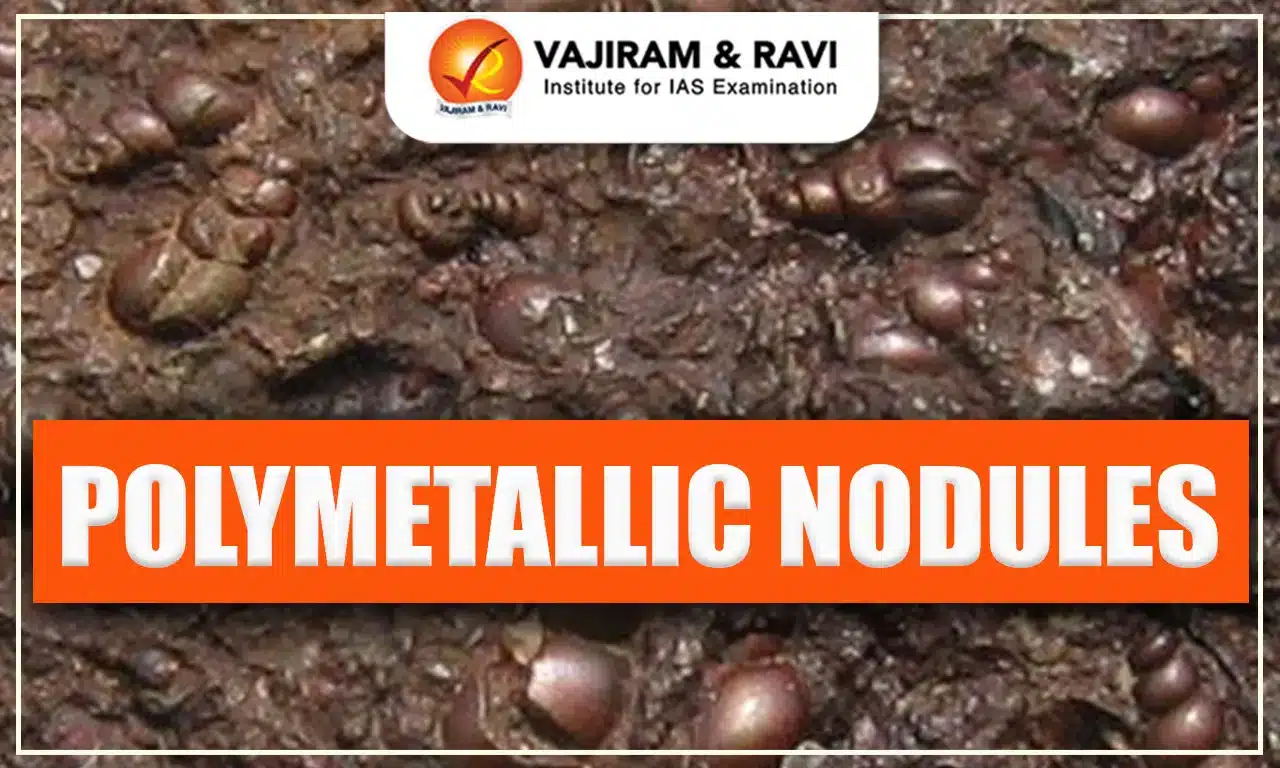
Polymetallic Nodules, commonly called manganese nodules, are potato-shaped mineral deposits scattered across the seabed, mainly in deep ocean basins such as the Pacific and Indian Oceans. They are rich in key metals like manganese, nickel, cobalt, and copper, making them highly valuable for industries ranging from electronics to renewable energy.
Considered a source for future mineral supply, these Polymetallic Nodules could reduce dependence on land-based mining. However, their extraction also raises serious environmental and ethical debates, particularly concerning the protection of fragile marine ecosystems and the rights of coastal and island nations.
Polymetallic Nodules
Polymetallic Nodules, or manganese nodules, are rock-like mineral deposits found on the ocean floor, especially in deep-sea regions such as the Clarion-Clipperton Zone of the Pacific Ocean. They are primarily made up of manganese, nickel, copper, and cobalt, along with small quantities of rare earth elements. These nodules form over millions of years through the slow accumulation of minerals from seawater around a core, such as a shell fragment or volcanic particle.
Their high concentration of critical minerals makes them valuable for industries like electronics, renewable energy, and battery manufacturing, which rely heavily on these metals. However, extracting them through deep-sea mining poses serious risks, including disruption of fragile marine ecosystems and biodiversity loss. To harness their potential responsibly, sustainable mining technologies and strong international regulations are essential to strike a balance between resource demand and environmental protection.
Polymetallic Nodules Significance
Polymetallic Nodules carry immense economic, industrial, and scientific importance because of their rich deposits of manganese, nickel, copper, and cobalt. Their role extends beyond mining, linking directly to global development, energy transition, and scientific discovery.
- Economic Importance
- These nodules are a major potential source of critical metals used in electronics, battery manufacturing, and renewable energy industries. Nickel and cobalt, in particular, are vital for electric vehicle batteries and energy storage.
- With rising global demand, they can act as a future reserve of essential minerals, reducing reliance on limited land-based sources.
- Energy Transition
- The metals within nodules are key components of clean energy systems, including solar panels, wind turbines, and electric mobility solutions. They are central to supporting the shift towards a low-carbon economy.
- Scientific Value
- Nodules form over millions of years and provide rare insights into mineral deposition, ocean chemistry, and deep-sea geological processes. Studying them helps understand Earth’s history and marine ecosystems.
- Potential for Sustainable Mining
- As terrestrial reserves shrink, nodules could provide a longer-term supply of critical minerals. Yet, this requires careful adoption of sustainable and eco-sensitive mining practices to avoid irreversible damage to marine biodiversity.


Polymetallic Nodules Challenges
- Environmental Impact: Destruction of fragile deep-sea ecosystems, biodiversity loss, and toxic release; sediment plumes disrupt food chains and smother marine life.
- Technological Barriers: Extreme pressure, low temperatures, and corrosive seawater make operations difficult; efficient extraction and transport methods are still under development.
- Economic Concerns: Very high infrastructure costs, uncertain profitability, and competition from cheaper, established land-based mining.
- Regulatory Issues: Lack of clear international rules, ownership disputes in international waters, and weak monitoring of environmental safeguards.
- Public & Ethical Concerns: Strong opposition from scientists and environmental groups, ethical debates on exploiting untouched ocean ecosystems, and reputational risks for industries.
Schemes and Missions for Polymetallic Nodules
Several global and national initiatives have been launched to explore and utilize Polymetallic Nodules while balancing economic interests with environmental concerns. These missions aim to promote sustainable mining practices, advance technology for deep-sea exploration, and regulate activities in international waters. The table below highlights the Schemes and Missions for Polymetallic Nodules:
| Schemes and Missions for Polymetallic Nodules | |||
|
Mission / Scheme |
Country / Organization |
Purpose / Objective |
Key Features / Focus |
|
International Seabed Authority (ISA) |
Global (UN body under UNCLOS) |
Regulates exploration and extraction from the international seabed |
Issues licenses, sets environmental guidelines, ensures sustainable deep-sea mining |
|
Deep Ocean Mission |
India (Ministry of Earth Sciences, 2021) |
Harness ocean resources, study deep sea, and extract nodules |
Identifying nodule-rich regions, developing mining tech, environmental monitoring, building deep-sea mining industry |
|
India–US Joint Deep-Sea Exploration Program |
India & United States |
Collaborative exploration of deep-sea resources |
Focus on research, technology development, environmental protection, and economic feasibility studies |
|
National Institute of Ocean Technology (NIOT) |
India (MoES) |
Develop technologies for deep-sea mining |
ROVs for exploration, marine mapping, extraction techniques, environmental impact assessments |
|
Private & International Companies |
Various (with ISA permits) |
Explore commercial potential of polymetallic nodules |
Joint ventures, exploration in Clarion-Clipperton Zone (CCZ), technological innovation |
|
Horizon 2020 Program |
European Union |
Fund sustainable mineral extraction research |
Develop eco-friendly mining tech, lifecycle analysis, sustainable alternatives |
|
International Geoscience & Geoparks Programme (IGGP) |
UNESCO |
Support marine geology research & promote sustainable resource use |
International collaborations, study of mineral deposits, assess environmental impacts |

 Last updated on Sep, 2026
→ UPSC 2027 Notification will be released on 13 January 2027 at upsconline.nic.in.
→ Asian Games 2026 are being held in Aichi-Nagoya, Japan, from 19 September to 4 October.
→ Check out the latest UPSC Syllabus here.
→ Download UPSC Model Answers for Mains 2026
→ UPSC Mains Question Paper 2026 is out now for Essay & GS Paper 1, 2, 3 & 4.
→ UPSC Calendar 2027 has been released.
→ Enroll in Vajiram & Ravi’s UPSC Mains Test Series 2027 for structured answer writing practice, expert evaluation, and exam-oriented feedback.
→ Join Vajiram & Ravi’s UPSC Mentorship Program 2027 for personalized guidance, strategy planning, and one-to-one support from experienced mentors.
→ Go through the UPSC Mains Previous Year Papers to enhance your preparation.
→ UPSC has released UPSC Toppers List 2025 with the Civil Services final result on its official website.
→ Also check Best UPSC Coaching in India
Polymetallic Nodules FAQs
Q1. What is a polymetallic nodule?+
Q2. What are polymetallic nodules in UPSC?+
Q3. Why are polymetallic nodules valuable?+
Q4. What minerals are commonly found in polymetallic nodules?+
Q5. Is nodule harmful?+
Tags: polymetallic nodules