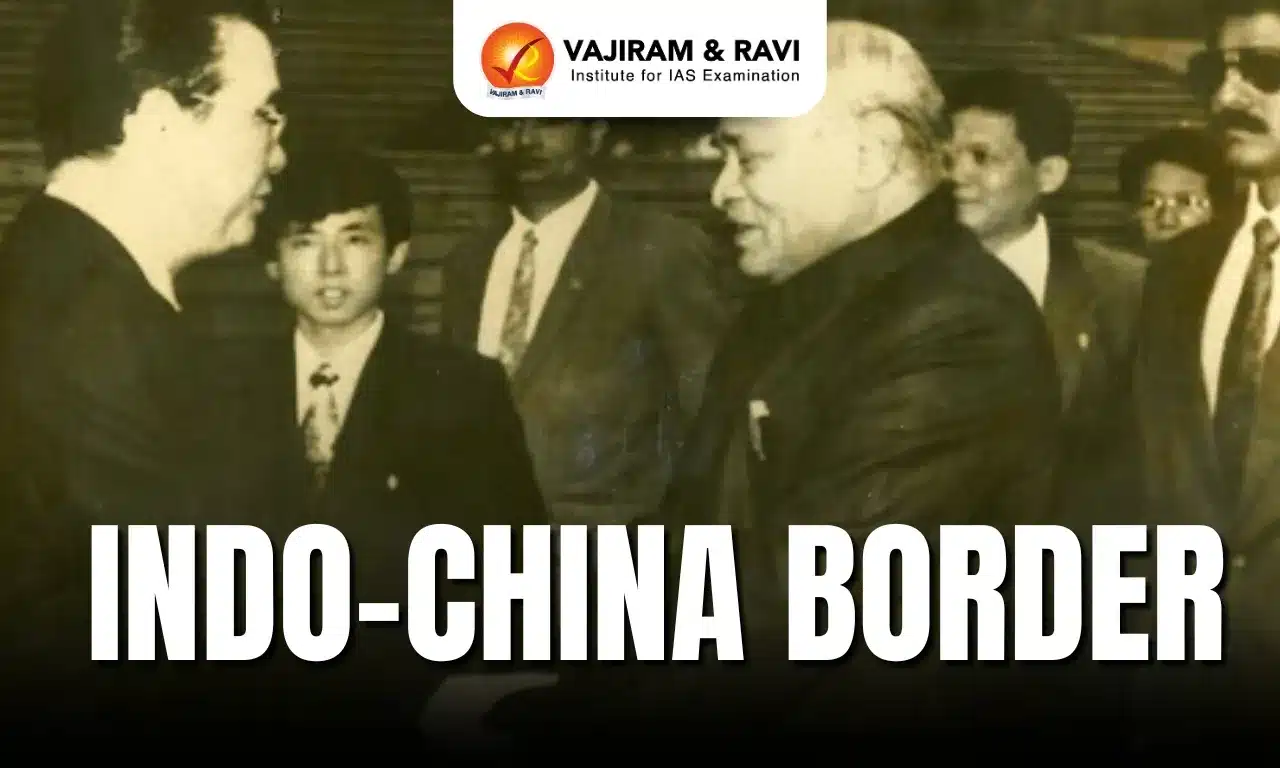
Indo-China Border Latest News
- The India-China border dispute, after decades of talks and agreements since 1993, has failed to define the Line of Actual Control, keeping tensions unresolved.
Introduction
- The India-China border dispute remains one of the most complex territorial issues in Asia, shaped by history, geopolitics, and national security concerns.
- Despite decades of dialogue, agreements, and attempts at confidence-building, the Line of Actual Control (LAC) remains undefined, leading to recurring face-offs and clashes.
- This article traces the evolution of negotiations since the late 1980s and highlights why the inability to formalise the LAC has kept the dispute alive.


Early Efforts and Diplomatic Engagements
- India-China border negotiations gained momentum after Prime Minister Rajiv Gandhi’s 1988 visit to Beijing, which marked a turning point in bilateral relations.
- Subsequent political changes in India initially slowed progress, but by the early 1990s, both nations recognised the necessity of peaceful engagement.
- Six rounds of the Joint Working Group (JWG) meetings between 1988 and 1993 laid the groundwork for military-to-military engagement and the resumption of border trade.
- India’s Defence Minister Sharad Pawar’s 1992 visit to Beijing further expanded cooperation in academic, military, and scientific exchanges.
The 1993 Border Peace and Tranquillity Agreement (BPTA)
- In September 1993, Prime Minister P.V. Narasimha Rao’s visit to Beijing resulted in the signing of the Border Peace and Tranquillity Agreement (BPTA).
- This landmark nine-article agreement committed both countries to peaceful consultation and the non-use of force. It was the first document to explicitly refer to the LAC.
- Key provisions included:
- Both sides are to refrain from crossing the LAC and withdraw if cautioned.
- Minimal troop deployment along the border.
- Reduction of forces on the principle of “mutual and equal security.”
- The agreement aimed to freeze the status quo and promote cooperation in other areas of bilateral relations.
Expansion Through the 1996 Agreement
- The 1996 agreement, signed during Chinese President Jiang Zemin’s visit to India, expanded on the BPTA by introducing detailed military confidence-building measures (CBMs). It emphasised:
- Limits on the deployment of heavy weaponry, missiles, and large-scale exercises near the LAC.
- Restrictions on military exercises facing the other side.
- Mutual agreement on ceilings for forces in sensitive sectors.
- However, the agreement also acknowledged that successful implementation depended on a common understanding of the LAC’s alignment, something both sides failed to achieve.
Attempts at Clarification and Collapse of Map Exchange
- Between 2000 and 2002, India and China exchanged maps of the central and western sectors.
- However, the process collapsed almost immediately, with both sides rejecting the maximalist claims presented.
- Disputes persisted over areas such as Depsang, Pangong Tso, Demchok, and Chumar. By 2005, the mapping exercise was abandoned altogether.
- This failure institutionalised ambiguity around the LAC. Many of the same disputed areas later witnessed face-offs, including the 2020 Galwan Valley clash.
Structural Problem in Defining the LAC
- The central issue is that neither India nor China is willing to concede ground in strategically sensitive areas.
- China’s infrastructure advantage, roads and logistics in Tibet, contrasts with India’s more difficult terrain in Ladakh and Arunachal Pradesh. This imbalance complicates negotiations.
- Without a common definition of the LAC, both armies continue to patrol up to their perceived lines, increasing the likelihood of accidental confrontations turning into violent clashes.
Current Implications and Lessons
- While the 1993 and 1996 agreements temporarily reduced tensions, their failure to resolve the core issue of defining the LAC has kept the border volatile.
- India and China have invested in mechanisms to prevent escalation, but the lack of political will to finalise the boundary has undermined peace-building efforts.
- The recurring standoffs highlight the urgency of either clarifying the LAC or developing stronger mechanisms to prevent patrol confrontations from spiralling into conflict.
Source: TH

 Last updated on Oct, 2026
→ UPSC 2027 Notification will be released on 13 January 2027 at upsconline.nic.in.
→ Asian Games 2026 are being held in Aichi-Nagoya, Japan, from 19 September to 4 October.
→ Check Nobel Prize 2026 Winners List here.
→ Download PIB PRiSM Monthly Magazine 2026 here.
→ Check UPSC Monthly Current Affairs Magazine The Recitals here.
→ Check out the latest UPSC Syllabus here.
→ Download UPSC Model Answers for Mains 2026
→ UPSC Mains Question Paper 2026 is out now for Essay & GS Paper 1, 2, 3 & 4.
→ UPSC Calendar 2027 has been released.
→ Enroll in Vajiram & Ravi’s UPSC Mains Test Series 2027 for structured answer writing practice, expert evaluation, and exam-oriented feedback.
→ Join Vajiram & Ravi’s UPSC Mentorship Program 2027 for personalized guidance, strategy planning, and one-to-one support from experienced mentors.
→ Go through the UPSC Mains Previous Year Papers to enhance your preparation.
→ UPSC has released UPSC Toppers List 2025 with the Civil Services final result on its official website.
→ Also check Best UPSC Coaching in India
Indo-China Border FAQs
Q1. What was the 1993 Border Peace and Tranquillity Agreement (BPTA)?+
Q2. Why did the 2002 map exchange between India and China fail?+
Q3. What did the 1996 agreement add to the 1993 BPTA?+
Q4. Which areas remain most disputed between India and China?+
Q5. Why has the India-China border dispute persisted?+
Tags: indo-china border mains articles upsc current affairs upsc mains current affairs