


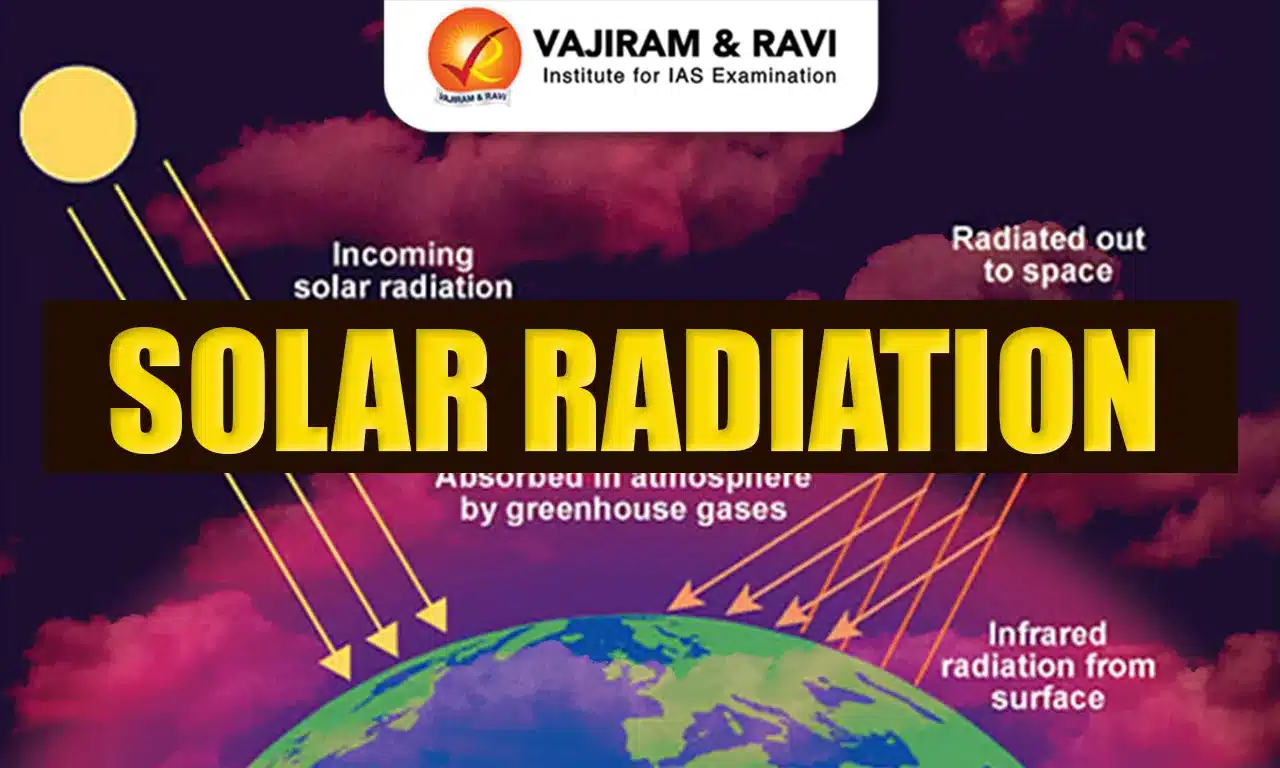
Solar Radiation is the energy released by the Sun in the form of electromagnetic waves, like shortwave radiation that includes visible light, ultraviolet and infrared that travel through space and reach the Earth, providing the primary source of heat and light that drives weather, climate and life processes on the Earth. In this article, we are going to cover solar radiation, its variability and distribution.
Solar Radiation
The sun radiates energy on the surface of Earth in the form of shortwave radiation. This incoming energy is known as insolation or incoming solar radiation. This energy is absorbed by the Earth and acts as a source of energy for all natural life processes. The shape of the Earth is round and due to this the rays of the sun strike the upper atmosphere at different angles. Due to this only a fraction of the total solar energy released by the Sun actually gets intercepted by the Earth. On average, at the top layer of the atmosphere, the Earth receives about 1.94 calories per square centimetre per minute which is known as the solar constant.
Solar Radiation Variability of Insolation
The amount of sunlight and its intensity is not always constant on the Earth surface, they fluctuate daily, seasonally and annually. The variation happens due to many reasons including the Earth’s rotation on its axis, tilt of its surface relative to the Sun’s rays and the length of daytime hours, clarity of atmosphere and the orientation of the landmasses. Along with this, an important factor is the angle of incidence of solar rays that are linked to latitude. At higher latitudes, the sun rays strike at a slant and cover a larger area and finally reduce the intensity of energy per unit surface. Vertical rays, however, concentrate energy over a smaller area. Along with this, slanting rays travel through a thicker layer of atmosphere helping with more absorption, scattering and diffusion, thereby reducing the net solar energy that reaches the ground.


Solar Radiation Passage through the Atmosphere
The atmosphere is transparent to shortwave radiation that allows more of the solar energy to each Earth’s surface. However, there are certain radiations that don’t pass through. Gases like the ozone and water vapour absorb a portion of near infrared radiation in the troposphere. Along with this, tiny suspended particles scatter visible light in different directions and this scattering creates natural optical phenomena that is when the sky appears blue due to shorter wavelengths scattered more properly, while the reddish hues that occur during sunrise and sunset are caused due to scattering of longer wavelengths when the sun is low on the horizon.
Solar Radiation Distribution
Solar Energy distribution is uneven across the Earth’s surface. Tropical regions, located near the equator, receive about 320 Watt/m², while polar regions only receive about 70 Watt/m² due to the low solar angles. Subtropical deserts have high insolation since they have minimal cloud cover and equatorial regions get less energy than the tropics due to frequent cloudiness. Landmasses absorb more solar energy in comparison to oceans at the same latitude because water reflects and distributes heat unevenly. Seasonal variation is also seen during winter when middle and higher latitudes receive less solar energy than during summer months.
Terrestrial Solar Radiation
When shortwave solar energy is absorbed, the Earth’s surface gets warmed up and radiates energy back into the atmosphere in the form of longwave radiation. This emission is called terrestrial radiation. Unlike shortwave energy, longwave radiation is absorbed by greenhouse gases, particularly carbon dioxide and water vapour. This process warms up the lower atmosphere and hence is important in regulating the Earth’s climate.
Heat Budget of Earth
Heat budget is the balance between the incoming solar energy absorbed and the outgoing terrestrial radiation emitted. If the amount of heat received and the heat lost is not balanced, Earth would heat up uncontrollably or cool drastically. The current balance makes sure that the planet remains within a livable temperature range. This process can be understood using an example-
If the atmosphere is receiving 100% insolation, only 35 units are being reflected back into space and 27 units are absorbed by the clouds and 2 units are bouncing back by bright surfaces like snow and ice. All these units come together and form the Earth’s albedo. The remaining 65 units are absorbed with 14 absorbed within the atmosphere and 51 absorbed directly by the surface.
This absorbed radiation is re-emitted by the Earth in the form of longwave radiation of which some energy gets directly escaped into space and some is absorbed by the atmosphere. Apart from this, the atmosphere itself emits radiation that is released into space. Thus, the total outgoing energy gets balanced with the original absorbed energy. This dynamic equilibrium between shortwave and longwave radiation is the Earth’s Heat Budget.
Heat Balance
The Earth tries to create a stable climate by making sure that the incoming heat from the sun matches the outgoing terrestrial radiation. While some energy is lost through reflection and scattering, a big portion is absorbed and re-radiated maintaining equilibrium. It is due to this reason that the Earth is neither excessively hot nor freezing cold despite the constant energy exchanges.
Temperature
When insolation interacts with the Earth’s surface and the atmosphere, it generates heat, which we perceive as temperature. While heat refers to the movement and energy of particles within matter, temperature is a numerical measure of how hot or cold something is, expressed in degrees (Celsius, Fahrenheit, or Kelvin).
Temperature Inversion
Under normal conditions, air temperature decreases with altitude in the troposphere. However, temperature inversion refers to a reversal of this trend, where a layer of cooler air lies beneath warmer air. This phenomenon is common in hilly or mountainous regions and often occurs at night due to air drainage.
During nighttime, the slopes cool quickly, and dense, cold air flows down into valleys, displacing warmer air upwards. This process not only creates inversion layers but also acts as a natural protective mechanism for crops, shielding them from frost damage.

 Last updated on Oct, 2026
→ UPSC 2027 Notification will be released on 13 January 2027 at upsconline.nic.in.
→ Check Nobel Prize 2026 Winners List here.
→ Download PIB PRiSM Monthly Magazine 2026 here.
→ Check UPSC Monthly Current Affairs Magazine The Recitals here.
→ Check out the latest UPSC Syllabus here.
→ Download UPSC Model Answers for Mains 2026
→ UPSC Mains Question Paper 2026 is out now for Essay & GS Paper 1, 2, 3 & 4.
→ UPSC Calendar 2027 has been released.
→ Enroll in Vajiram & Ravi’s UPSC Mains Test Series 2027 for structured answer writing practice, expert evaluation, and exam-oriented feedback.
→ Join Vajiram & Ravi’s UPSC Mentorship Program 2027 for personalized guidance, strategy planning, and one-to-one support from experienced mentors.
→ Go through the UPSC Mains Previous Year Papers to enhance your preparation.
→ UPSC has released UPSC Toppers List 2025 with the Civil Services final result on its official website.
→ Also check Best UPSC Coaching in India
Solar Radiation FAQs
Q1. What is the solar radiation?+
Q2. What are the three types of solar radiation?+
Q3. What is Earth’s Albedo?+
Q4. What is temperature inversion?+
Q5. What is heat balance?+
Tags: solar radiation








