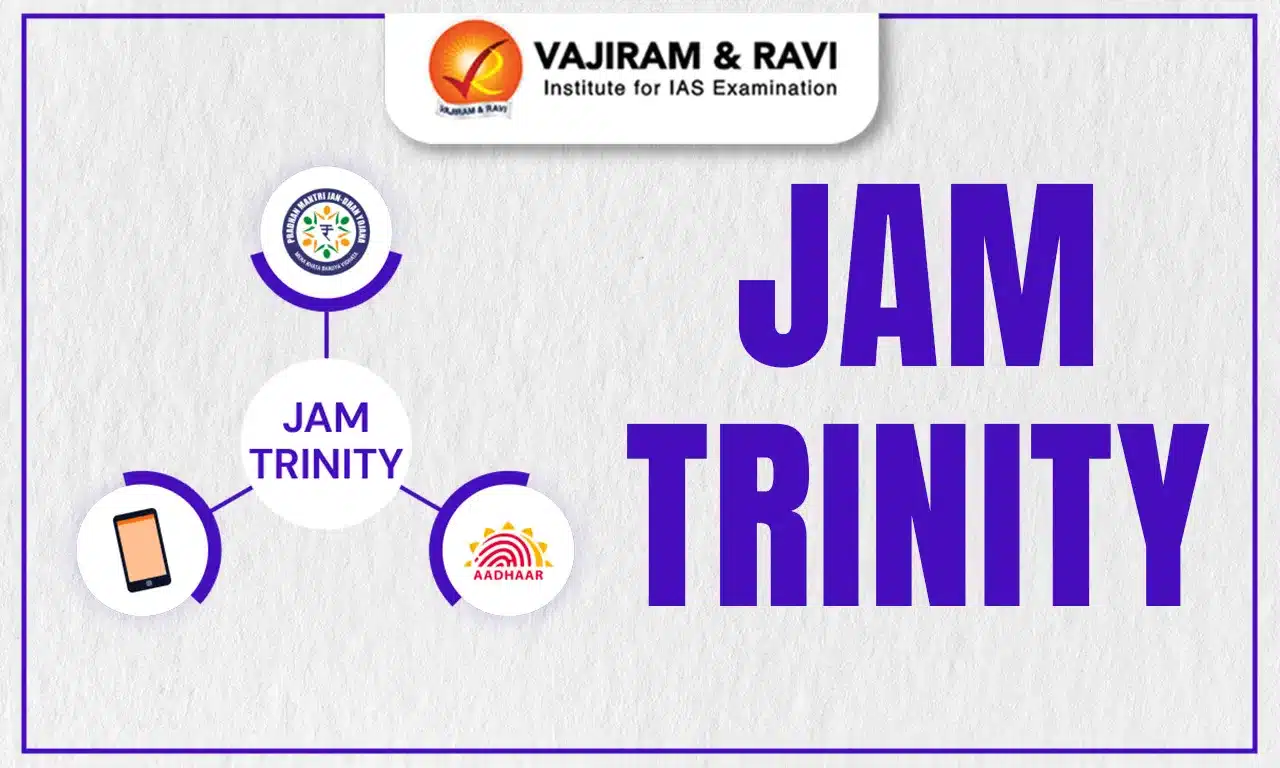
The JAM Trinity, Jan Dhan, Aadhaar, and Mobile represents a key initiative of the Indian government aimed at achieving financial inclusion and efficient governance. This integration has revolutionized the delivery of subsidies, welfare schemes, and other financial services by making them more direct, transparent, and efficient. It has minimized leakages, reduced middlemen, and strengthened the government’s vision of inclusive growth.
JAM Trinity
The JAM Trinity is a landmark initiative of the Government of India designed to advance financial inclusion and improve the delivery of subsidies and welfare benefits.
- Jan Dhan Yojana ensures universal access to bank accounts, bringing the unbanked population into the formal financial system.
- Aadhaar, the world’s largest biometric identification system, provides each citizen with a unique identity, enabling targeted and transparent delivery of services.
- Mobile connectivity acts as the technological backbone, linking beneficiaries to banking and digital platforms in real time.
By integrating these three pillars, the JAM framework removes intermediaries, reduces leakages, and enhances accountability. Linking bank accounts with Aadhaar and mobile numbers has enabled direct benefit transfers (DBT) of subsidies such as LPG, pensions, and scholarships.
Beyond efficient welfare delivery, the JAM Trinity has also empowered marginalized groups, promoted digital payments, and accelerated India’s transition toward a less-cash economy, contributing to inclusive growth and poverty reduction.
JAM Trinity Features
The JAM Trinity is a transformative framework introduced by the Government of India to strengthen financial inclusion, enhance transparency, and improve efficiency in the delivery of public services. It integrates three critical components, Jan Dhan bank accounts, Aadhaar biometric identification, and mobile connectivity to create a unified platform for welfare delivery and financial empowerment.
- Financial Inclusion: Through the Pradhan Mantri Jan Dhan Yojana (PMJDY), millions of previously unbanked individuals gained access to zero-balance bank accounts with facilities like overdraft, micro-credit, insurance, and pensions.
- Aadhaar-Based Authentication: Aadhaar acts as a unique biometric identifier, ensuring accurate targeting of beneficiaries. Its authentication mechanism reduces duplication, ghost beneficiaries, and fraud in welfare schemes.
- Direct Benefit Transfers (DBT): JAM enables subsidies and welfare benefits (LPG, pensions, MNREGA wages, etc.) to be transferred directly into beneficiaries’ bank accounts, cutting out intermediaries and minimizing leakages.
- Mobile Connectivity: The rapid spread of mobile phones has strengthened access to financial services and government schemes, even in remote areas. Services like mobile banking and SMS alerts promote transparency and digital literacy.
- Cost Efficiency and Transparency: Digitized transactions lower administrative costs and strengthen accountability in public expenditure.
- Empowering the Underserved: By expanding financial access and ensuring targeted delivery of welfare, JAM empowers marginalized communities and integrates them into the formal economy.


JAM Trinity Objectives
- Financial Inclusion: By linking Jan Dhan accounts with Aadhaar and mobile numbers, JAM ensures universal access to basic financial services such as savings, credit, insurance, and pensions, particularly in rural and underserved areas.
- Direct Benefit Transfer (DBT): Subsidies, pensions, and welfare benefits are transferred directly into beneficiaries’ bank accounts, cutting out intermediaries and reducing leakages.
- Transparency and Accountability: Aadhaar-based biometric verification prevents duplication, ghost beneficiaries, and corruption, ensuring that resources reach the intended recipients.
- Efficiency in Governance: The use of digital platforms improves service delivery, reduces administrative delays, and lowers costs of implementing welfare programs.
- Economic Empowerment: By enabling secure and accessible digital transactions, JAM integrates citizens into the digital economy, enhancing resilience and financial independence.
JAM Trinity Significance
The JAM Trinity, Jan Dhan, Aadhaar, and Mobile is a landmark framework that has redefined financial inclusion and welfare delivery in India. By integrating universal bank accounts, biometric identification, and mobile connectivity, the government has built a robust mechanism to transfer benefits directly to citizens, cutting out intermediaries and minimizing leakages.
- Jan Dhan Yojana has brought millions of unbanked individuals into the formal financial system through zero-balance accounts, promoting savings, financial literacy, and access to credit and insurance.
- Aadhaar provides every citizen with a unique biometric identity, enabling accurate identification and ensuring that welfare schemes reach the intended beneficiaries without duplication or fraud.
- Mobile connectivity serves as the digital backbone, bridging communication gaps and enabling smooth transactions, notifications, and access to services even in remote areas.
The Trinity has greatly strengthened the Direct Benefit Transfer (DBT) system, making subsidies such as LPG transfers, pensions, and MGNREGA payments faster, more transparent, and less prone to corruption. By reducing inefficiencies, it has saved significant public resources.
Beyond welfare delivery, JAM has also fueled India’s transition to a digital economy. It has expanded access to microcredit, insurance, and digital payment systems, empowering rural communities, women, and marginalized groups with financial autonomy and greater participation in economic life.
JAM Trinity Limitations
While the JAM Trinity has been a game-changer in advancing financial inclusion, several challenges limit its full potential:
- Digital Divide: Large sections of the rural and marginalized population still lack smartphones, reliable internet, and digital literacy. This weakens JAM’s inclusivity and reach.
- Aadhaar-Related Issues: Biometric authentication errors and technical glitches often result in the exclusion of genuine beneficiaries. Concerns over data privacy and potential misuse of Aadhaar data remain unresolved.
- Banking Infrastructure Deficit: Many Jan Dhan accounts remain inactive or dormant due to poor branch penetration, inadequate financial awareness, and limited accessibility in remote areas.
- Exclusion Errors: Tying subsidies and welfare schemes strictly to Aadhaar and Jan Dhan has sometimes denied benefits to eligible individuals because of documentation mismatches or technical lapses.
- Data Security Risks: Linking Aadhaar with mobile numbers and bank accounts raises vulnerabilities of data breaches, identity theft, and unauthorized access at an unprecedented scale.
- Overdependence on Technology: Power cuts, weak connectivity, and system crashes can disrupt JAM’s functioning, affecting time-sensitive welfare transfers.
| Also Check Other Posts | |
| Civil Society | FCRA |
| India’s Ranking in Different Indexes | 1st ARC Report |

 Last updated on Oct, 2026
→ UPSC 2027 Notification will be released on 13 January 2027 at upsconline.nic.in.
→ Asian Games 2026 are being held in Aichi-Nagoya, Japan, from 19 September to 4 October.
→ Check Nobel Prize 2026 Winners List here.
→ Download PIB PRiSM Monthly Magazine 2026 here.
→ Check UPSC Monthly Current Affairs Magazine The Recitals here.
→ Check out the latest UPSC Syllabus here.
→ Download UPSC Model Answers for Mains 2026
→ UPSC Mains Question Paper 2026 is out now for Essay & GS Paper 1, 2, 3 & 4.
→ UPSC Calendar 2027 has been released.
→ Enroll in Vajiram & Ravi’s UPSC Mains Test Series 2027 for structured answer writing practice, expert evaluation, and exam-oriented feedback.
→ Join Vajiram & Ravi’s UPSC Mentorship Program 2027 for personalized guidance, strategy planning, and one-to-one support from experienced mentors.
→ Go through the UPSC Mains Previous Year Papers to enhance your preparation.
→ UPSC has released UPSC Toppers List 2025 with the Civil Services final result on its official website.
→ Also check Best UPSC Coaching in India
JAM Trinity FAQs
Q1. What do you mean by JAM Trinity?+
Q2. What is the Trinity of JAM?+
Q3. What is the success of JAM Trinity?+
Q4. What does JAM stand for in banking?+
Q5. What is the full form of JAM? +
Tags: jam trinity