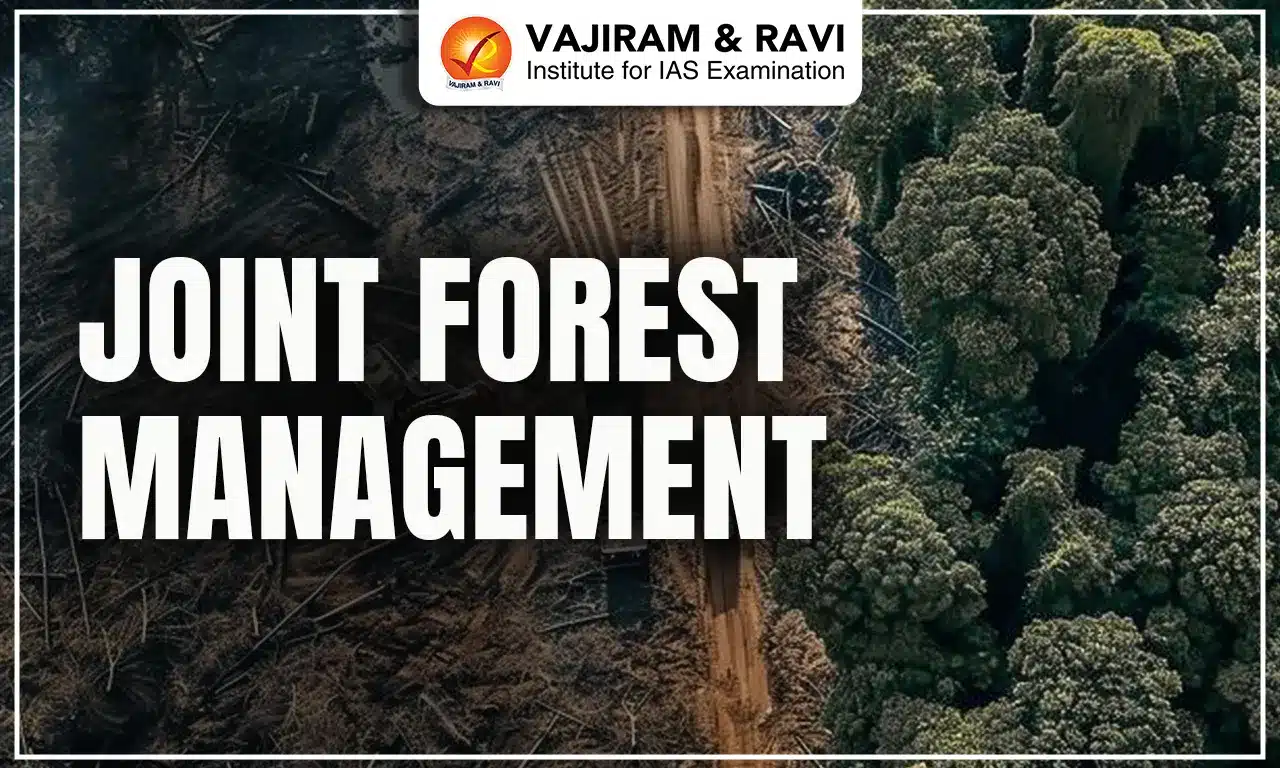
The Joint Forest Management (JFM) initiative marks a paradigm shift in India’s forest governance, moving from a purely state-controlled model to one that actively involves local communities. Introduced in the 1990s, JFM was designed to recognize the vital role that forest-dependent communities play in protecting and regenerating forests.
The program is built on the principle of partnership, where responsibilities and benefits of forest conservation are shared between the government and village-level institutions. Over the years, JFM has not only improved forest cover but has also contributed to livelihood generation, biodiversity conservation, and participatory decision-making in forest management.
Joint Forest Management
Joint Forest Management (JFM) in India is built on the principle that forests thrive when local communities become active partners in their care. It arose as a response to growing forest degradation and the realization that state-centric management alone was not enough for long-term conservation. Rooted in the National Forest Policy of 1988, JFM encourages cooperation between state forest departments and forest-dependent communities by ensuring shared responsibilities, costs, and benefits.
Unlike earlier revenue-based entitlements, this model grants communities a clear share in both the final harvest and intermediate forest products, creating stronger incentives for protection. At the ground level, village-based Joint Forest Management Committees (JFMCs) serve as the backbone of this initiative, driving collective decision-making and sustainable use of forest resources.
Joint Forest Management Committee
- The Joint Forest Management Committee (JFMC) serves as a democratic institution at the village level, where the Forest Department and village communities work together as partners.
- The General Body of the Committee includes all willing adult members of the village and is chaired by a President, elected through majority consensus. For day-to-day operations, the Committee elects an Executive Body, with the President of the General Body also acting as the President of the EB.
- To ensure inclusive participation, policy guidelines mandate representation of women and marginalized sections of society. JFMCs are known by different names across states, such as Forest Protection Committee (FPC), Village Forest Committee (VFC), and Van Sanrakshan Samiti (VSS).
- A key function of the JFMC is the preparation of a Micro Plan. This document includes baseline information about the village and outlines activities proposed for the next five to ten years, based on local community needs and priorities.
- The activities undertaken by the Committee range from forest conservation, afforestation, and nursery raising to soil and moisture conservation, awareness generation, entry point development activities, livelihood enhancement, and overall forest management.
- Through these initiatives, JFMCs act as vital institutions linking ecological protection with community welfare.


Joint Forest Management Committee Benefits
- Economic Benefits
- Provides access to fuelwood, timber, and non-timber forest produce (NTFPs) that support marginalized communities.
- Acts as a substitute income source for farmers during times of agricultural distress.
- Enhances employment opportunities through wage work, creation of assets, and alternative livelihood options.
- Ecological Benefits
- Contributes to ecological restoration by increasing forest cover.
- Improves the soil moisture regime, safeguards crops in adjoining farms, and reduces soil erosion.
- Helps balance the trade-off between development and conservation of forests.
- Livelihood Security
- Promotes Self Help Groups (SHGs), enabling communities to harness their skills and resources effectively.
- Encourages income-generating activities like leaf plate making, silkworm rearing, bamboo crafts, honey collection and processing, vermicomposting, and eco-tourism.
- Social Empowerment
- Facilitates greater participation of women in the workforce, leading to more equitable growth.
- Strengthens community ownership, ensuring that forest conservation and development go hand in hand.
Joint Forest Management Committee Challenges
- Weak Gram Panchayats: Many Gram Panchayats lack adequate capacity and resources to effectively coordinate, monitor, and manage JFM activities. This often limits their role in ensuring accountability and smooth functioning.
- Benefit Sharing Issues: Disputes over the equitable distribution of benefits remain a persistent challenge. In several cases, marginalized groups or women are excluded from fair access to forest produce and revenue sharing.
- Lack of Technical Expertise: Local communities usually do not possess the scientific and technical knowledge needed for sustainable forest management, which makes them dependent on external agencies for planning and implementation.
- External Pressures: Illegal activities like encroachment, timber smuggling, and deforestation continue to threaten the success of JFM. Such pressures reduce community motivation and undermine conservation efforts.
| Also Check Other Posts | |
| Coastal Regulation Zone | Global Plastic Treaty |
| Nitrogen Cycle | Carbon Cycle |

 Last updated on Sep, 2026
→ UPSC 2027 Notification will be released on 13 January 2027 at upsconline.nic.in.
→ Asian Games 2026 are being held in Aichi-Nagoya, Japan, from 19 September to 4 October.
→ Check out the latest UPSC Syllabus here.
→ Download UPSC Model Answers for Mains 2026
→ UPSC Mains Question Paper 2026 is out now for Essay & GS Paper 1, 2, 3 & 4.
→ UPSC Calendar 2027 has been released.
→ Enroll in Vajiram & Ravi’s UPSC Mains Test Series 2027 for structured answer writing practice, expert evaluation, and exam-oriented feedback.
→ Join Vajiram & Ravi’s UPSC Mentorship Program 2027 for personalized guidance, strategy planning, and one-to-one support from experienced mentors.
→ Go through the UPSC Mains Previous Year Papers to enhance your preparation.
→ UPSC has released UPSC Toppers List 2025 with the Civil Services final result on its official website.
→ Also check Best UPSC Coaching in India
Joint Forest Management Committee FAQs
Q1. Who are the members of the Joint Forest Management Committee (JFMC)?+
Q2. What is a Joint Forest Management program?+
Q3. Who launched the Joint Forest Management?+
Q4. Which state first passed JFM?+
Q5. Who can become a member of JFMC?+
Tags: joint forest management