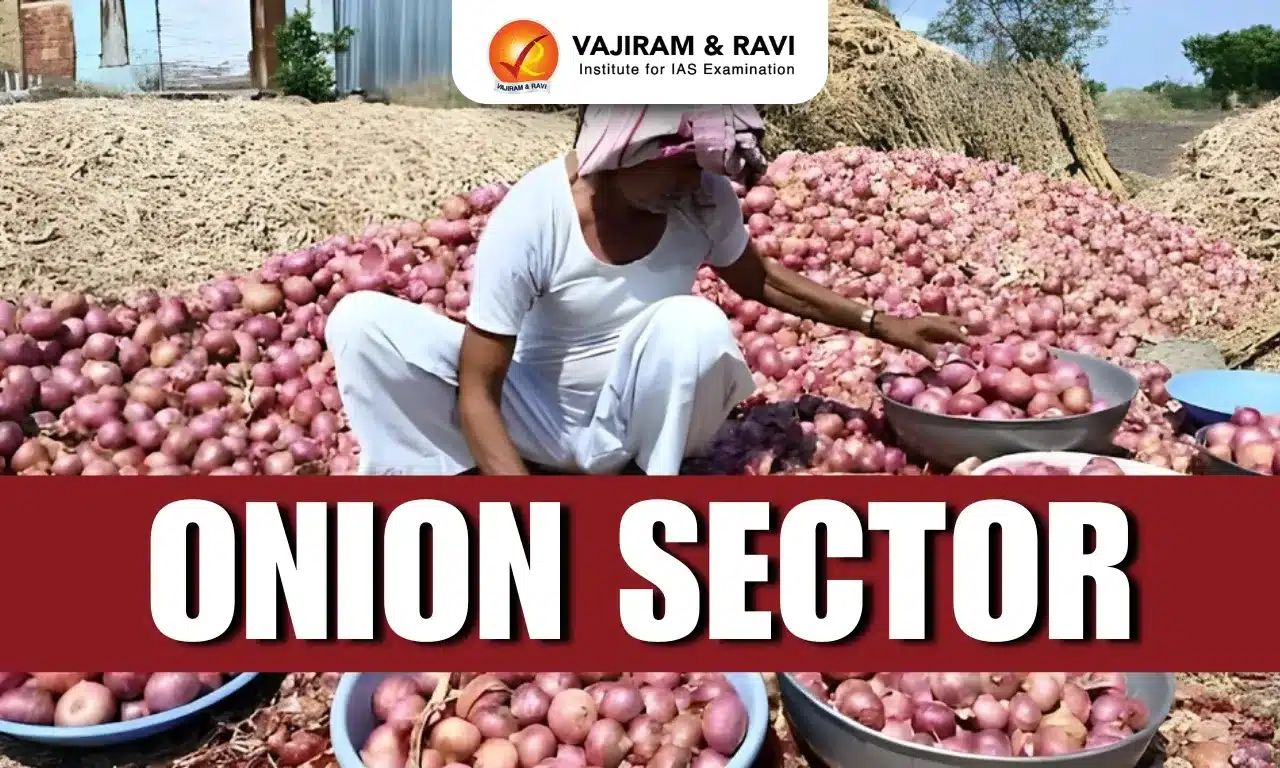
Onion Sector Latest News
- Maharashtra’s onion farmers are protesting after prices crashed below production costs, demanding compensation, stable export policies, and procurement support.
Onion Production in India
- India is the world’s second-largest producer of onions, after China, with annual production averaging 25–30 million tonnes.
- Maharashtra, Madhya Pradesh, Karnataka, Gujarat, and Rajasthan are the leading producers.
- The country grows three onion crops, Kharif, Late Kharif, and Rabi, with Rabi onions having higher storage potential and accounting for nearly 60% of annual output.
- Maharashtra dominates production due to a favourable climate and large-scale cultivation in districts like Nashik, Ahmednagar, Pune, and Solapur. However, despite its massive output, the sector faces persistent problems.


Challenges Faced by the Onion Sector
- Price volatility: Onions often witness extreme price fluctuations due to excess production, poor storage, and sudden export restrictions.
- Storage losses: A significant portion of Rabi onions deteriorates due to poor storage infrastructure, leading to wastage and distress sales.
- Export policy flip-flops: Frequent bans and restrictions undermine India’s credibility in global onion markets, leading to competitors like China and Pakistan capturing India’s lost share.
- High production costs: Fertilisers, seeds, storage, and labour raise production costs to Rs. 2,200-Rs. 2,500 per quintal, but farmers often receive far less in the market.
News Summary
- Farmers in Maharashtra began agitating on September 12, 2025, after onion prices fell sharply.
- Currently, they are receiving only Rs. 800-Rs. 1,000 per quintal, less than half the cost of production.
- The crisis worsened because Rabi onions stored in anticipation of higher prices began deteriorating, forcing distress sales.
- Adding to the distress, the government released buffer stocks into the market through the National Cooperative Consumers’ Federation (NCCF) and National Agricultural Cooperative Marketing Federation of India (NAFED).
- While the buffer stock policy aims to stabilise consumer prices, it further dragged down wholesale rates, aggravating farmers’ losses.
- Farmers’ Demands
- A compensation of Rs. 1,500 per quintal for the losses.
- Immediate halt to the sale of NCCF and NAFED buffer stocks in cities.
- A uniform and stable export policy to restore trust among importing nations.
- Discussions with key buyers like Bangladesh and Sri Lanka, which were once major markets for Indian onions.
- Impact of Export Policy
- India exported 25.25 lakh tonnes of onions in 2022–23, but exports fell drastically to 11.47 lakh tonnes in 2024–25.
- This sharp fall eroded India’s competitiveness, with buyers shifting to China and Pakistan.
- Experts argue that inconsistent export policies have damaged India’s reputation in global markets.
- Alternative Solutions Suggested
- Farmers and exporters have urged the government to incentivise exports to regain India’s lost market share.
- Replicating Andhra Pradesh’s procurement model, where onions are purchased at Rs. 1,200 per quintal, is being suggested for Maharashtra to ensure a minimum support price.
- Long-term measures such as cold storage expansion and farmer-producer organisations (FPOs) for collective bargaining have been emphasised.
Conclusion
- The onion crisis in Maharashtra reflects the deep-rooted systemic flaws in India’s agricultural pricing and export policies.
- While buffer stock release and price stabilisation policies aim to protect consumers, they often end up hurting farmers.
- The current protests underline the urgent need for structural reforms, from stable export strategies to better procurement models and infrastructure upgrades.
- Without these, India’s onion farmers will remain at the mercy of volatile markets, recurring protests, and policy inconsistencies.
Source: TH

 Last updated on Sep, 2026
→ UPSC 2027 Notification will be released on 13 January 2027 at upsconline.nic.in.
→ Asian Games 2026 are being held in Aichi-Nagoya, Japan, from 19 September to 4 October.
→ Check out the latest UPSC Syllabus here.
→ Download UPSC Model Answers for Mains 2026
→ UPSC Mains Question Paper 2026 is out now for Essay & GS Paper 1, 2, 3 & 4.
→ UPSC Calendar 2027 has been released.
→ Enroll in Vajiram & Ravi’s UPSC Mains Test Series 2027 for structured answer writing practice, expert evaluation, and exam-oriented feedback.
→ Join Vajiram & Ravi’s UPSC Mentorship Program 2027 for personalized guidance, strategy planning, and one-to-one support from experienced mentors.
→ Go through the UPSC Mains Previous Year Papers to enhance your preparation.
→ UPSC has released UPSC Toppers List 2025 with the Civil Services final result on its official website.
→ Also check Best UPSC Coaching in India
Onion Sector FAQs
Q1. Why are onion farmers in Maharashtra protesting?+
Q2. What price are farmers demanding as compensation?+
Q3. How is the buffer stock policy affecting onion farmers?+
Q4. Why have India’s onion exports declined sharply?+
Q5. What solution is suggested as a model for Maharashtra?+
Tags: mains articles onion sector upsc current affairs upsc mains current affiars