Isobutanol-Diesel Blending Latest News
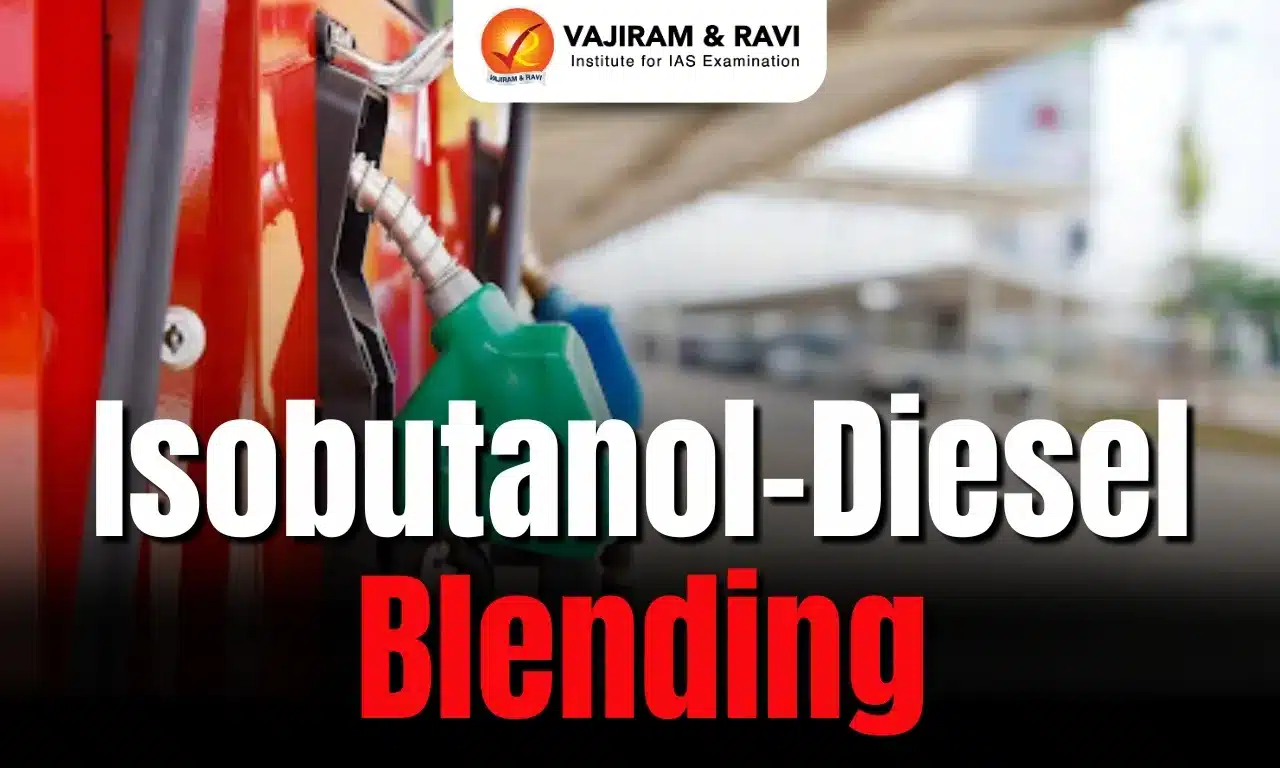
- India is exploring isobutanol-diesel blending as an alternative to ethanol, with a pilot project underway to assess its technical and economic feasibility.
Introduction
- India is pushing forward in its biofuel journey, experimenting with new alternatives to conventional fossil fuels to meet its energy and climate goals.
- After ethanol blending with diesel proved technically unsuitable, the government and the Automotive Research Association of India (ARAI) have turned their attention to isobutanol, an alcohol-based compound with promising blending properties.
- Transport Minister Nitin Gadkari recently announced that India is working on pilot projects to evaluate the feasibility of isobutanol-diesel blending, which, if successful, could make India the first country to achieve this breakthrough.


Understanding Isobutanol and Its Properties
- Isobutanol is a four-carbon alcohol widely used as a solvent in industries such as paints and chemicals. Its key attributes include:
- Higher Flash Point: Less volatile and safer than ethanol, lowering fire risks.
- Better Miscibility with Diesel: Compared with ethanol, isobutanol blends more effectively with diesel without requiring extensive chemical modifications.
- Versatile Feedstock: Like ethanol, it can be produced from sugarcane syrup, molasses, and grains through microbial fermentation.
- These properties make it technically more compatible with diesel engines than ethanol.
Why Ethanol Blending Failed with Diesel
- Ethanol has been a cornerstone of India’s biofuel policy, especially in petrol blending, where the country has achieved 12% ethanol blending in 2023-24.
- However, blending ethanol with diesel faced hurdles:
- Low Flash Point: Increased volatility and fire risk.
- Poor Compatibility: Required chemical additives to stabilise the blend.
- Engine Concerns: Blending caused ignition and combustion irregularities in diesel engines.
- Thus, isobutanol emerged as a promising alternative for diesel blending.
Production and Economic Viability of Isobutanol
- Isobutanol production follows a fermentation process similar to ethanol, but with specially engineered microbes that convert natural sugars into isobutanol.
- According to the Indian Sugar Mills Association (ISMA):
- A sugar refinery with 150 kilo litres per day (klpd) capacity can produce 125 klpd ethanol and 20 klpd isobutanol with minor infrastructure modifications.
- The use of surplus sugarcane and molasses, already abundant in India, provides a steady raw material supply.
- However, the imbalance between rising cane prices and stagnant ethanol procurement prices poses an economic challenge that could extend to isobutanol production.
Technical and Performance Challenges
- While isobutanol blends better with diesel than ethanol, experts highlight several technical considerations:
- Cetane Number:
- Isobutanol has a lower cetane number than diesel, which may reduce combustion efficiency.
- This could cause engine knock, reduced power, and long-term damage.
- Additives Requirement:
- Cetane improvers would be needed, increasing costs.
- Blending beyond 10% isobutanol is not advisable due to performance risks.
- Emission Reduction Potential:
- If optimised, the blend can reduce harmful emissions and support the import substitution of fossil fuels.
Pilot Project and Global Context
- ARAI has initiated a pilot project, expected to take about 18 months, to study the impact of isobutanol-diesel blending across different vehicle classes.
- If India succeeds, it will become the first nation to commercialise this blend.
- Globally, biofuel innovation has largely focused on ethanol, biodiesel, and advanced biofuels.
- India’s foray into isobutanol represents an effort to diversify its biofuel basket while reducing dependence on imported crude oil.
Source: TH

 Last updated on Sep, 2026
→ UPSC 2027 Notification will be released on 13 January 2027 at upsconline.nic.in.
→ Asian Games 2026 are being held in Aichi-Nagoya, Japan, from 19 September to 4 October.
→ Check out the latest UPSC Syllabus here.
→ Download UPSC Model Answers for Mains 2026
→ UPSC Mains Question Paper 2026 is out now for Essay & GS Paper 1, 2, 3 & 4.
→ UPSC Calendar 2027 has been released.
→ Enroll in Vajiram & Ravi’s UPSC Mains Test Series 2027 for structured answer writing practice, expert evaluation, and exam-oriented feedback.
→ Join Vajiram & Ravi’s UPSC Mentorship Program 2027 for personalized guidance, strategy planning, and one-to-one support from experienced mentors.
→ Go through the UPSC Mains Previous Year Papers to enhance your preparation.
→ UPSC has released UPSC Toppers List 2025 with the Civil Services final result on its official website.
→ Also check Best UPSC Coaching in India
Isobutanol-Diesel Blending FAQs
Q1. Why is India exploring isobutanol-diesel blending?+
Q2. What are the advantages of isobutanol over ethanol?+
Q3. How is isobutanol produced?+
Q4. What challenges does isobutanol-diesel blending face?+
Q5. When will the pilot project on isobutanol blending be completed?+
Tags: isobutanol-diesel blending mains articles upsc current affairs upsc mains current affairs