River Pollution Latest News
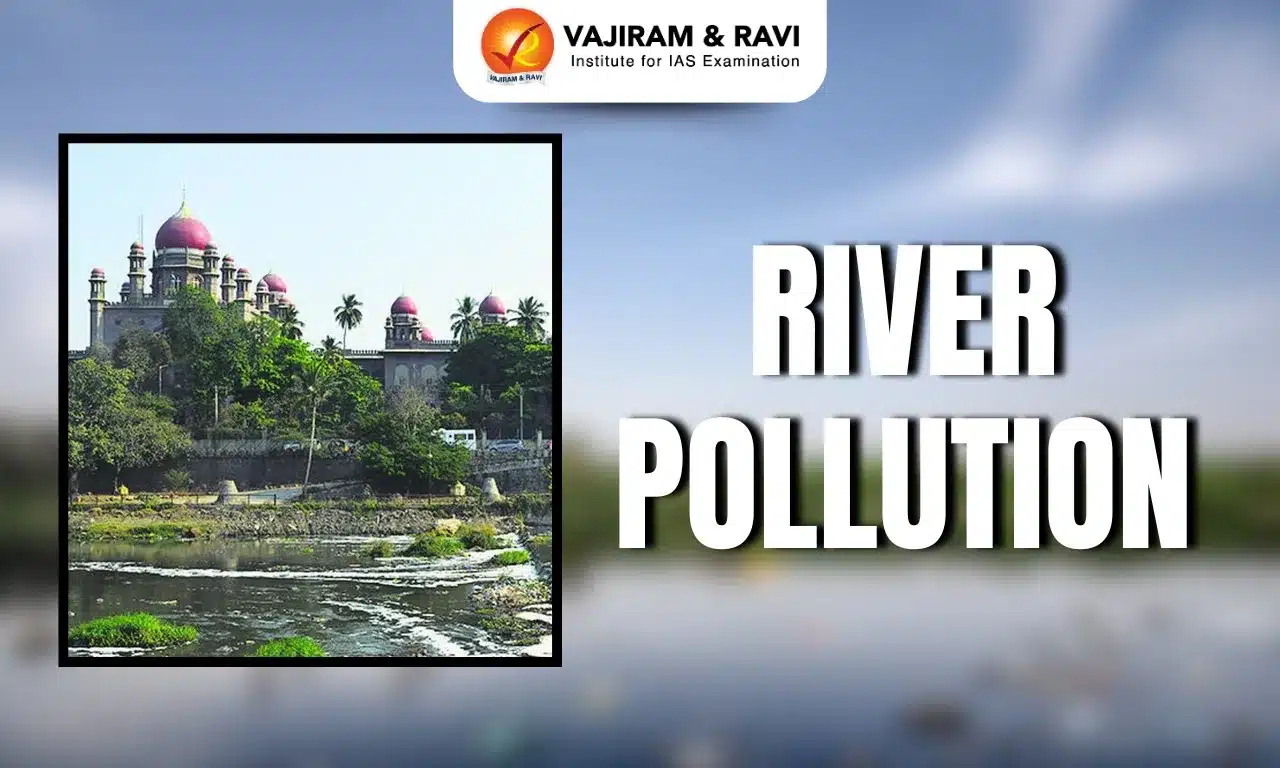
- The CPCB’s latest report shows a marginal reduction in polluted river stretches across India, though several rivers, especially in Maharashtra, remain critically contaminated.
Introduction
- Rivers are the lifelines of India, sustaining agriculture, industry, and millions of people.
- However, unchecked urbanisation, untreated sewage, and industrial effluents have turned several rivers into highly polluted water bodies.
- The Central Pollution Control Board (CPCB) regularly monitors river health, measuring biological oxygen demand (BOD) levels to identify polluted stretches.
- BOD measures the oxygen consumed by microorganisms to decompose organic matter in water, serving as a key indicator of organic pollution in aquatic ecosystems.
- Its latest report indicates a marginal reduction in the number of polluted river stretches across India, though concerns remain about severely contaminated segments.


River Pollution in India
- River pollution in India has been a persistent challenge, with most urban centres discharging untreated sewage directly into rivers.
- Industrial units, despite regulations, contribute chemical pollutants, while agricultural runoff adds pesticides and fertilisers.
- According to CPCB, a polluted river stretch is defined as two or more consecutive locations on a river where BOD levels exceed 3 mg/L, rendering water unfit for bathing.
- Major Causes
- Untreated sewage – Cities generate over 72,000 MLD of sewage, of which only about 30% is treated.
- Industrial effluents – Chemical and textile hubs like Gujarat, Maharashtra, and Tamil Nadu release toxic waste.
- Agricultural runoff – Fertilisers and pesticides flow into rivers during monsoons.
- Encroachments and sand mining – These degrade river ecosystems and floodplains.
- Impact
- Decline in aquatic biodiversity.
- Unsafe drinking and bathing water, leading to waterborne diseases.
- Economic loss to fisheries and agriculture.
- Social unrest, as seen in protests around rivers like the Yamuna and Ganga.
- The Ganga, Yamuna, Sabarmati, Godavari, and Musi are among India’s most polluted rivers, with stretches frequently falling into the CPCB’s “Priority I” category, meaning they require immediate remediation.
News Summary: CPCB’s Latest Findings
- Marginal Improvement
- According to CPCB’s 2023 report, the number of polluted river stretches decreased from 311 to 296, covering 271 rivers across 32 states and Union Territories.
- Most Affected States
- Maharashtra continues to top the list with 54 polluted stretches.
- Kerala (31), Madhya Pradesh and Manipur (18 each), and Karnataka (14) also reported significant pollution.
- Priority Classifications
- Priority I (BOD > 30 mg/L) – 37 stretches, down from 46 in 2022. These include the Yamuna in Delhi, the Sabarmati in Ahmedabad, the Chambal in Madhya Pradesh, and stretches of the Tungabhadra and Sarabanga.
- Priority V (BOD 3.1–6 mg/L) – Indicating less polluted stretches needing minimal intervention.
- Rivers Showing Deterioration
- Despite marginal progress overall, certain rivers recorded worsening conditions.
- These include Jhelum (J&K), Ganga and Sikrahna (Bihar), Hasdeo and Mahanadi (Chhattisgarh), Cauvery and Tungabhadra (Karnataka), Periyar (Kerala), and Krishna (Telangana).
- Long-Term Monitoring
- CPCB, in collaboration with State Pollution Control Boards, monitors water quality at over 4,700 locations under the National Water Quality Monitoring Programme.
- Institutional Interventions
- Following a 2018 directive by the National Green Tribunal (NGT), states are mandated to prepare river rejuvenation action plans.
- The current CPCB report emphasises catchment management, sewage treatment, and floodplain protection as critical measures for reducing river pollution.
Challenges in River Rejuvenation
- Infrastructure gaps – Sewage treatment plants (STPs) are under-capacity or non-functional in many cities.
- Coordination failures – Overlapping jurisdictions between CPCB, State Boards, and local authorities hinder accountability.
- Funding and monitoring – Many state-level action plans lack financial backing and robust evaluation.
- Urbanisation pressures – Continuous encroachments and waste generation outpace clean-up efforts.
Future Outlook
- While the marginal reduction in polluted stretches offers cautious optimism, India’s river rejuvenation efforts must scale up significantly.
- Initiatives like the Namami Gange Mission, Jal Jeevan Mission, and the push for decentralised sewage treatment are steps in the right direction.
- However, tackling agricultural runoff, enforcing industrial compliance, and engaging communities will be crucial for sustainable outcomes.

 Last updated on Oct, 2026
→ UPSC 2027 Notification will be released on 13 January 2027 at upsconline.nic.in.
→ Check Nobel Prize 2026 Winners List here.
→ Download PIB PRiSM Monthly Magazine 2026 here.
→ Check UPSC Monthly Current Affairs Magazine The Recitals here.
→ Check out the latest UPSC Syllabus here.
→ Download UPSC Model Answers for Mains 2026
→ UPSC Mains Question Paper 2026 is out now for Essay & GS Paper 1, 2, 3 & 4.
→ UPSC Calendar 2027 has been released.
→ Enroll in Vajiram & Ravi’s UPSC Mains Test Series 2027 for structured answer writing practice, expert evaluation, and exam-oriented feedback.
→ Join Vajiram & Ravi’s UPSC Mentorship Program 2027 for personalized guidance, strategy planning, and one-to-one support from experienced mentors.
→ Go through the UPSC Mains Previous Year Papers to enhance your preparation.
→ UPSC has released UPSC Toppers List 2025 with the Civil Services final result on its official website.
→ Also check Best UPSC Coaching in India
River Pollution FAQs
Q1. What is a polluted river stretch according to CPCB?+
Q2. How many polluted river stretches were identified in CPCB’s latest report?+
Q3. Which state has the highest number of polluted river stretches?+
Q4. What does the Priority I category mean in CPCB’s classification?+
Q5. What measures has the CPCB recommended to address river pollution?+
Tags: mains articles river pollution upsc current affairs upsc mains current affairs