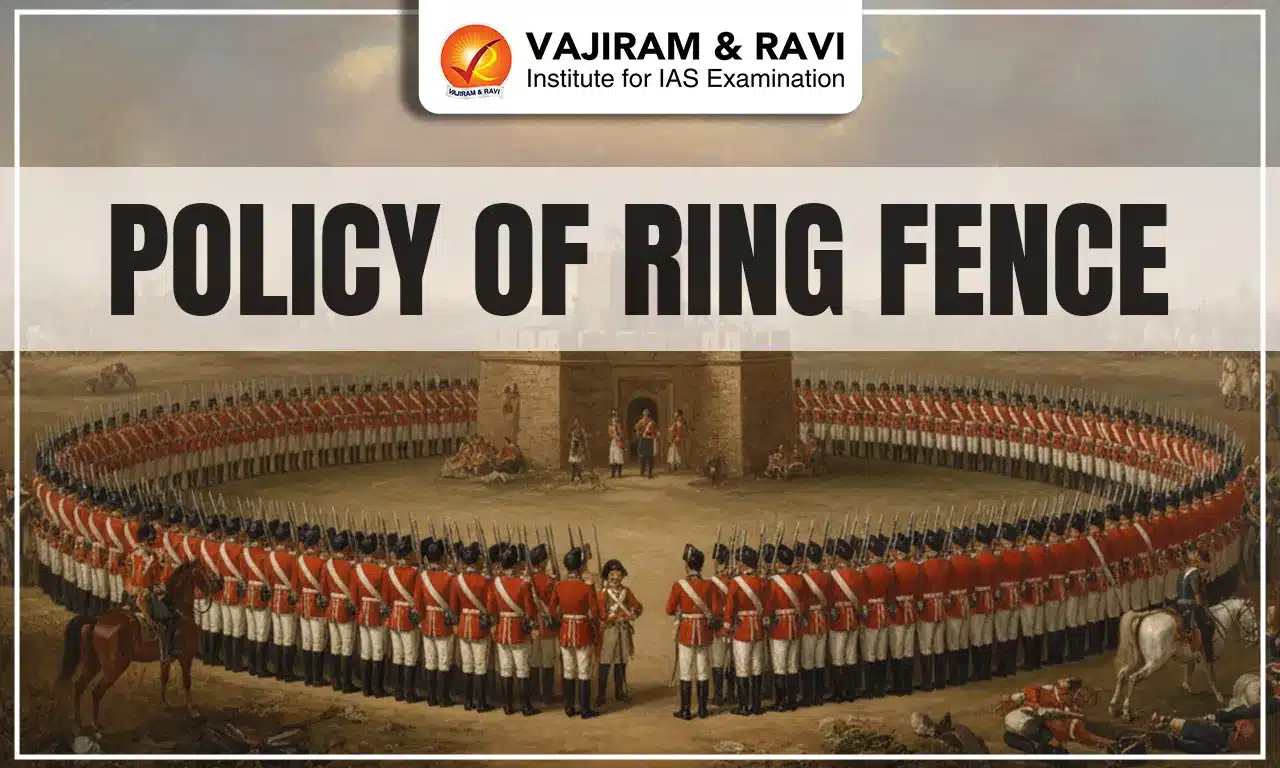
Warren Hastings, the first Governor-General of Bengal, introduced the Policy of Ring of Fence between 1765 and 1813 to secure the British East India Company’s frontiers. The strategy involved creating buffer zones of allied or subordinate states around British territories. These states were required to maintain subsidiary armies under Company officers, ensuring both their protection and the security of British interests. Policy of Ring Fence reflected the British focus on strategic expediency, balancing alliances and control while steadily advancing their imperial ambitions in India.
Policy of Ring Fence
The Policy of Ring Fence (1765-1813), implemented by Warren Hastings, aimed to protect the Company’s territories by defending the borders of neighboring states and creating buffer zones. Under this policy, the ring-fence states were required to maintain subsidiary forces, which were organized, equipped, and commanded by Company officers, with the rulers of these states covering the expenses. While the British carried out this policy under the guise of protection, they never lost sight of their imperial ambitions, and their interactions with native states were guided by self-interest, which evolved over time.
Policy of Ring Fence History
During this period, the British treated native states as independent entities, as they had not yet established supreme power in India. Consequently, they could not intervene everywhere, nor could they claim full sovereignty over the native rulers who became their allies. Key events of this time included the Anglo-Mysore Wars, the First and Second Maratha Wars, and treaties with Awadh, Hyderabad, and Punjab. The Wellesley Wars, along with subsidiary treaties with various rulers, gradually established the British as the dominant power in India, while their allies became dependent states.
Two points stand out regarding their relationships with native rulers:
- With the exception of the treaty with the Wodeyars of Mysore, all treaties were equal and reciprocal, reflecting a give-and-take approach. The British made no claims to suzerainty while negotiating these agreements.
- Every treaty explicitly ensured that the native ruler retained complete control over the internal affairs of his state.


Policy of Ring Fence Establishment
To safeguard their own territories, Warren Hastings devised the Ring-Fence policy, which involved protecting the borders of neighbouring states. This approach was evident in conflicts with the Kingdom of Mysore and the Marathas. For example, the East India Company took responsibility for organizing Awadh’s defence to ensure Bengal’s security, as threats from the Marathas and Afghan invaders were significant.
The rulers of these kingdoms bore the cost of maintaining the troops that the Company dispatched to strengthen their fortifications. In effect, the East India Company became essential to the local ruler’s defence. During the Ring-Fence era, the British did not consider native rulers as having suzerainty over them; they treated these states as independent nations, free to manage their internal affairs. The exception was the Hindu ruler of Mysore, with whom treaties were negotiated on an equal footing.
Later, Wellesley expanded this framework through the subsidiary alliance system. Powerful states such as the Marathas, Awadh, and Hyderabad accepted subsidiary partnerships, further entrenching British dominance in India.
| Also Check Other Posts | |
| British Policies in India from 1765 to 1857 | Economic Policies of British in India |
| Drain of Wealth Theory | Land Revenue System in British India |

 Last updated on Sep, 2026
→ UPSC 2027 Notification will be released on 13 January 2027 at upsconline.nic.in.
→ Asian Games 2026 are being held in Aichi-Nagoya, Japan, from 19 September to 4 October.
→ Check out the latest UPSC Syllabus here.
→ Download UPSC Model Answers for Mains 2026
→ UPSC Mains Question Paper 2026 is out now for Essay & GS Paper 1, 2, 3 & 4.
→ UPSC Calendar 2027 has been released.
→ Enroll in Vajiram & Ravi’s UPSC Mains Test Series 2027 for structured answer writing practice, expert evaluation, and exam-oriented feedback.
→ Join Vajiram & Ravi’s UPSC Mentorship Program 2027 for personalized guidance, strategy planning, and one-to-one support from experienced mentors.
→ Go through the UPSC Mains Previous Year Papers to enhance your preparation.
→ UPSC has released UPSC Toppers List 2025 with the Civil Services final result on its official website.
→ Also check Best UPSC Coaching in India
Policy of Ring Fence FAQs
Q1. What is the ring-fence policy?+
Q2. What are the rules for ring-fencing?+
Q3. What is ring-fencing in insurance?+
Q4. Who was the governor of the ring-fence policy?+
Q5. What is the ring-fencing rule?+
Tags: policy of ring fence