Personality Rights in India Latest News
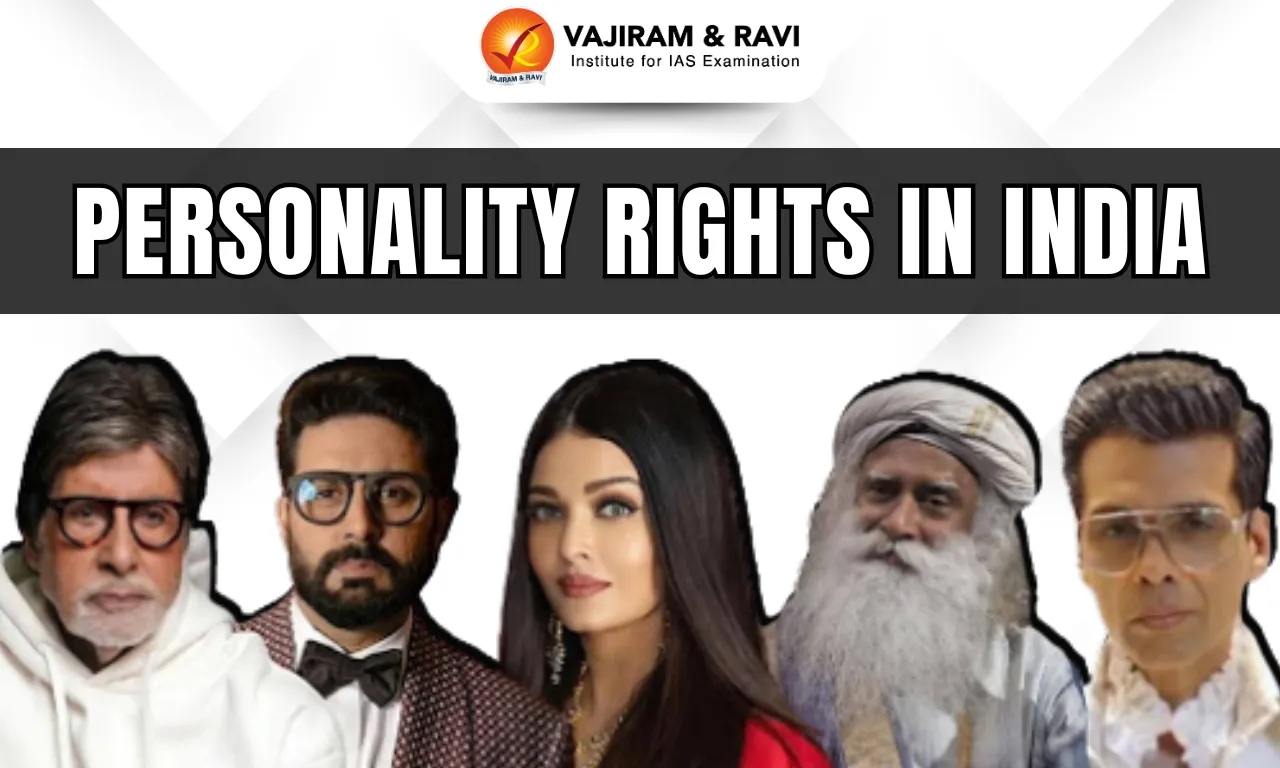
- The Delhi High Court has recently expanded protection of personality rights for Bollywood stars against unauthorised use of their images, voices, and likeness.
- The court granted relief to Aishwarya Rai Bachchan and Abhishek Bachchan, following complaints of AI-generated misuse.
- Earlier, Amitabh Bachchan, Anil Kapoor, and Jackie Shroff had secured such safeguards.
- This growing series of petitions marks a significant judicial shift in recognising and enforcing personality rights in India’s digital era.
Protection of Personality Rights in India
- Personality rights protect an individual’s name, likeness, image, voice, signature, and other unique traits from unauthorised commercial use.
- Though not codified under a single statute, they are safeguarded through judicial precedents and common law doctrines of privacy, defamation, and publicity rights.
- Courts can grant injunctions, damages, or takedown orders to prevent misuse in ads, merchandise, AI-generated content, or digital platforms.
Statutory Safeguards
- Protection is dispersed across intellectual property laws.
- Under the Copyright Act, 1957, performers enjoy exclusive rights (Section 38A) and moral rights (Section 38B) to control reproduction and object to distortion of their work.
- The Trade Marks Act, 1999 allows celebrities to register names, signatures, or catchphrases as trademarks — a step taken by actors like Shah Rukh Khan, Priyanka Chopra, Ajay Devgn, and Amitabh Bachchan.
- Additionally, the common law tort of “passing off” (Section 27) safeguards goodwill from misrepresentation or false endorsement, though it requires proof of reputation before courts grant relief.
Constitutional Backing
- Personality rights are rooted in Article 21 of the Constitution, which guarantees autonomy and privacy.
- While celebrities may authorise the use of their identity in films, ads, or campaigns, unauthorised use — such as printing images on merchandise or creating AI deepfakes — strips them of control and compromises dignity and agency.


Court Rulings on Personality Rights in India
- The jurisprudence on personality rights in India began with the 1994 Supreme Court judgment in R. Rajagopal v. State of Tamil Nadu.
- The Court upheld an individual’s right to control their identity, grounding it in the constitutional right to privacy.
- In 2015, the Madras High Court strengthened the doctrine in a case involving actor Rajinikanth.
- It ruled that infringement occurs even without proof of falsity, confusion, or deception if the celebrity is identifiable, thereby protecting him against unauthorised commercial use of his name, image, and style.
- The Delhi High Court has since played a pivotal role in addressing new threats posed by AI.
- In 2023, it granted Anil Kapoor broad protection over his persona, barring online misuse of his name, likeness, and catchphrase “jhakaas.”
- HC clarified that free speech allows parody and criticism but not commercial exploitation or tarnishment of reputation.
- In 2024, the same court protected Jackie Shroff’s personality rights against misuse by e-commerce platforms and AI chatbots.
- Later, in 2023, the Bombay High Court upheld Arijit Singh’s rights in a landmark ruling against AI voice cloning.
- The court condemned the unauthorised creation of artificial recordings, warning of the dangers generative AI poses to performers’ dignity and control over their identity.
Balancing Personality Rights and Free Expression
- While courts in India have expanded protection of personality rights, they have also emphasised the need to balance them with Article 19(1)(a).
- Article 19 guarantees freedom of speech, including criticism, parody, and satire of public figures.
- In DM Entertainment Pvt. Ltd. v. Baby Gift House (2010), the Delhi High Court granted relief against unauthorised commercial exploitation of singer Daler Mehndi’s likeness.
- However, it cautioned that parodies, caricatures, and lampooning would not ordinarily violate publicity rights.
- This balance was reaffirmed in Digital Collectibles PTE Ltd. v. Galactus Funware Technology Pvt. Ltd. (2023), involving the unauthorised use of sports stars’ likenesses.
- The Court ruled that publicity rights cannot override free expression, especially when material is already in the public domain.
- It clarified that legitimate uses of celebrity names or images — such as satire, art, scholarship, news, and music — fall under free speech and do not amount to infringement.
Concerns Around Personality Rights in India
- Experts highlight the urgent need for a comprehensive legislative framework to regulate personality rights, as current enforcement relies heavily on fragmented judicial precedents.
- Without a clear regulatory regime, responses remain ad hoc and risk blurring the line between artistic freedom and infringement.
- Clear exceptions must be established to prevent misuse of personality rights as a tool for censorship.
- Experts also stress that personality rights are not exclusive to celebrities.
- Ordinary citizens, particularly women, face disproportionate harm through deepfakes, impersonation, and revenge pornography.
- While courts often direct governments to block such harmful content, the sheer volume of violations makes consistent enforcement extremely difficult.

 Last updated on Sep, 2026
→ UPSC 2027 Notification will be released on 13 January 2027 at upsconline.nic.in.
→ Check out the latest UPSC Syllabus here.
→ Download UPSC Model Answers for Mains 2026
→ UPSC Mains Question Paper 2026 is out now for Essay & GS Paper 1, 2, 3 & 4.
→ UPSC Calendar 2027 has been released.
→ Enroll in Vajiram & Ravi’s UPSC Mains Test Series 2027 for structured answer writing practice, expert evaluation, and exam-oriented feedback.
→ Join Vajiram & Ravi’s UPSC Mentorship Program 2027 for personalized guidance, strategy planning, and one-to-one support from experienced mentors.
→ Go through the UPSC Mains Previous Year Papers to enhance your preparation.
→ UPSC has released UPSC Toppers List 2025 with the Civil Services final result on its official website.
→ Also check Best UPSC Coaching in India
Personality Rights in India FAQs
Q1. What are personality rights in India?+
Q2. Which Indian laws support personality rights?+
Q3. How have Indian courts ruled on personality rights?+
Q4. Do personality rights conflict with free expression?+
Q5. Why is a legal framework for personality rights needed?+
Tags: mains articles personality rights in India upsc current affairs upsc mains current affairs