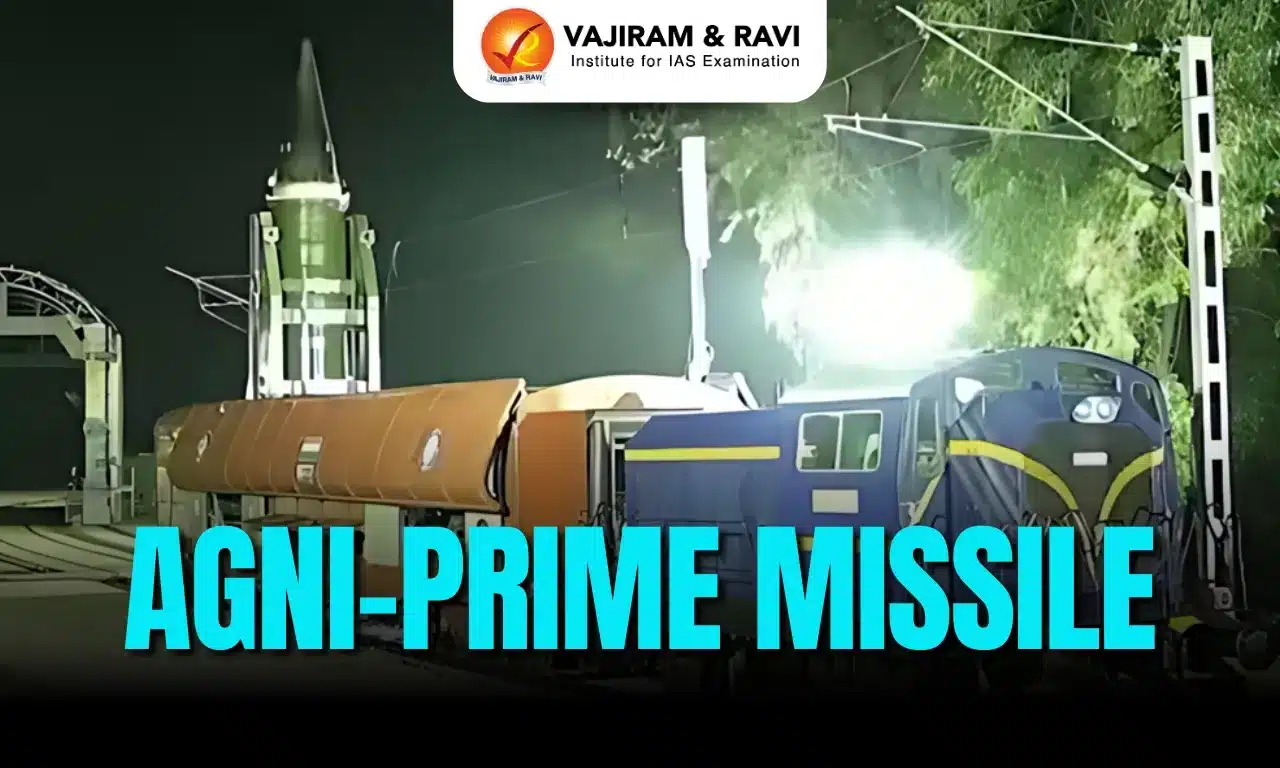
Agni-Prime Missile Latest News
- The Defence Research and Development Organisation (DRDO) successfully test-fired the Agni-Prime (Agni-P) missile from a rail-based mobile launcher.
- This launch has placed India among a select group of nations — Russia, the US, China, and possibly North Korea — with the capability to launch long-range ballistic missiles from railway platforms using canisterised launch systems.
Agni Series of Missiles
- The Agni series is India’s family of nuclear-capable ballistic missiles, developed under the Integrated Guided Missile Development Programme (IGMDP) by the Defence Research and Development Organisation (DRDO).
- They are a key element of India’s strategic deterrence capability.
- Agni-I (1989): A medium-range ballistic missile (MRBM) with a range of 700–1,000 km. It was India’s first in the series and is road- and rail-mobile.
- Agni-II (1999): A two-stage solid-fuel missile with a range of 2,000–3,000 km, capable of carrying nuclear warheads.
- Agni-III (2006): An intermediate-range ballistic missile (IRBM) with a range of 3,500–5,000 km, providing wider regional coverage.
- Agni-IV (2011): Improved navigation and accuracy, range of 3,500–4,000 km, lighter and more advanced than Agni-III.
- Agni-V (2012): An intercontinental ballistic missile (ICBM) with a range of 5,000–8,000 km, extending India’s deterrence to cover much of Asia and parts of Europe and Africa.
- Agni-P (Agni-Prime, 2021): A next-generation variant with a range of 1,000–2,000 km, combining advanced technologies from Agni-IV and V, lighter, more accurate, and canisterised.
- Agni-VI (under development): Expected range of 8,000–10,000 km, with potential multiple independently targetable re-entry vehicle (MIRV) capability.


Agni-P: The Next-Generation Upgrade to Agni-I
- India’s Agni missile series, developed since the late 1980s, began with the Agni-I medium range ballistic missile (700–1,000 km range) tested in 1989.
- While Agni-I remains in service, defence planners sought upgrades, leading to the development of Agni-P (Agni-Prime).
- Agni-P combines Agni-I’s range with advanced propulsion and navigation technologies from Agni-IV and Agni-V.
- It is the sixth missile in the Agni series.
- Weighing 11,000 kg, it is a two-stage, solid-fuel missile with an operational range of 1,000–2,000 km, capable of carrying high explosive, thermobaric, or nuclear warheads.
- A nuclear-capable version tested in 2021 drew praise from the then Defence Minister, who said it would further bolster India’s Credible Deterrence capabilities.
Mobile Launch Platforms and India’s Second-Strike Capability
- Mobile launch systems are vital to a nation’s second-strike capability, enabling it to retaliate after a nuclear attack.
- For India, which follows a “no first use” nuclear doctrine, such survivability is critical.
- Advances in satellite imagery, missile accuracy, and sensing technologies have made stationary silos increasingly vulnerable.
- As noted by defence experts, silos face heightened risks from both conventional and nuclear strikes.
- To counter this, militaries rely on mobile launch platforms — submarines, aircraft, and road or rail-based launchers — which are harder to detect and more resilient in an all-out conflict.
Advantages of Rail-Based Missile Launchers
- Rail-based missile platforms offer distinct advantages over road or sea systems.
- While road-based launchers are constrained by road width and quality, India’s 70,000-km railway network enables nationwide mobility without major preparation.
- The numerous railway tunnels provide natural hiding spots, allowing launchers to evade enemy satellite surveillance and remain concealed until deployment.
- Compared to submarine-launched ballistic missiles (SLBMs), rail-based platforms are also cheaper to build and maintain, making them a more efficient and scalable option for strengthening strategic deterrence.
Countries with Rail-Based Missile Technology
- India’s recent test places it among a select group of nations with rail-based missile launch capability.
- The idea dates back to the Cold War, when both the US and USSR explored rail-mobile ICBMs.
- The US studied rail launchers for its Minuteman ICBMs in the 1950s and again planned Peacekeeper deployment in the 1980s, but abandoned both due to cost and the Soviet collapse.
- The Soviet Union successfully deployed the RT-23 Molodets rail-based ICBM system, later dismantled under the START Treaty.
- Russia later considered reviving the concept with the Barguzin system but shelved it in favour of hypersonic missile development.
- In 2016, China reportedly tested a rail-mobile version of its DF-41 ICBM.
- North Korea has also tested rail-based short-range ballistic missiles (SRBMs), demonstrating their mobility and survivability.
- Experts note that rail-based missiles are a cheap, reliable option for enhancing nuclear force survivability, with Russia pioneering it, the US considering it, and North Korea actively pursuing it.

 Last updated on Sep, 2026
→ UPSC 2027 Notification will be released on 13 January 2027 at upsconline.nic.in.
→ Asian Games 2026 are being held in Aichi-Nagoya, Japan, from 19 September to 4 October.
→ Check out the latest UPSC Syllabus here.
→ Download UPSC Model Answers for Mains 2026
→ UPSC Mains Question Paper 2026 is out now for Essay & GS Paper 1, 2, 3 & 4.
→ UPSC Calendar 2027 has been released.
→ Enroll in Vajiram & Ravi’s UPSC Mains Test Series 2027 for structured answer writing practice, expert evaluation, and exam-oriented feedback.
→ Join Vajiram & Ravi’s UPSC Mentorship Program 2027 for personalized guidance, strategy planning, and one-to-one support from experienced mentors.
→ Go through the UPSC Mains Previous Year Papers to enhance your preparation.
→ UPSC has released UPSC Toppers List 2025 with the Civil Services final result on its official website.
→ Also check Best UPSC Coaching in India
Agni-Prime Missile FAQs
Q1. What is the Agni-Prime missile?+
Q2. Why is the Agni-Prime test significant?+
Q3. How does a rail-based launcher help India?+
Q4. Which countries have rail-based missile technology?+
Q5. What role does Agni-Prime play in India’s nuclear doctrine?+
Tags: Agni-Prime missile mains articles upsc current affairs upsc mains current affairs