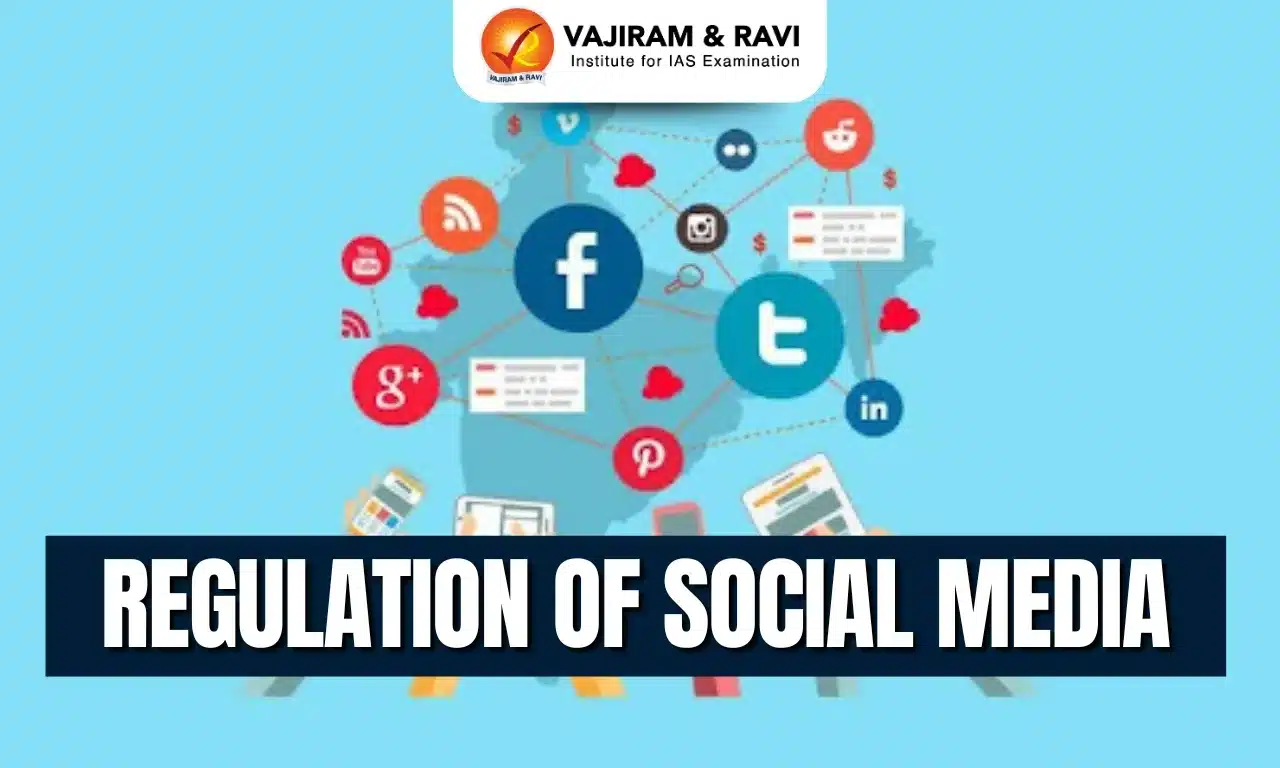
Regulation of Social Media Latest News
- The Karnataka High Court rejected social media platform X’s plea against the Central Government’s Sahyog Portal – a digital mechanism to issue content takedown notices.
- The Court upheld the State’s right to regulate social media, calling Sahyog an “instrument of public good” and a “beacon of cooperation” between citizens, state, and platforms.
- The Court stressed that social media platforms cannot operate in a state of “anarchic freedom.”
Sahyog Portal – A Public Good
- Launched: October 2024 by the Union Home Ministry, and maintained by the Indian Cyber Crime Coordination Centre (I4C).
- Purpose: A centralised channel (which connects central agencies, state police, and online intermediaries to combat cybercrime) for issuing takedown notices to intermediaries.
- Legal basis: Section 79(3)(b), IT Act, 2000 – intermediaries lose “safe harbour protection” if they fail to act upon government notices of unlawful content.
- Operational data:
- 65 intermediaries and nodal officers onboarded by April 2025.
- 130 takedown notices issued (Oct 2024 – Apr 2025) to platforms including Google, YouTube, Amazon, Microsoft.


X Corporation’s Challenge
- Claim: Sahyog is a “censorship portal” creating a parallel, extra-legal content blocking regime.
- Arguments:
- Section 79(3)(b) notices bypass stricter procedural safeguards under Section 69A IT Act. Unlike Section 69A, notices under Section 79(3)(b) lack transparency, hearing, and written reasoning.
- Violates Shreya Singhal (2015) judgment, in which the apex court had specified that a takedown order under Section 79(3)(b) –
- Could only be issued pursuant to a court order or a government notification and
- Must relate to grounds similar to those in Section 69A.
- State governments and police issuing notices via Sahyog expands censorship arbitrarily.
- Support: Supporting X’s challenge, Digipub (collective of 92 digital publishers) argued that blocking orders through Sahyog threatens media freedom.
Government’s Defence
- Necessity: Social media requires stricter regulation due to algorithmic amplification and rapid spread of harmful content.
- ‘Safe harbour’ is not absolute: It is a statutory privilege conditional upon due diligence.
- Separation of powers: Section 79(3)(b) and Section 69A operate independently.
- Section 79(3)(b): Failure to comply results in loss of safe harbour.
- Section 69A: Blocking power on grounds of sovereignty, security, public order.
- Efficiency: Sahyog is an efficient, transparent mechanism to expedite unlawful content removal.
- X Corp – a foreign entity: Hence, it cannot invoke Article 19 rights (available only to Indian citizens).
High Court’s Ruling
- The judgment outlined three red lines for social media companies –
- Social media cannot remain unregulated.
- Companies must comply with the laws of the land.
- Past precedents like Shreya Singhal (2015) cannot be used to interpret new regulatory frameworks under IT Rules 2021.
Key Legal Issues Touched upon by the HC
- Need for regulation:
- The spread of information has always been regulated across civilizations.
- Social media as a “modern amphitheater of ideas” cannot exist in anarchic freedom.
- Regulation is essential, especially for offences against women to safeguard the constitutional right to dignity.
- Regulation of social media is not unique to India, it is a global practice.
- Law of the Land – India is not a playground:
- Platforms cannot operate in India while ignoring its statutory framework.
- Liberty is tied to responsibility and accountability.
- X complies with the Take It Down Act in the US but refuses to follow similar takedown orders in India.
- American legal principles cannot be transplanted into the Indian constitutional framework.
- Shreya Singhal not applicable – New law, new interpretation:
- X argued that the 2015 Shreya Singhal judgment allowed censorship only via courts or under Section 69A, IT Act.
- Court held –
- Shreya Singhal judgment applied to the 2011 IT Rules (now obsolete).
- The 2021 IT Rules are distinct, requiring a new interpretative lens.
- Precedents cannot bind evolving regulatory regimes.
- Extent of Article 19 of the Indian Constitution: It applies only to Indian citizens; X, as a foreign corporation, cannot claim these protections.
Implications of the HC Ruling
- For intermediaries: Non-compliance with Sahyog notices may result in the loss of safe harbour protection – establishing legal liability.
- Digital governance: Shows India’s move towards platform accountability.
- Cybersecurity: Strengthens mechanisms against cybercrime, misinformation, and online harms.
- Law and constitution: Reasserts sovereign right to regulate speech, balancing Article 19(1)(a) – freedom of Speech with reasonable restrictions.
- Policy relevance: Demonstrates how courts interpret technological evolution in line with national context.
Conclusion
The ruling reaffirms India’s sovereign regulatory authority over digital platforms, emphasizes the balance between free speech and accountability, and calls for continuous legal adaptation in line with technological advancements.

 Last updated on Sep, 2026
→ UPSC 2027 Notification will be released on 13 January 2027 at upsconline.nic.in.
→ Check out the latest UPSC Syllabus here.
→ Download UPSC Model Answers for Mains 2026
→ UPSC Mains Question Paper 2026 is out now for Essay & GS Paper 1, 2, 3 & 4.
→ UPSC Calendar 2027 has been released.
→ Enroll in Vajiram & Ravi’s UPSC Mains Test Series 2027 for structured answer writing practice, expert evaluation, and exam-oriented feedback.
→ Join Vajiram & Ravi’s UPSC Mentorship Program 2027 for personalized guidance, strategy planning, and one-to-one support from experienced mentors.
→ Go through the UPSC Mains Previous Year Papers to enhance your preparation.
→ UPSC has released UPSC Toppers List 2025 with the Civil Services final result on its official website.
→ Also check Best UPSC Coaching in India
Regulation of Social Media FAQs
Q1. Why did X Corporation challenge the Union Government’s Sahyog portal in the Karnataka HC?+
Q2. What is the significance of “safe harbour” protection under Section 79 of the IT Act, 2000?+
Q3. How did the Karnataka HC justify the need for regulation of social media platforms?+
Q4. On what constitutional ground did the Court reject X Corporation’s claim to free speech rights?+
Q5. What broader implications does the Karnataka HC’s ruling on the Sahyog portal hold for internet intermediaries in India?+
Tags: mains articles regulation of social media upsc current affairs upsc mains current affairs