UN Reforms Latest News
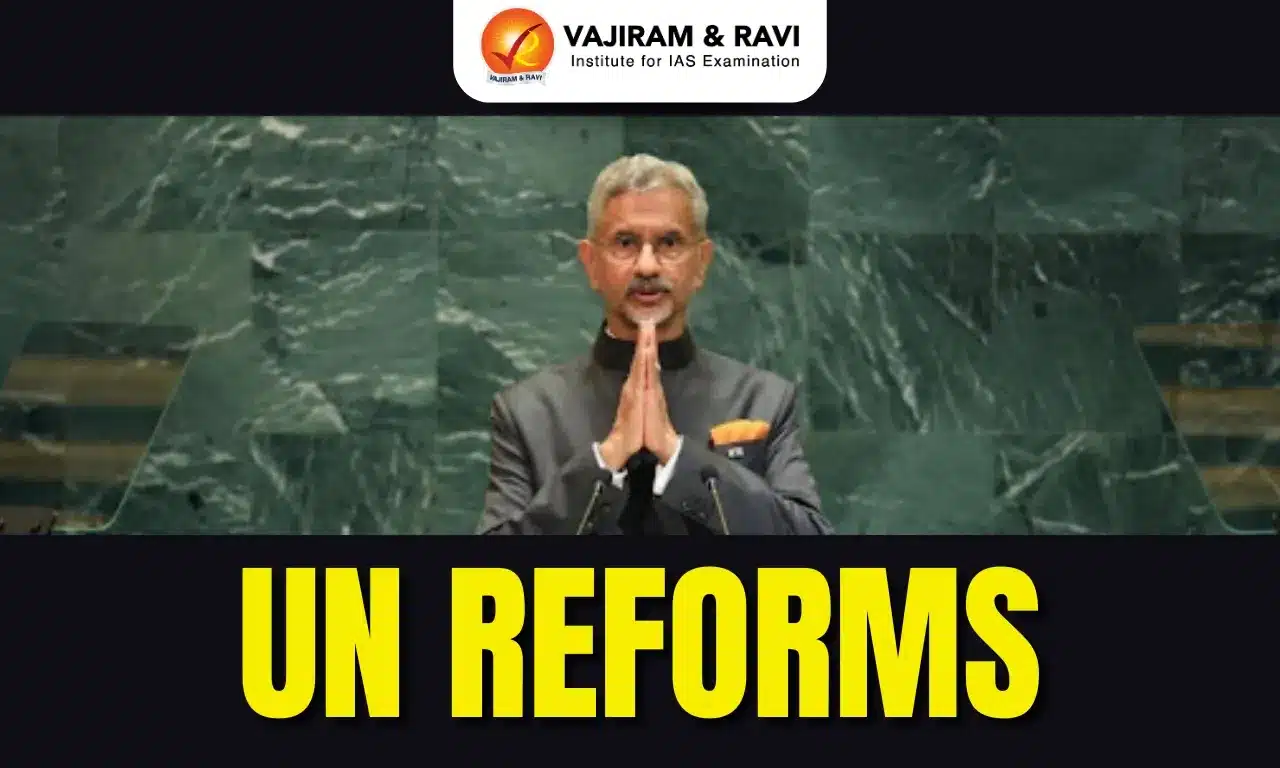
- India’s External Affairs Minister S. Jaishankar addressed the 80th session of the UN General Assembly.
- During this speech, he emphasised that the UN must be reformed and member states — led by active Global South contributors like India — must strengthen cooperation, confront terrorism, and restore multilateral credibility to meet 21st-century challenges.
UN General Assembly
- The UN General Assembly (UNGA) is the main deliberative, policymaking and representative organ of the United Nations.
- All 193 UN member states are members (each with one vote). The Holy See and Palestine are permanent observers.
- It provides a global forum for multilateral discussion of international issues — peace & security, development, human rights, international law, budgetary and administrative matters.
Working
- It holds an annual Regular Session (High-Level Week in September) plus Special and Emergency Special Sessions when required.
- Structure: Six Main Committees handle substantive work:
- Disarmament & International Security
- Economic & Financial
- Social, Humanitarian & Cultural
- Special Political & Decolonization
- Administrative & Budgetary
- Legal
- President & Bureau: A President (elected for one year) chairs sessions and sets procedural priorities; elected from different regional groups on rotation.
Decision-Making & Voting
- Important questions (admission of members, budget, peace & security recommendations) normally require a two-thirds majority.
- Other questions require a simple majority.
- Nature of GA decisions: Most resolutions and declarations are non-binding politically influential instruments; binding enforcement is typically the Security Council’s domain.
Key Powers & Functions
- Approve the UN budget and apportion member contributions.
- Elect non-permanent members of the Security Council, members of other UN bodies and the judges of the ICJ (in conjunction with the Security Council).
- Recommend appointment of the Secretary-General to the Security Council.
- Create subsidiary organs and specialised agencies; convene world conferences.
Key Achievements & Historical Impact
- Universal Declaration of Human Rights (1948): Adopted by UNGA — foundational text in international human rights.
- Decolonization: Adopted the 1960 Declaration on Granting Independence to Colonial Countries and Peoples and guided a major wave of decolonization through UN support and membership expansion.
- Development agendas: Endorsed the Millennium Declaration (MDGs) and later the 2030 Agenda for Sustainable Development and the SDGs (2015) — global compacts for development.


The General Debate
- The general debate is part of the General Assembly session and is held at the beginning of each regular session in September.
- Purpose: Heads of state/government and ministers present national views and priorities and respond to global issues under a chosen theme.
- Speaking order & practice: Traditionally Brazil speaks first, then the United States, followed by other states in order of request and protocol.
- Theme of 80th session – Better Together: 80 years and more for peace, development and human rights.
- Presidency of 80th session – Annalena Baerbock of Germany is the President of 80th UNGA being held in New York.
EAM Jaishankar at the UN — Key Points & Takeaways
- EAM argued that the UN’s founding Charter calls for peace and human dignity, but the state of the world shows the organisation struggling to deliver.
- He said that the global problems (conflict, climate, development, trade, terrorism) make a compelling case for more international cooperation — and urgent reform of multilateral institutions.
State of the world — Where the UN is Falling Short
- Major conflicts: Cited Ukraine and the Middle East as evidence that the UN’s conflict-resolution role is under strain.
- Development shortfalls: Slow progress on the Sustainable Development Goals; resources and delivery lag.
- Climate credibility at risk: “If climate action itself is questioned, what hope is there for climate justice?” — concern over hollow commitments and creative accounting.
- Economic friction: Rising tariff volatility, technology controls, supply-chain grip, and restricted labour mobility undermine open trade and require multilateral responses.
Terrorism — An Urgent, Shared Threat
- Terrorism synthesises bigotry, violence, intolerance and fear and remains a priority.
- India’s experience: living next to a state that is a centre for global terrorism underlines the urgency.
- Required measures: choke terrorism financing, sanction prominent terrorists, and deepen international cooperation against sponsors and sympathisers.
UN Credibility & The Need for Reform
- The UN is “in a state of crisis”: gridlock has reduced its ability to build common ground and weakened belief in multilateralism.
- Security Council reform is essential — expand both permanent and non-permanent membership to reflect contemporary realities.
India and the Global South — Readiness to Lead
- India stands ready to assume greater responsibilities, and the Global South must contribute more actively.
- Cited India’s international role: development projects, crisis response, safe commerce, and security assistance.
- Call for countries that can engage all sides (e.g., in Ukraine and the Middle East) to step up mediation and search for solutions.
Principles for Action — Cooperation, Empathy, Common Purpose
- International cooperation must prevail; islands of prosperity cannot flourish in an ocean of turbulence.
- A functioning world order requires common purpose and empathy — the UN should be the forum to enable that.
- Reforming multilateralism is presented as the obvious, necessary path forward.

 Last updated on August, 2026
→ UPSC Mains 2026 commenced on 21st August 2026 and will continue through 30th August 2026, as per the official examination schedule.
→ UPSC Mains Question Paper 2026 is out now for Essay & GS Paper 1, 2, 3 & 4.
→ UPSC Mains GS Paper 1 2026 is out now.
→ UPSC Mains GS Paper 2 2026 is out now.
→ UPSC Mains GS Paper 3 2026 is out now.
→ UPSC Mains GS Paper 4 2026 is out now.
→ Check out the latest UPSC Syllabus 2026 here.
→ UPSC Mains Admit Card 2026 is now out.
→ Enroll in Vajiram & Ravi’s UPSC Mains Test Series 2027 for structured answer writing practice, expert evaluation, and exam-oriented feedback.
→ Join Vajiram & Ravi’s UPSC Mentorship Program 2027 for personalized guidance, strategy planning, and one-to-one support from experienced mentors.
→ Go through the UPSC Mains Previous Year Papers to enhance your preparation.
→ Download UPSC Mains Essay Paper 2025, UPSC Mains GS Paper-I 2025, UPSC Mains GS Paper-II 2025, UPSC Mains GS Paper-III 2025, UPSC Mains GS Paper-IV 2025, UPSC Mains English (Compulsory) Paper 2025, UPSC Mains Hindi (Qualifying) Paper 2025 here.
→ UPSC has released UPSC Toppers List 2025 with the Civil Services final result on its official website.
→ UPSC Calendar 2027 has been released.
→ Also check Best UPSC Coaching in India
UN Reforms FAQs
Q1. Why is India calling for UN reforms?+
Q2. What did Jaishankar highlight at the UNGA?+
Q3. How does India view its role in UN reforms?+
Q4. What reforms does India propose for the UN Security Council?+
Q5. Why does terrorism remain central in India’s UN message?+
Tags: mains articles UN reforms upsc current affairs upsc mains current affairs