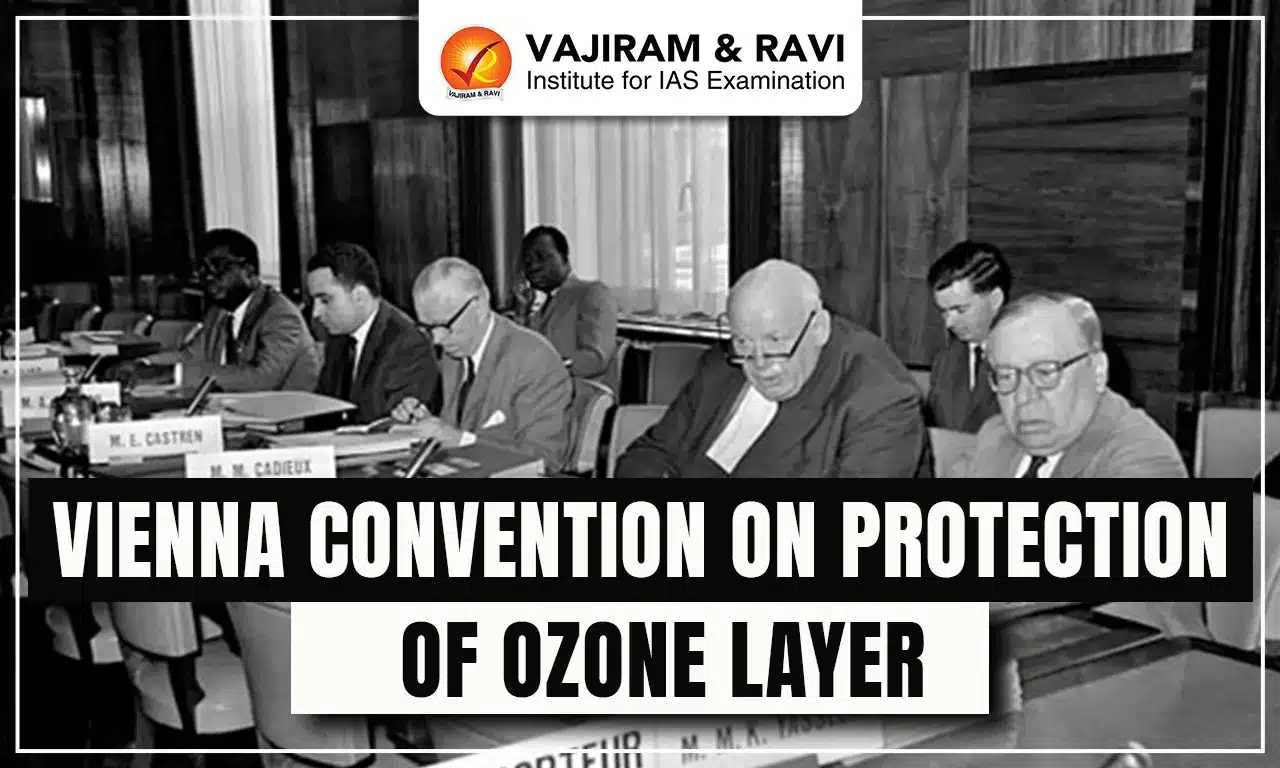
The Vienna Convention for the Protection of the Ozone Layer was adopted in 1985, as an important framework in international environmental cooperation. It was one of the first global treaties to address an environmental issue on the basis of scientific evidence and precaution, even before the full scale of the crisis was visible. By uniting the international community against the threat of ozone depletion, the Convention laid the foundation for subsequent agreements, particularly the Montreal Protocol on Substances that Deplete the Ozone Layer (1987), which is considered as the most successful environmental treaty in history. In this article, we are going to cover the Vienna Convention for the Protection of the Ozone Layer, its historical importance, objectives and provisions.
Vienna Convention for the Protection of the Ozone Layer
The Vienna Convention for the Protection of the Ozone Layer represents international environmental diplomacy. By setting up a global framework for cooperation, it paved the way for the Montreal Protocol and subsequent successes in phasing out ozone-depleting substances. Its achievements extend beyond ozone recovery, encompassing public health improvements, biodiversity protection, and climate mitigation. Above all, the Convention acts as a reminder that collective global action, guided by science and precaution, can reverse even the gravest environmental threats. As the world grapples with challenges like climate change, biodiversity loss, and pollution, the Vienna Convention stands as a treaty of hope and a model of how humanity can unite to protect the planet.
Ozone Layer
The ozone layer is located in the stratosphere about 10-50 km above the Earth’s surface. It is rich in ozone molecules (O₃). This thin but important shield absorbs the majority of the Sun’s harmful ultraviolet (UV-B) radiation, which, if unchecked, can cause skin cancers, cataracts, immune system suppression, and damage to crops and marine ecosystems.
By the mid-20th century, however, scientific studies showed that human activities like the release of chlorofluorocarbons (CFCs) and other ozone-depleting substances (ODS) were causing important thinning of this protective layer. The most visible manifestation of this was the Antarctic ozone hole, first detected in the early 1980s.The alarming evidence galvanized scientists, policymakers, and civil society groups, ultimately leading to the negotiation of the Vienna Convention.


Vienna Convention Adoption Historical Background
The adoption of the Vienna Convention was rooted in the evolution of scientific understanding. This included:
- 1974 Breakthrough: Chemists Mario Molina and F. Sherwood Rowland published a seminal paper showing how CFCs, used in refrigeration and aerosols, could migrate to the stratosphere, break down under UV light, and release chlorine atoms. These chlorine atoms acted as catalysts, destroying ozone molecules in big quantities.
- Late 1970s-Early 1980s: Continuous research confirmed the harmful link between man-made chemicals and ozone depletion. Alarm peaked when British scientists reported the dramatic thinning of ozone over Antarctica.
- 1985 Helsinki Meeting: In response to growing scientific consensus, an international gathering of scientists and policymakers discussed the risks of ozone depletion. This meeting generated momentum for a formal legal instrument.
- 22 March 1985: The Vienna Convention was formally adopted in Vienna, Austria, under the auspices of the United Nations Environment Programme (UNEP). It came into force in 1988 and was ratified by nearly all UN member states, showing rare and almost universal global consensus. The Convention was the first international environmental treaty to address a global atmospheric issue based on precaution rather than waiting for irreversible damage.
Vienna Convention Objectives
The Vienna Convention was not a regulatory treaty but a framework agreement. Its primary aim was to create an environment where countries could collaborate, exchange knowledge, and eventually develop binding obligations to protect the ozone layer. The objectives included:
- Promoting International Cooperation: Establishing systematic observations, monitoring, and research on the ozone layer.
- Encouraging Information Sharing: Facilitating the exchange of scientific, legal, and technical information on ozone depletion and its impacts.
- Supporting Scientific Research: Advancing understanding of the chemical and physical processes affecting ozone.
- Encouraging National Measures: Urging states to adopt legislative or administrative actions to prevent ozone damage.
- Providing a Legal Basis: Preparing the ground for subsequent binding agreements, notably the Montreal Protocol.
- Raising Public Awareness: Enhancing recognition of the ozone layer’s importance and the dangers of its depletion.
Vienna Convention Key Provisions
The Vienna Convention is structured to provide clarity, cooperation, and flexibility. Key provisions of the Vienna Convention include:
- Article 1: Establishes uniform definitions of important terms like “ozone layer” and “adverse effects,” providing consistency in interpretation.
- Article 2: Motivates parties to cooperate in scientific research, monitoring, and data exchange, and to adopt measures for ozone protection.
- Article 3: Encourages nations to strengthen systematic observations of the ozone layer and its interactions with human activities.
- Article 4: Pushes the states to take precautionary steps even if scientific certainty is incomplete.
- Article 5: Promotes advancement of knowledge and development of alternatives to harmful substances.
- Article 6: Facilitates the sharing of scientific, technical, socio-economic, and commercial information.
- Article 7: Requires parties to periodically report measures they have adopted.
- Article 8: Provides mechanisms to support developing countries.
- Article 9 & 10: Mandates regular meetings of the parties to evaluate progress and adapt the treaty to new scientific knowledge.
These provisions ensured that the Convention was dynamic, flexible, and adaptable and an important feature for dealing with a problem rooted in evolving scientific knowledge.
Vienna Convention Implementation Mechanisms
The effectiveness of the Vienna Convention is related to its implementation mechanisms. This includes:
- Monitoring and Reporting: Parties are required to submit regular reports on actions taken, providing accountability.
- UNEP’s Role: UNEP acts as the secretariat, providing technical and scientific expertise, facilitating negotiations, and coordinating research.
- Capacity Building: Developing countries receive technical assistance, funding, and training to improve monitoring and enforcement capabilities.
- Periodic Reviews: Meetings of the Conference of the Parties (COP) act as a platform for assessing progress and updating commitments.
- Flexibility and Evolution: The Convention anticipated the need for a stronger protocol, leading to the Montreal Protocol of 1987, which introduced legally binding obligations for phasing out ODS.
Vienna Convention Impact
The Vienna Convention, along with the Montreal Protocol, has many positive consequences:
Environmental Impact
- Huge decline in the production and consumption of ozone-depleting substances.
- Early signs of ozone layer recovery, with projections suggesting a return to pre-1980 levels by the mid-21st century.
- Reduced UV radiation at the Earth’s surface, safeguarding ecosystems, agriculture, and marine life.
Public Health Benefits
- Reduced incidence of skin cancers and cataracts, which would have risen dramatically without ozone protection.
- Protection of the human immune system from UV-induced suppression.
Climate Change Co-benefits
- Many ODS are also potent greenhouse gases. Their phase-out has prevented substantial climate forcing, making the Vienna-Montreal framework a hidden but powerful contributor to climate change mitigation.
- Studies estimate that these agreements have prevented emissions equivalent to hundreds of gigatonnes of CO₂.
Governance Model
- The Convention showed the success of the “precautionary principle”, acting even before complete scientific certainty was achieved.
- It set a precedent for global cooperation on transboundary environmental problems, influencing later agreements on climate change and biodiversity.
Vienna Convention Lessons
The Vienna Convention provides many lessons for current and future environmental challenges:
- Science-Policy Interface: Strong collaboration between scientists and policymakers is important for informed decision-making.
- Precautionary Principle: Waiting for absolute certainty can be disastrous and preventive action is more effective and less costly.
- Global Solidarity: Universal participation and equitable support for developing countries ensure widespread compliance.
- Flexibility: A framework approach that can evolve into binding protocols helps sustain momentum.
- Linkages Across Issues: Addressing one problem (ozone depletion) can simultaneously benefit others (climate change).
| Also Check Other Posts | |
| Coastal Regulation Zone | Global Plastic Treaty |
| Nitrogen Cycle | Carbon Cycle |

 Last updated on Oct, 2026
→ UPSC 2027 Notification will be released on 13 January 2027 at upsconline.nic.in.
→ Check Nobel Prize 2026 Winners List here.
→ Download PIB PRiSM Monthly Magazine 2026 here.
→ Check UPSC Monthly Current Affairs Magazine The Recitals here.
→ Check out the latest UPSC Syllabus here.
→ Download UPSC Model Answers for Mains 2026
→ UPSC Mains Question Paper 2026 is out now for Essay & GS Paper 1, 2, 3 & 4.
→ UPSC Calendar 2027 has been released.
→ Enroll in Vajiram & Ravi’s UPSC Mains Test Series 2027 for structured answer writing practice, expert evaluation, and exam-oriented feedback.
→ Join Vajiram & Ravi’s UPSC Mentorship Program 2027 for personalized guidance, strategy planning, and one-to-one support from experienced mentors.
→ Go through the UPSC Mains Previous Year Papers to enhance your preparation.
→ UPSC has released UPSC Toppers List 2025 with the Civil Services final result on its official website.
→ Also check Best UPSC Coaching in India
Vienna Convention on Protection of Ozone Layer FAQs
Q1. What is the Vienna Convention on Protection of the ozone layer?+
Q2. What is the main aim of the Vienna Convention?+
Q3. What was the main aim of the Vienna Convention of 1985?+
Q4. What was the impact of Vienna Convention?+
Q5. What is the Ozone Layer?+
Tags: vienna convention on protection of ozone layer