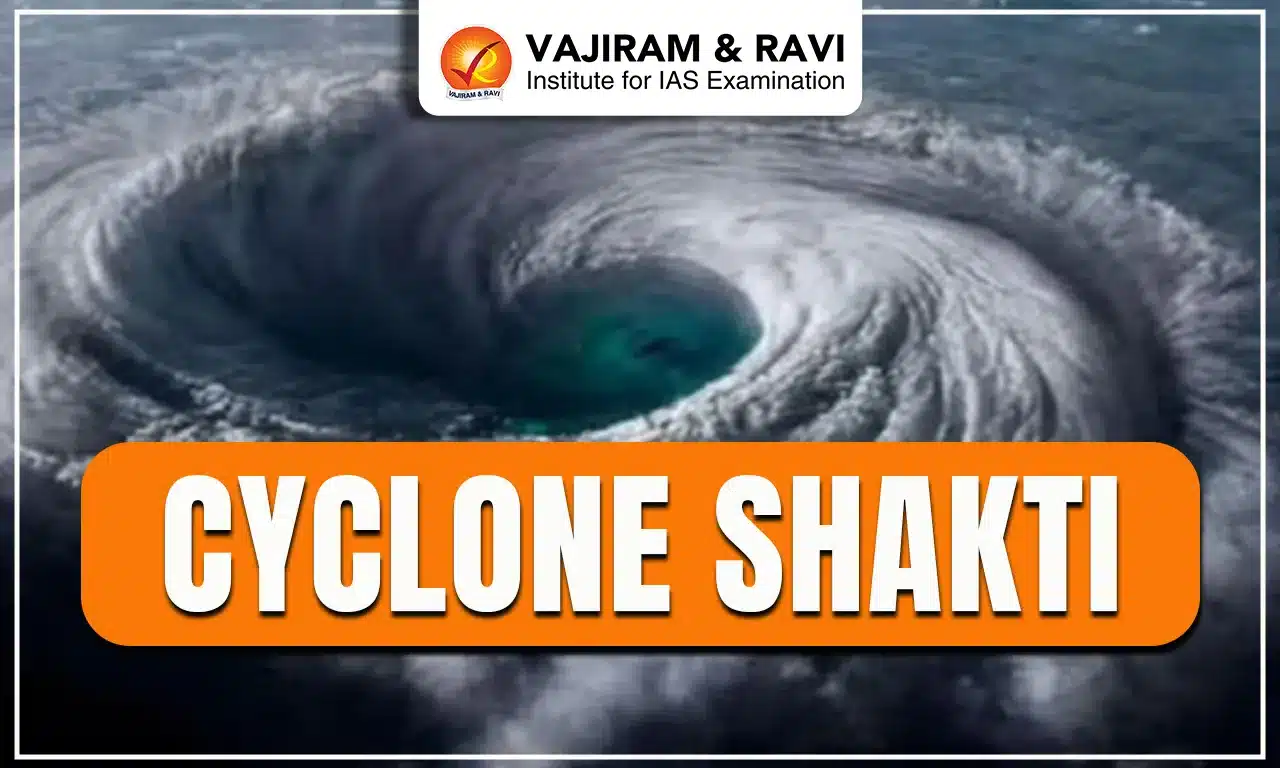
Cyclone Shakti is a recent example of a tropical cyclone that formed over the Arabian Sea in 2025. It provides an important case study for understanding cyclone formation, movement, and classification in India. The event highlights the increasing trend of severe cyclones over the Arabian Sea as reported by the Indian Meteorological Department (IMD) and Indian Institute of Tropical Meteorology (IITM) due to warming ocean temperatures.
Cyclone Shakti
Cyclone Shakti was classified as a Severe Cyclonic Storm (SCS) by the IMD. It formed over the east-central Arabian Sea with wind speeds expected reaching 130-145 km/h. The cyclone serves as a representative example for studying the physical processes of tropical cyclone development, including oceanic heat content, Coriolis force, and atmospheric instability. Such cyclones are part of the tropical storm system in the North Indian Ocean Basin.
Cyclone Shakti 2025 Naming
The naming of Cyclone Shakti 2025 follows the guidelines of the World Meteorological Organization (WMO) and the ESCAP Panel on Tropical Cyclones. The name “Shakti,” proposed by Sri Lanka, symbolizes power and resilience. Names are selected from lists contributed by 13 member countries, including India, Bangladesh, Oman, and Myanmar. The purpose of naming cyclones is to facilitate better communication and public awareness during weather forecasting and disaster management.


Cyclone Shakti Formation
Cyclone Shakti formed through a process typical of tropical cyclone development. Warm ocean waters above 27°C provided latent heat, fueling convection. Rising moist air created low pressure at the surface, while the Coriolis effect caused rotation, forming a cyclonic system. In the upper troposphere, outflow maintained the system’s structure. The low vertical wind shear over the Arabian Sea in October 2025 allowed the cyclone to intensify into a Severe Cyclonic Storm.
Factors Affecting Cyclone Formation in Arabian Sea
The Arabian Sea has become increasingly favorable for cyclones due to changing climatic and oceanic conditions. According to a 2017 study by the Centre for Science and Environment (CSE) the annual mean temperature of India has increased by about 1.2℃ since 1901. This warming has enhanced the frequency of intense cyclones. Additionally, reduced vertical wind shear and increased moisture transport from the equatorial region have supported cyclone formation near India’s west coast.
Cyclone Shakti Geographical Location and Path
Cyclone Shakti developed over the east-central Arabian Sea, roughly near 21°N latitude and 66.8°E longitude. Located about 270 km southwest to Naliya, 300km east to Porbandar and 360 km south of Karachi, as of Oct 03, 2025 morning. Its path followed a typical northwestward movement under the influence of subtropical westerly winds. The Arabian Sea’s unique geography- enclosed by landmasses on three sides and open toward the southwest- helps trap heat and moisture, providing ideal conditions for cyclone formation. This path also reflects the regional wind circulation patterns during the post-monsoon season.
Classification of Cyclones in India
The IMD classifies cyclones based on their wind speeds and pressure levels. Cyclone Shakti falls under the “Severe Cyclonic Storm” category with sustained wind speeds between 118 and 165 km/h. The classification of cyclones helps in understanding cyclone intensity and potential damage levels. Such categorization also aligns with the international Saffir-Simpson Scale, though the Indian scale has region-specific terminology for the North Indian Ocean basin.
| Classification of Cyclones in India | ||
|
IMD Category |
Wind Speed (km/h) |
Example |
|
Cyclonic Storm |
62-88 |
Cyclone Nilam (2012) |
|
Severe Cyclonic Storm |
89-117 |
Cyclone Ockhi (2017) |
|
Very Severe Cyclonic Storm |
118-165 |
Cyclone Hudhud (2014) |
|
Extremely Severe Cyclonic Storm |
166-220 |
Cyclone Tauktae (2021) |
|
Super Cyclone |
>221 |
Odisha Super Cyclone (1999) |
Cyclone Trends in the Arabian Sea
The Arabian Sea, traditionally less active than the Bay of Bengal, has witnessed a rise in intense cyclones over the past two decades. The IITM and Union Ministry of Earth Sciences’ 2021 Annual Climate Report noted a 52% increase in Severe Cyclonic Storms in the Arabian Sea between 2001 and 2019. Cyclone Shakti exemplifies this growing pattern, showing how climatic warming and Indian Ocean Dipole events influence cyclone frequency and intensity.
Cyclone Shakti Challenges
Cyclone Shakti poses multi-dimensional challenges affecting ecology, economy, and human settlements along the western coast of India.
- Climate Change Intensification: Rising Arabian Sea temperatures increase cyclone frequency and intensity, stressing existing coastal ecosystems.
- Coastal Erosion and Landform Damage: Strong winds and storm surges erode beaches, deltas, and mangroves, altering natural buffers.
- Agricultural Losses: Salinity intrusion and flooding damage crops, fisheries, and aquaculture-based livelihoods.
- Infrastructure Vulnerability: Roads, power lines, and small coastal settlements face high risk due to inadequate climate-resilient design.
- Socio-economic Impact: Displacement, loss of income, and disruption of local economies challenge recovery and development in affected areas
Way Forward:
Addressing Cyclone Shakti’s impacts requires integrated approaches combining environmental, social, and infrastructural strategies.
- Coastal Ecosystem Restoration: Strengthen mangroves, dunes, and wetlands to act as natural storm buffers.
- Climate-resilient Infrastructure: Upgrade housing, roads, and electricity networks to withstand high winds and flooding.
- Sustainable Agriculture and Fisheries: Promote salt-tolerant crops, aquaculture planning, and adaptive farming practices.
- Disaster-Resilient Livelihood Programs: Support local communities with alternate income sources and insurance schemes.
- Research and Monitoring: Track Arabian Sea warming trends, coastal erosion, and socio-economic vulnerabilities for long-term mitigation planning.
Cyclone Shakti Recent Developments
Cyclone Shakti, the first cyclonic storm of the Arabian Sea season, has intensified into a severe cyclonic storm as of October 4, 2025. Expected 45-55 kmph wind speed, that may intensify. The India Meteorological Department (IMD) reported that the storm is moving west-southwestward at a speed of 18 km/h and is expected to continue intensifying. As of 12 PM on October 4, the storm was located approximately 420 km from Dwarka in Gujarat. The IMD has issued warnings for rough seas and squally winds along the Gujarat and Maharashtra coasts. Authorities have advised fishermen to avoid venturing into the sea, and coastal residents are urged to stay alert.
Impact of Cyclone Shakti
Cyclone Shakti is likely to affect coastal environments, landforms, and ecosystems, demonstrating the geographical and socio-economic effects of severe cyclones.
- Coastal Erosion: Shorelines experienced sediment displacement and loss of 2-3 meters in vulnerable areas, altering landforms.
- Flooding: Heavy rainfall leading to temporary inundation of low-lying coastal zones and river mouths.
- Soil and Agriculture: Saline water intrusion damages soil fertility, affecting crops and mangroves.
- Fisheries and Livelihoods: Disruption of marine ecosystems and fishing zones impacted local economies dependent on coastal resources.
Government Initiatives for Cyclone Management
India has established multiple institutions and policies to improve disaster preparedness and cyclone resilience across coastal states.
- National Cyclone Risk Mitigation Project (NCRMP): Strengthens early warning, evacuation, and infrastructure along the coast.
- Integrated Coastal Zone Management (ICZM): Promotes sustainable coastal development and environmental conservation.
- Regional Specialized Meteorological Centre (RSMC), IMD: Monitors cyclones, issues forecasts, and provides scientific data.
Community Awareness Programs: Focus on training local populations for preparedness and response during severe cyclonic events.
| Also Check Other Posts | |
| Coastal Regulation Zone | Global Plastic Treaty |
| Nitrogen Cycle | Carbon Cycle |

 Last updated on Sep, 2026
→ UPSC 2027 Notification will be released on 13 January 2027 at upsconline.nic.in.
→ Asian Games 2026 are being held in Aichi-Nagoya, Japan, from 19 September to 4 October.
→ Check out the latest UPSC Syllabus here.
→ Download UPSC Model Answers for Mains 2026
→ UPSC Mains Question Paper 2026 is out now for Essay & GS Paper 1, 2, 3 & 4.
→ UPSC Calendar 2027 has been released.
→ Enroll in Vajiram & Ravi’s UPSC Mains Test Series 2027 for structured answer writing practice, expert evaluation, and exam-oriented feedback.
→ Join Vajiram & Ravi’s UPSC Mentorship Program 2027 for personalized guidance, strategy planning, and one-to-one support from experienced mentors.
→ Go through the UPSC Mains Previous Year Papers to enhance your preparation.
→ UPSC has released UPSC Toppers List 2025 with the Civil Services final result on its official website.
→ Also check Best UPSC Coaching in India
Cyclone Shakti Maharashtra FAQs
Q1. What is Cyclone Shakti?+
Q2. Why was the Cyclone named Shakti?+
Q3. What factors caused Cyclone Shakti?+
Q4. How are cyclones classified in India?+
Q5. Why are Arabian Sea cyclones increasing?+
Tags: cyclone shakti cyclone shakti maharashtra