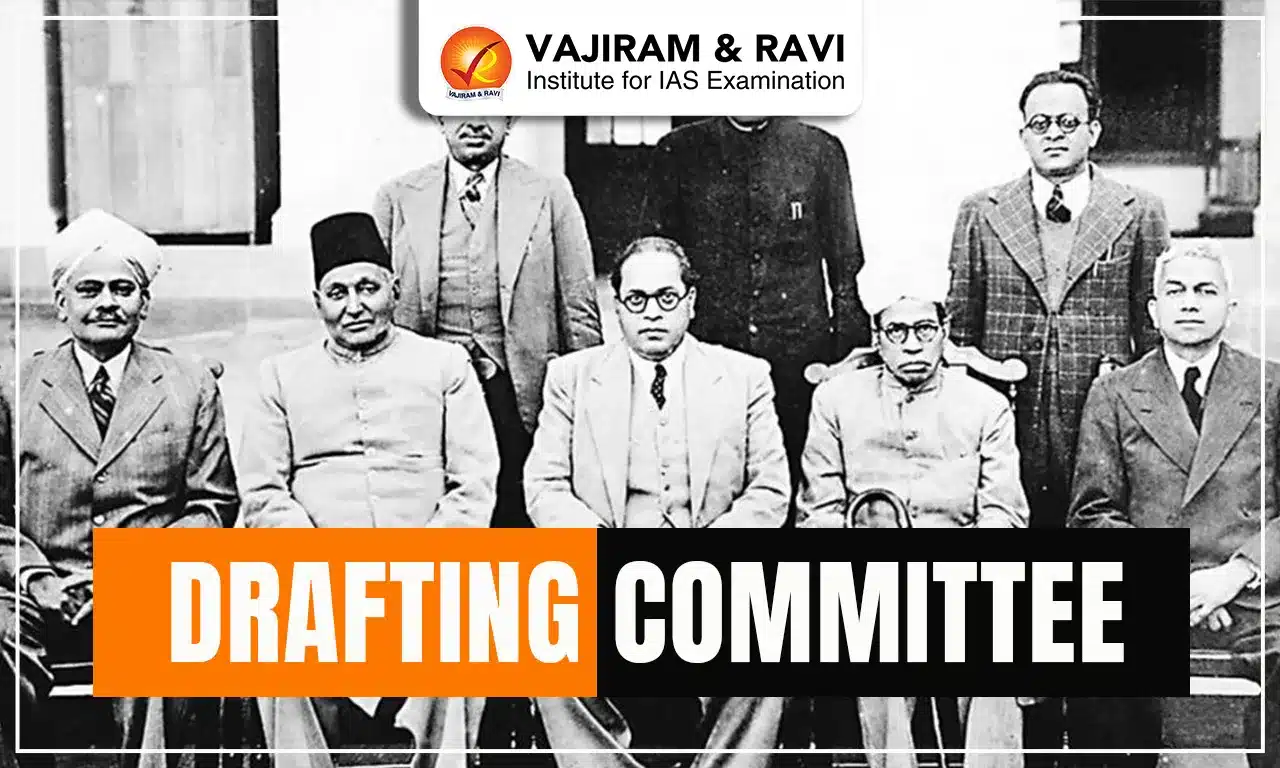
The Drafting Committee was one of the major committees of the Constituent Assembly of India. It was tasked with framing the Constitution of independent India, ensuring that the nation became a sovereign and democratic republic. The committee embedded the core values of justice, liberty, equality, and fraternity into the governance structure, while also considering India’s cultural, linguistic, and religious diversity.
What is Drafting Committee?
The Committee served as the central body that synthesized proposals from various sub-committees, analyzed suggestions from members of the Constituent Assembly, and prepared drafts for discussion. The committee laid the foundation for a legal framework of India. It was part of the Constituent Assembly.
Drafting Committee Formation
The Drafting Committee was set up on 29 August 1947, shortly after India gained independence on 15 August 1947. The formation was recommended by the Constituent Assembly’s Steering Committee, chaired by Dr. Rajendra Prasad. The decision was formalized to assign the task of preparing a draft Constitution to a smaller, focused group with expertise in law, governance, and public administration.


Drafting Committee Members
The Drafting Committee had seven members, chaired by Dr. B. R. Ambedkar, considered the “Father of the Indian Constitution.” Each member contributed uniquely to different aspects of the Constitution:
| Members of the Drafting Committee | |
| Member | Roles and Contributions |
|
Dr. B. R. Ambedkar |
Drafting Committee Chairman; led drafting of fundamental rights, directive principles, and social justice provisions |
|
Alladi Krishnaswami Ayyar |
Legal expert; contributed to judicial and administrative provisions |
|
N. Gopalaswami Ayyangar |
Worked on federal structure and state reorganization |
|
K. M. Munshi |
Advocated for cultural preservation and fundamental rights |
|
Mohammad Saadulla |
Focused on minority rights and regional interests |
|
B. L. Mitter / N. Madhava Rau |
Legal and administrative contributions, replaced resigning members |
|
D. P. Khaitan / T. T. Krishnamachari |
Assisted in drafting, replaced members as necessary |
Drafting Committee Objectives
The Drafting Committee was guided by the following objectives:
- Draft a Constitution suitable for India’s socio-political diversity.
- Safeguard individual rights through Fundamental Rights and Directive Principles of State Policy.
- Ensure a federal structure balancing central and state powers.
- Promote social justice, minority rights, and affirmative action.
- Establish strong governance institutions with checks and balances between Executive, Legislature, and Judiciary.
Process of Drafting of the Constitution
The drafting of the Indian Constitution was carried out in well-defined stages, beginning with the Objectives Resolution in 1946 and culminating in its adoption in 1949. The timeline below highlights the major steps:
| Drafting of the Indian Constitution | |||
| Stage | Title | Date | Key Highlights |
|
Stage 1 |
First Session of Constituent Assembly |
13 Dec 1946 – 22 Jan 1947 |
Nehru moved the Objectives Resolution on 13 Dec 1946; adopted on 22 Jan 1947, setting guiding principles for the Constitution. |
|
Stage 2 |
Committee Stages & Second Session |
27 Feb 1947 – 30 Aug 1947 |
Advisory Committee, Union Powers Committee, Provincial Constitution Committee submitted reports; debates concluded on 30 Aug 1947. |
|
Stage 3 |
Draft by Constitutional Adviser (B. N. Rau) |
1 Feb 1947 – 31 Oct 1947 |
B. N. Rau prepared the Draft Constitution, completed by Oct 1947 and submitted to Drafting Committee. |
|
Stage 4 |
First Draft by Drafting Committee |
27 Oct 1947 – 21 Feb 1948 |
Drafting Committee, chaired by Ambedkar, revised Rau’s draft; First Draft submitted on 21 Feb 1948. |
|
Stage 5 |
Public Circulation of Draft |
21 Feb 1948 – 26 Oct 1948 |
Draft Constitution circulated for feedback; Special Committee reviewed suggestions; revised draft re-submitted on 26 Oct 1948. |
|
Stage 6 |
Draft Presented to Assembly |
4 Nov 1948 |
Dr. B. R. Ambedkar introduced the Draft Constitution in the Constituent Assembly. |
|
Stage 7 |
First Reading (Clause-by-Clause Debates) |
15 Nov 1948 – 17 Oct 1949 |
Assembly held extensive debates, with over 2,000 amendments proposed and discussed article by article. |
|
Stage 8 |
Revision & Second Reading |
3 Nov 1949 – 16 Nov 1949 |
Drafting Committee revised Constitution as per debates; Second Reading held from 14–16 Nov 1949. |
|
Stage 9 |
Third Reading |
17 Nov 1949 – 26 Nov 1949 |
Final speeches and general comments; Constitution adopted on 26 Nov 1949. |
|
Stage 10 |
Enactment & Adoption |
24 Jan 1950 – 26 Jan 1950 |
Constitution signed by members on 24 Jan 1950; came into effect on 26 Jan 1950 (Republic Day). |
First Draft (21 February 1948)
The Drafting Committee, chaired by Dr. B.R. Ambedkar, presented the first draft on 21 February 1948. It had 315 Articles and 8 Schedules. This draft was circulated for public discussion, attracting over 7,000 comments from provincial assemblies, legal experts, and the public, shaping future revisions.
Second Draft (21 October 1948)
The second draft was introduced in the Constituent Assembly on 21 October 1948. It reflected changes from public feedback and Assembly debates. Members deliberated extensively on fundamental rights, the federal system, and emergency provisions. This draft remained open for detailed discussions until November 1949.
Third Draft (Feb – Oct, 1949)
Between February and October 1949, the Drafting Committee submitted the third draft after considering nearly 2,000 amendments moved in the Assembly. Key debates covered the national language, separation of powers, minority rights, and the judiciary’s role, bringing the Constitution close to its final shape.
Final Draft (26 November 1949)
On 26 November 1949, the Constituent Assembly formally adopted the final Constitution with 395 Articles, 22 Parts, and 8 Schedules. The process had taken 2 years, 11 months, and 18 days. This date is now observed as Constitution Day in India.
Signature (24 January 1950)
On 24 January 1950, 284 of 299 members of the Constituent Assembly signed the final handwritten copies in English and Hindi. Two days later, on 26 January 1950, the Constitution came into effect, marking India’s transition to a sovereign democratic republic.
Challenges Faced by Drafting Committee
The drafting committee although being filled with the members belonging to Political and Legal backgrounds faced several challenges while drafting of the constitution as given below:
- Balancing linguistic, religious, and cultural differences.
- Fundamental Rights vs Directive Principles while Ensuring social justice without compromising liberty.
- Confusion in Federal vs Unitary Structure while determining power distribution between Union and States.
- Adapting and integrating ideas from other constitutions to suit Indian context.
- Drafting amid post-independence economic and political instability.
Criticism of Drafting Committee
In spite of various features and successful implementation of final draft, the drafting committee faced several backlashes including:
- Limited representation, with only seven members, potentially reducing diversity of perspectives.
- Dominant influence of the Chairman, Dr. Ambedkar, though positive for efficiency.
- Too complex for the Public to understand.
- Domination of Advocates and Politicians.
- No representation of Woman.
- Borrowing of Provisions
- Excessive Restrictions on Fundamental Rights
Also Read: Salient Features of Indian Constitution

 Last updated on Oct, 2026
→ UPSC 2027 Notification will be released on 13 January 2027 at upsconline.nic.in.
→ Check Nobel Prize 2026 Winners List here.
→ Download PIB PRiSM Monthly Magazine 2026 here.
→ Check UPSC Monthly Current Affairs Magazine The Recitals here.
→ Check out the latest UPSC Syllabus here.
→ Download UPSC Model Answers for Mains 2026
→ UPSC Mains Question Paper 2026 is out now for Essay & GS Paper 1, 2, 3 & 4.
→ UPSC Calendar 2027 has been released.
→ Enroll in Vajiram & Ravi’s UPSC Mains Test Series 2027 for structured answer writing practice, expert evaluation, and exam-oriented feedback.
→ Join Vajiram & Ravi’s UPSC Mentorship Program 2027 for personalized guidance, strategy planning, and one-to-one support from experienced mentors.
→ Go through the UPSC Mains Previous Year Papers to enhance your preparation.
→ UPSC has released UPSC Toppers List 2025 with the Civil Services final result on its official website.
→ Also check Best UPSC Coaching in India
Drafting Committee FAQs
Q1. Who chaired the Drafting Committee of India?+
Q2. When was the Drafting Committee formed?+
Q3. How many members were initially in the Drafting Committee?+
Q4. When was the final draft of the Constitution completed?+
Q5. What was the main objective of the Drafting Committee?+
Tags: constitution of india drafting committee indian polity post independence