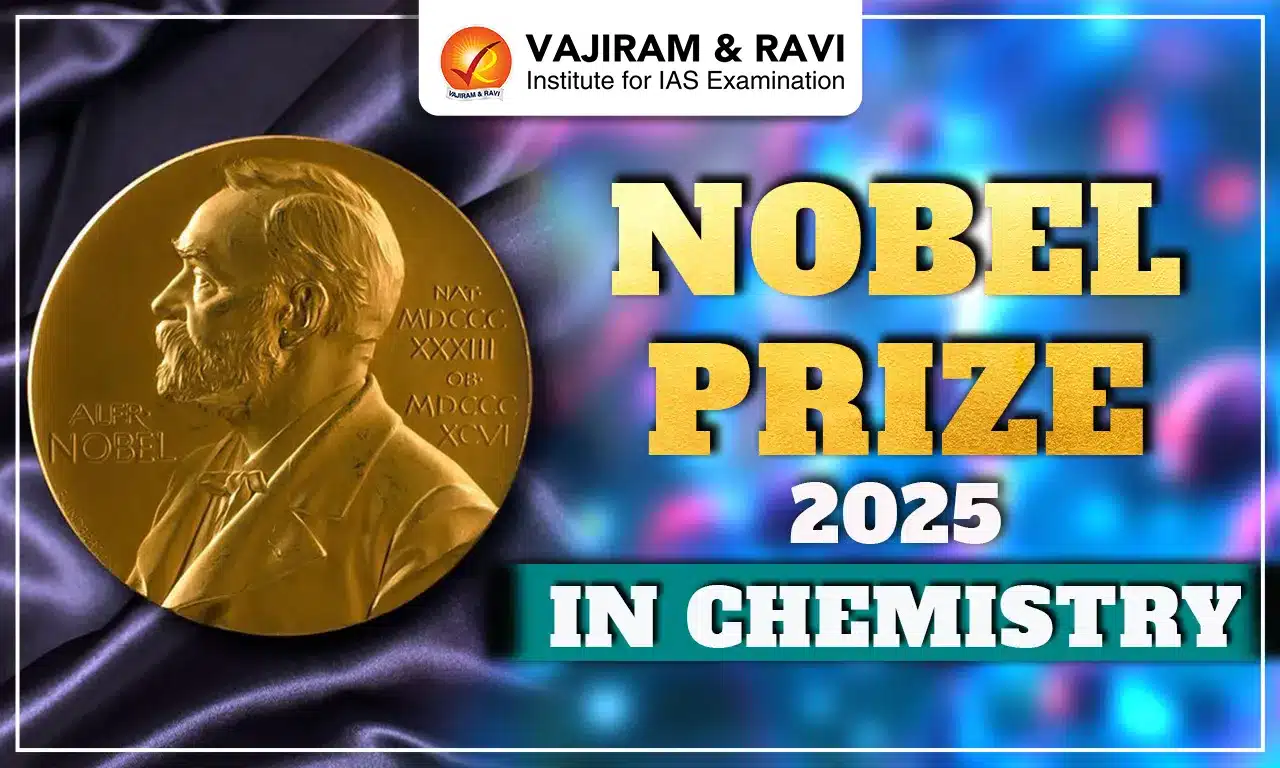
Susumu Kitagawa, Richard Robson, and Omar Yaghi are the recipients of the 2025 Nobel Prize in Chemistry for their groundbreaking contributions to molecular architecture. They created a novel molecular structure where metal ions serve as cornerstones linked by extended organic (carbon-based) molecules.
Established by the will of Alfred Nobel, the Swedish inventor of dynamite, the Nobel Prize in Chemistry has been awarded annually since 1901. It honors individuals who have made significant contributions to the advancement of chemistry. The prize includes a medal, a diploma, and a cash award, which in 2024 amounted to 11 million Swedish kronor (approximately ₹10 crore).
Nobel Prize 2025 in Chemistry
Susumu Kitagawa, Richard Robson, and Omar Yaghi have been awarded the Nobel Prize in Chemistry 2025 for their pioneering work in molecular architecture. They developed a new type of molecular structure in which metal ions act as cornerstones, connected by long organic (carbon-based) molecules. Together, these components form crystalline structures with large internal cavities. These highly porous materials are known as metal-organic frameworks (MOFs). By altering the building blocks, chemists can design MOFs to capture and store specific substances, facilitate chemical reactions, or even conduct electricity.
Also Check:
Nobel Prize in Chemistry Historical Background
The Nobel Prize in Chemistry is one of the most prestigious awards in the field of science, established in accordance with the will of Alfred Nobel, the Swedish industrialist, chemist, and inventor of dynamite. Alfred Nobel’s vision was to reward individuals whose work “conferred the greatest benefit to humankind”, and the chemistry prize was meant to honor outstanding achievements in chemical research and innovation.
- Founder: Alfred Nobel (1833-1896), Swedish chemist, engineer, and inventor of dynamite.
- Purpose: To reward contributions that benefit humanity, especially in chemistry.
- First Awarded: 1901, with Jacobus H. van ‘t Hoff as the inaugural laureate.
- Administered by: Royal Swedish Academy of Sciences.
- Selection Process: Nominations and recommendations are reviewed by experts, ensuring originality, scientific merit, and impact.
- Prize Components: Medal, diploma, and cash award.
- Scope: Recognizes both fundamental research and applied chemistry, including biochemistry, organic/inorganic chemistry, molecular biology, and chemical engineering.
- Global Influence: Encourages international collaboration and inspires generations of chemists.
- Historical Significance: Demonstrates the evolution of chemistry and highlights landmark discoveries that have shaped modern science.
Also Check:


Nobel Prize Winners in Chemistry List (2024-1901)
Since its inception in 1901, the Nobel Prize in Chemistry has been awarded 116 times to a total of 197 laureates between 1901 and 2025. Remarkably, two chemists, Frederick Sanger and K. Barry Sharpless, have each been honored twice for their groundbreaking contributions. Accounting for these multiple awards, a total of 195 individuals have received the prestigious prize.
| Nobel Prize Winners in Chemistry List (2025-1901) | ||
| Year | Winners | Contribution |
|
2025 |
Susumu Kitagawa, Richard Robson and Omar Yaghi |
For metal-organic frameworks (MOF) |
|
2024 |
David Baker |
For computational protein design |
|
2024 |
Demis Hassabis, John Jumper |
For protein structure prediction |
|
2023 |
Moungi Bawendi, Louis Brus, Aleksey Yekimov |
For the discovery and synthesis of quantum dots |
|
2022 |
Carolyn Bertozzi, Morten Meldal, K. Barry Sharpless |
For the development of click chemistry and bioorthogonal chemistry |
|
2021 |
Benjamin List, David W.C. MacMillan |
For the development of asymmetric organocatalysis |
|
2020 |
Emmanuelle Charpentier, Jennifer A. Doudna |
For the development of a method for genome editing |
|
2019 |
John B. Goodenough, M. Stanley Whittingham, Akira Yoshino |
For the development of lithium-ion batteries |
|
2018 |
Frances H. Arnold |
For the directed evolution of enzymes |
|
2018 |
George P. Smith, Sir Gregory P. Winter |
For the phage display of peptides and antibodies |
|
2017 |
Jacques Dubochet, Joachim Frank, Richard Henderson |
For developing cryo-electron microscopy for high-resolution structure determination of biomolecules in solution |
|
2016 |
Jean-Pierre Sauvage, Sir J. Fraser Stoddart, Bernard L. Feringa |
For the design and synthesis of molecular machines |
|
2015 |
Tomas Lindahl, Paul Modrich, Aziz Sancar |
For mechanistic studies of DNA repair |
|
2014 |
Eric Betzig, Stefan W. Hell, William E. Moerner |
For the development of super-resolved fluorescence microscopy |
|
2013 |
Martin Karplus, Michael Levitt, Arieh Warshel |
For the development of multiscale models for complex chemical systems |
|
2012 |
Robert J. Lefkowitz, Brian Kobilka |
For studies of G-protein-coupled receptors |
|
2011 |
Dan Shechtman |
For the discovery of quasicrystals |
|
2010 |
Richard F. Heck, Ei-ichi Negishi, Akira Suzuki |
For palladium-catalyzed cross couplings in organic synthesis |
|
2009 |
Venkatraman Ramakrishnan, Thomas A. Steitz, Ada E. Yonath |
For studies of the structure and function of the ribosome |
|
2008 |
Osamu Shimomura, Martin Chalfie, Roger Y. Tsien |
For the discovery and development of the green fluorescent protein, GFP |
|
2007 |
Gerhard Ertl |
For his studies of chemical processes on solid surfaces |
|
2006 |
Roger D. Kornberg |
For his studies of the molecular basis of eukaryotic transcription |
|
2005 |
Yves Chauvin, Robert H. Grubbs, Richard R. Schrock |
For the development of the metathesis method in organic synthesis |
|
2004 |
Aaron Ciechanover, Avram Hershko, Irwin Rose |
For the discovery of ubiquitin-mediated protein degradation |
|
2003 |
Peter Agre |
For the discovery of water channels |
|
2003 |
Roderick MacKinnon |
For structural and mechanistic studies of ion channels |
|
2002 |
John B. Fenn, Koichi Tanaka |
For development of soft desorption ionisation methods for mass spectrometric analyses of biological macromolecules |
|
2002 |
Kurt Wüthrich |
For development of nuclear magnetic resonance spectroscopy for determining 3D structure of biological macromolecules in solution |
|
2001 |
William Knowles, Ryoji Noyori |
For work on chirally catalysed hydrogenation reactions |
|
2001 |
K. Barry Sharpless |
For work on chirally catalysed oxidation reactions |
|
2000 |
Alan Heeger, Alan MacDiarmid, Hideki Shirakawa |
For the discovery and development of conductive polymers |
|
1999 |
Ahmed Zewail |
For studies of the transition states of chemical reactions using femtosecond spectroscopy |
|
1998 |
Walter Kohn |
For development of the density-functional theory |
|
1998 |
John Pople |
For development of computational methods in quantum chemistry |
|
1997 |
Paul D. Boyer, John E. Walker |
For elucidation of the enzymatic mechanism underlying ATP synthesis |
|
1997 |
Jens C. Skou |
For first discovery of an ion-transporting enzyme, Na+, K+-ATPase |
|
1996 |
Robert F. Curl Jr., Sir Harold Kroto, Richard E. Smalley |
For discovery of fullerenes |
|
1995 |
Paul J. Crutzen, Mario J. Molina, F. Sherwood Rowland |
For work in atmospheric chemistry, especially on ozone formation and decomposition |
|
1994 |
George A. Olah |
For contribution to carbocation chemistry |
|
1993 |
Kary B. Mullis |
For invention of polymerase chain reaction (PCR) method |
|
1993 |
Michael Smith |
For contributions to site-directed mutagenesis for protein studies |
|
1992 |
Rudolph A. Marcus |
For contributions to the theory of electron transfer reactions in chemical systems |
|
1991 |
Richard R. Ernst |
For contributions to the development of high-resolution NMR spectroscopy |
|
1990 |
Elias James Corey |
For the development of the theory and methodology of organic synthesis |
|
1989 |
Sidney Altman, Thomas R. Cech |
For discovery of catalytic properties of RNA |
|
1988 |
Johann Deisenhofer, Robert Huber, Hartmut Michel |
For determination of the 3D structure of a photosynthetic reaction centre |
|
1987 |
Donald J. Cram, Jean-Marie Lehn, Charles J. Pedersen |
For development and use of molecules with structure-specific interactions of high selectivity |
|
1986 |
Dudley R. Herschbach, Yuan T. Lee, John C. Polanyi |
For contributions concerning dynamics of chemical elementary processes |
|
1985 |
Herbert A. Hauptman, Jerome Karle |
For development of direct methods for determination of crystal structures |
|
1984 |
Bruce Merrifield |
For development of methodology for chemical synthesis on a solid matrix |
|
1983 |
Henry Taube |
For work on mechanisms of electron transfer reactions, especially in metal complexes |
|
1982 |
Aaron Klug |
For development of crystallographic electron microscopy and structural elucidation of nucleic acid-protein complexes |
|
1981 |
Kenichi Fukui, Roald Hoffmann |
For theories concerning the course of chemical reactions, developed independently |
|
1980 |
Paul Berg |
For fundamental studies of the biochemistry of nucleic acids, especially recombinant DNA |
|
1980 |
Walter Gilbert, Frederick Sanger |
For contributions concerning the determination of base sequences in nucleic acids |
|
1979 |
Herbert C. Brown, Georg Wittig |
For development of boron- and phosphorus-containing compounds as reagents in organic synthesis |
|
1978 |
Peter Mitchell |
For contribution to understanding of biological energy transfer via chemiosmotic theory |
|
1977 |
Ilya Prigogine |
For contributions to non-equilibrium thermodynamics, particularly dissipative structures |
|
1976 |
William Lipscomb |
For studies on structure of boranes illuminating problems of chemical bonding |
|
1975 |
John Cornforth |
For work on stereochemistry of enzyme-catalyzed reactions |
|
1975 |
Vladimir Prelog |
For research into stereochemistry of organic molecules and reactions |
|
1974 |
Paul J. Flory |
For achievements in physical chemistry of macromolecules |
|
1973 |
Ernst Otto Fischer, Geoffrey Wilkinson |
For pioneering work on organometallic “sandwich” compounds |
|
1972 |
Christian Anfinsen |
For work on ribonuclease connecting amino acid sequence to biologically active conformation |
|
1972 |
Stanford Moore, William H. Stein |
For understanding connection between chemical structure and catalytic activity of ribonuclease |
|
1971 |
Gerhard Herzberg |
For contributions to knowledge of electronic structure and geometry of molecules, particularly free radicals |
|
1970 |
Luis Leloir |
For discovery of sugar nucleotides and their role in carbohydrate biosynthesis |
|
1969 |
Derek Barton, Odd Hassel |
For contributions to the development of concept of conformation and its application in chemistry |
|
1968 |
Lars Onsager |
For discovery of reciprocal relations fundamental for thermodynamics of irreversible processes |
|
1967 |
Manfred Eigen, Ronald G.W. Norrish, George Porter |
For studies of extremely fast chemical reactions using short pulses of energy |
|
1966 |
Robert S. Mulliken |
For fundamental work on chemical bonds and electronic structure using molecular orbital method |
|
1965 |
Robert B. Woodward |
For outstanding achievements in the art of organic synthesis |
|
1964 |
Dorothy Crowfoot Hodgkin |
For determination by X-ray techniques of structures of important biochemical substances |
|
1963 |
Karl Ziegler, Giulio Natta |
For discoveries in chemistry and technology of high polymers |
|
1962 |
Max F. Perutz, John C. Kendrew |
For studies of structures of globular proteins |
|
1961 |
Melvin Calvin |
For research on carbon dioxide assimilation in plants |
|
1960 |
Willard F. Libby |
For method to use carbon-14 for age determination in various sciences |
|
1959 |
Jaroslav Heyrovsky |
For discovery and development of polarographic methods of analysis |
|
1958 |
Frederick Sanger |
For work on structure of proteins, especially insulin |
|
1957 |
Lord Todd |
For work on nucleotides and nucleotide co-enzymes |
|
1956 |
Sir Cyril Hinshelwood, Nikolay Semenov |
For researches into mechanism of chemical reactions |
|
1955 |
Vincent du Vigneaud |
For work on biochemically important sulfur compounds, especially first synthesis of a polypeptide hormone |
|
1954 |
Linus Pauling |
For research into nature of chemical bond and elucidation of complex substances |
|
1953 |
Hermann Staudinger |
For discoveries in macromolecular chemistry |
|
1952 |
Archer J.P. Martin, Richard L.M. Synge |
For invention of partition chromatography |
|
1951 |
Edwin M. McMillan, Glenn T. Seaborg |
For discoveries in chemistry of transuranium elements |
|
1950 |
Otto Diels, Kurt Alder |
For discovery and development of diene synthesis |
|
1949 |
William F. Giauque |
For contributions in chemical thermodynamics, especially at extremely low temperatures |
|
1948 |
Arne Tiselius |
For research on electrophoresis and adsorption analysis of serum proteins |
|
1947 |
Sir Robert Robinson |
For investigations on plant products of biological importance, especially alkaloids |
|
1946 |
James B. Sumner |
For discovery that enzymes can be crystallized |
|
1946 |
John H. Northrop, Wendell M. Stanley |
For preparation of enzymes and virus proteins in pure form |
|
1945 |
Artturi Virtanen |
For research and inventions in agricultural and nutrition chemistry, especially fodder preservation method |
|
1944 |
Otto Hahn |
For discovery of fission of heavy nuclei |
|
1943 |
George de Hevesy |
For use of isotopes as tracers in study of chemical processes |
|
1942 |
No Nobel Prize awarded |
Prize money allocated to special fund |
|
1941 |
No Nobel Prize awarded |
Prize money allocated to special fund |
|
1940 |
No Nobel Prize awarded |
Prize money allocated to special fund |
|
1939 |
Adolf Butenandt |
For work on sex hormones |
|
1939 |
Leopold Ruzicka |
For work on polymethylenes and higher terpenes |
|
1938 |
Richard Kuhn |
For work on carotenoids and vitamins |
|
1937 |
Norman Haworth |
For investigations on carbohydrates and vitamin C |
|
1937 |
Paul Karrer |
For investigations on carotenoids, flavins, and vitamins A and B2 |
|
1936 |
Peter Debye |
For contributions to molecular structure via dipole moments and X-ray/electron diffraction in gases |
|
1935 |
Frédéric Joliot, Irène Joliot-Curie |
In recognition of their synthesis of new radioactive elements |
|
1934 |
Harold C. Urey |
For discovery of heavy hydrogen |
|
1933 |
No Nobel Prize awarded |
Prize money allocated to special fund |
|
1932 |
Irving Langmuir |
For discoveries and investigations in surface chemistry |
|
1931 |
Carl Bosch, Friedrich Bergius |
In recognition of contributions to the invention and development of chemical high-pressure methods |
|
1930 |
Hans Fischer |
For researches into the constitution of haemin and chlorophyll and synthesis of haemin |
|
1929 |
Arthur Harden, Hans von Euler-Chelpin |
For investigations on fermentation of sugar and fermentative enzymes |
|
1928 |
Adolf Windaus |
For research into constitution of sterols and their connection with vitamins |
|
1927 |
Heinrich Wieland |
For investigations of constitution of bile acids and related substances |
|
1926 |
The Svedberg |
For work on disperse systems |
|
1925 |
Richard Zsigmondy |
For demonstration of heterogeneous nature of colloid solutions and methods fundamental to colloid chemistry |
|
1924 |
No Nobel Prize awarded |
Prize money allocated to special fund |
|
1923 |
Fritz Pregl |
For invention of method of micro-analysis of organic substances |
|
1922 |
Francis W. Aston |
For discovery of isotopes in non-radioactive elements using mass spectrograph and enunciation of whole-number rule |
|
1921 |
Frederick Soddy |
For contributions to chemistry of radioactive substances and investigations into origin and nature of isotopes |
|
1920 |
Walther Nernst |
In recognition of his work in thermochemistry |
|
1919 |
No Nobel Prize awarded |
Prize money allocated to special fund |
|
1918 |
Fritz Haber |
For synthesis of ammonia from its elements |
|
1917 |
No Nobel Prize awarded |
Prize money allocated to special fund |
|
1916 |
No Nobel Prize awarded |
Prize money allocated to special fund |
|
1915 |
Richard Willstätter |
For researches on plant pigments, especially chlorophyll |
|
1914 |
Theodore W. Richards |
For accurate determinations of atomic weight of many chemical elements |
|
1913 |
Alfred Werner |
For work on linkage of atoms in molecules, opening new fields especially in inorganic chemistry |
|
1912 |
Victor Grignard |
For discovery of Grignard reagent advancing organic chemistry |
|
1912 |
Paul Sabatier |
For method of hydrogenating organic compounds in presence of finely disintegrated metals, advancing organic chemistry |
|
1911 |
Marie Curie |
For discovery of radium and polonium, isolation of radium, and study of its compounds |
|
1910 |
Otto Wallach |
For services to organic chemistry and chemical industry via pioneering work on alicyclic compounds |
|
1909 |
Wilhelm Ostwald |
For work on catalysis and investigations into principles governing chemical equilibria and reaction rates |
|
1908 |
Ernest Rutherford |
For investigations into disintegration of elements and chemistry of radioactive substances |
|
1907 |
Eduard Buchner |
For biochemical research and discovery of cell-free fermentation |
|
1906 |
Henri Moissan |
For investigation and isolation of fluorine and development of Moissan electric furnace |
|
1905 |
Adolf von Baeyer |
For advancement of organic chemistry and chemical industry through work on dyes and hydroaromatic compounds |
|
1904 |
Sir William Ramsay |
For discovery of inert gaseous elements in air and determination of their place in periodic system |
|
1903 |
Svante Arrhenius |
For extraordinary services to chemistry via electrolytic theory of dissociation |
|
1902 |
Emil Fischer |
For extraordinary services via work on sugar and purine syntheses |
|
1901 |
Jacobus H. van ‘t Hoff |
For discovery of laws of chemical dynamics and osmotic pressure in solutions |

 Last updated on Sep, 2026
→ UPSC 2027 Notification will be released on 13 January 2027 at upsconline.nic.in.
→ Check out the latest UPSC Syllabus here.
→ Download UPSC Model Answers for Mains 2026
→ UPSC Mains Question Paper 2026 is out now for Essay & GS Paper 1, 2, 3 & 4.
→ UPSC Calendar 2027 has been released.
→ Enroll in Vajiram & Ravi’s UPSC Mains Test Series 2027 for structured answer writing practice, expert evaluation, and exam-oriented feedback.
→ Join Vajiram & Ravi’s UPSC Mentorship Program 2027 for personalized guidance, strategy planning, and one-to-one support from experienced mentors.
→ Go through the UPSC Mains Previous Year Papers to enhance your preparation.
→ UPSC has released UPSC Toppers List 2025 with the Civil Services final result on its official website.
→ Also check Best UPSC Coaching in India
Nobel Prize 2025 in Chemistry FAQs
Q1. Who won the Nobel Prize in Chemistry 2025?+
Q2. What are metal-organic frameworks (MOFs)?+
Q3. Why was this research important?+
Q4. When and where was the Nobel Prize announced?+
Q5. How do MOFs benefit everyday life?+
Tags: nobel prize 2025 in chemistry