Shram Shakti Niti Latest News
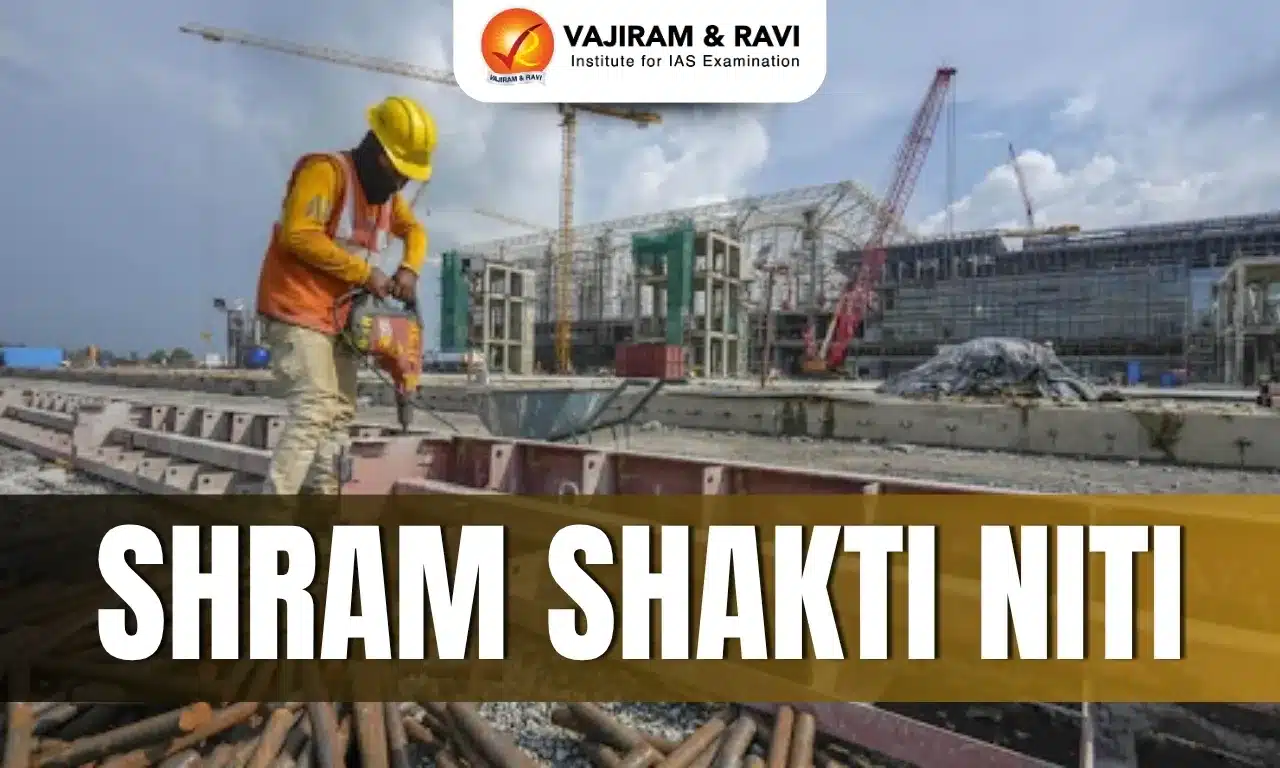
- The Ministry of Labour and Employment has released the draft National Labour & Employment Policy — Shram Shakti Niti 2025 for public consultation, aligning with India’s Viksit Bharat @2047 vision.
- Marking a shift from regulation to facilitation, the policy redefines the ministry’s role as an “employment facilitator” focused on creating a fair, inclusive, and technology-driven labour ecosystem.
- It seeks to promote collaboration among workers, employers, and training institutions through data-driven and integrated systems.
Shram Shakti Niti 2025: Blueprint for a Fair, Inclusive, and Future-Ready Workforce
- Labour” as a subject is in the Concurrent List of the Constitution of India.
- Hence, both the Central Government as well as State Governments can make rules/laws on this subject.
- As a result, the Union Ministry of Labour and Employment has released the draft National Labour and Employment Policy — Shram Shakti Niti 2025 for public consultation.
- Rooted in India’s civilisational ethos of “śrama dharma” — the dignity and moral value of work — the policy seeks to create a balanced framework that ensures protection, productivity, and participation for every worker while enabling enterprises to grow sustainably.
National Career Service (NCS): Digital Public Infrastructure for Employment
- At the heart of the policy is the NCS, envisioned as India’s Digital Public Infrastructure for Employment.
- The platform will offer:
- AI-enabled job matching and career guidance
- Credential verification and skill mapping
- Cross-sectoral and regional employment linkages
- The NCS will serve as a unified interface to connect employers, job seekers, and training providers through trusted digital systems.
Focus Areas and Core Objectives
- The draft policy emphasizes creating a resilient, skilled, and inclusive workforce ready for emerging global challenges such as technological disruption, climate change, and evolving value chains.
- Key focus areas include:
- Universal social security and income protection
- Occupational safety and health (OSH)
- Women and youth empowerment
- Green and technology-enabled jobs
- Continuous skill development and lifelong learning
Unified Labour Stack: Integrated Digital Ecosystem
- The policy proposes integrating major national databases — EPFO, ESIC, e-Shram, and NCS — into a unified labour stack.
- This integration will enable:
- Interoperable data systems for better policy coordination
- Lifelong learning opportunities
- Universal social protection and income security
- Real-time labour market insights for evidence-based governance
Complementing Labour Law Reforms
- The new policy complements the government’s recent consolidation of 29 central labour laws into four simplified labour codes, namely:
- Code on Wages (2019)
- Industrial Relations Code (2020)
- Occupational Safety, Health and Working Conditions Code (2020)
- Social Security Code (2020)
- Together, these reforms aim to simplify compliance, improve worker protection, and foster formal employment.
Guiding Principles and Pillars
- The policy is guided by four foundational pillars:
- Dignity of labour
- Universal inclusion
- Cooperative federalism
- Data-driven governance
- It envisions a resilient institutional framework based on convergence across digital systems, ensuring policy coherence and long-term impact.
Seven Strategic Priorities
- The draft policy identifies seven strategic priorities for achieving its goals:
- Universal and portable social security
- Occupational safety and health
- Employment and future readiness
- Women and youth empowerment
- Ease of compliance and formalisation
- Technology and green transitions
- Convergence through good governance
Women and Youth Empowerment
- The draft aims to increase women’s labour participation to 35% by 2030 and promote youth entrepreneurship and career guidance.
- Key initiatives include:
- Single-window digital compliance for MSMEs with self-certification and simplified returns
- Expanded career services through the National Career Service (NCS) platform
- Green jobs and just-transition pathways for workers adapting to new industries and technologies
Technology-Driven Governance and Data Integration
- The policy envisions a unified national labour data architecture to ensure inter-ministerial coherence and transparent monitoring.
- Key digital initiatives include:
- AI-enabled safety systems
- Predictive analytics for workforce planning
- Real-time digital dashboards to track progress
- Annual National Labour Report presented to Parliament
- Labour & Employment Policy Evaluation Index (LPEI) to benchmark State performance
Implementation and Accountability Plan
- Policy execution will proceed in three phases:
- Phase I (2025–27): Institutional setup and integration of social-security systems.
- Phase II (2027–30): Nationwide rollout of universal social-security accounts, skill-credit systems, and district-level Employment Facilitation Cells.
- Phase III (Beyond 2030): Full paperless governance, predictive policy analytics, and continuous renewal mechanisms.
- Progress will be monitored through real-time dashboards, the LPEI index, and third-party evaluations to ensure transparency and accountability.
Expected Outcomes
- According to Union Labour Minister Mansukh Mandaviya, the policy envisions a resilient and inclusive labour ecosystem focused on both worker welfare and enterprise growth.
- Expected outcomes include:
- Universal worker registration
- Social security portability
- Near-zero workplace fatalities
- Female labour-force participation at 35% by 2030
- Reduction in informal employment through digital compliance
- AI-driven labour governance in all states
- Creation of millions of green and decent jobs
- A unified “One Nation Integrated Workforce” ecosystem


 Last updated on Oct, 2026
→ UPSC 2027 Notification will be released on 13 January 2027 at upsconline.nic.in.
→ Asian Games 2026 are being held in Aichi-Nagoya, Japan, from 19 September to 4 October.
→ Check Nobel Prize 2026 Winners List here.
→ Download PIB PRiSM Monthly Magazine 2026 here.
→ Check UPSC Monthly Current Affairs Magazine The Recitals here.
→ Check out the latest UPSC Syllabus here.
→ Download UPSC Model Answers for Mains 2026
→ UPSC Mains Question Paper 2026 is out now for Essay & GS Paper 1, 2, 3 & 4.
→ UPSC Calendar 2027 has been released.
→ Enroll in Vajiram & Ravi’s UPSC Mains Test Series 2027 for structured answer writing practice, expert evaluation, and exam-oriented feedback.
→ Join Vajiram & Ravi’s UPSC Mentorship Program 2027 for personalized guidance, strategy planning, and one-to-one support from experienced mentors.
→ Go through the UPSC Mains Previous Year Papers to enhance your preparation.
→ UPSC has released UPSC Toppers List 2025 with the Civil Services final result on its official website.
→ Also check Best UPSC Coaching in India
Shram Shakti Niti FAQs
Q1. What is Shram Shakti Niti 2025?+
Q2. What are the main goals of the policy?+
Q3. What digital initiatives are proposed?+
Q4. How will the policy be implemented?+
Q5. When can public feedback be submitted?+
Tags: mains articles Shram Shakti Niti upsc current affairs upsc mains current affairs