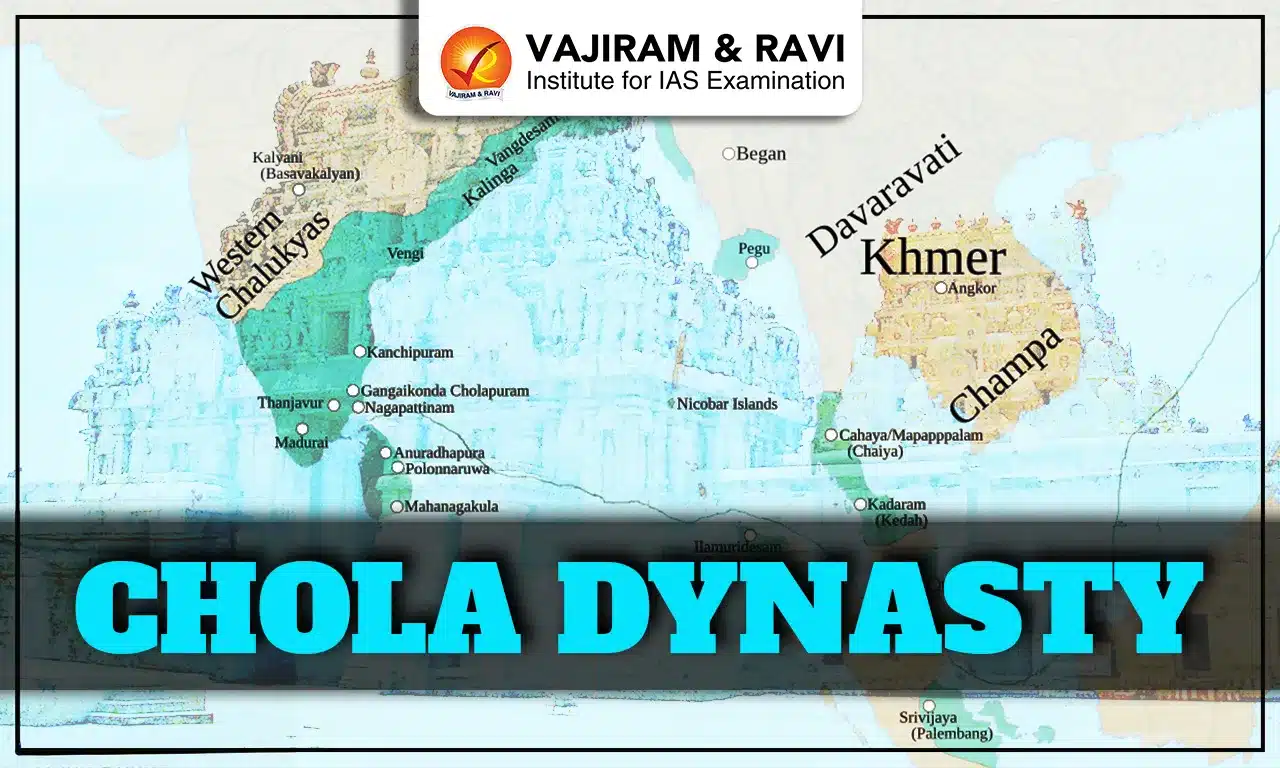
The Chola Dynasty was a prominent Tamil dynasty originating from Southern India, known for its long-lasting influence on South Indian history. At its peak, the Cholas ruled the expansive Chola Empire, a maritime power that extended across South and Southeast Asia. Early inscriptions, dating back to the 3rd century BCE during Ashoka’s reign, mention the Cholas as a neighboring kingdom. The dynasty reached its imperial height under the Medieval Cholas from the mid-9th century CE, leaving a lasting legacy in governance, culture, and trade.
Chola Dynasty
The Chola Dynasty emerged as one of the Three Crowned Kings of Tamilakam alongside the Chera and Pandya kingdoms. Its heartland was the fertile Kaveri River valley, enabling agricultural prosperity and population growth. Between the 9th and 13th centuries CE, the Cholas unified peninsular India south of the Tungabhadra River. Under rulers like Rajaraja I and Rajendra I, the empire became a military, economic, and cultural powerhouse, influencing South and Southeast Asia through trade, architecture, and temple-building projects that remain significant to Indian history.
Chola Dynasty Origin
The origins of the Chola Dynasty trace back to ancient Tamil literature, oral traditions, and inscriptions. Early references appear in Ashokan edicts (273–232 BCE) as southern neighbors of the Mauryan Empire. Buddhist texts like the Mahāvaṃsa recount Chola involvement in Sri Lanka during the 1st century BCE. Medieval Cholas claimed an ancient lineage, with names like Choda, Killi, Valavan, Sembiyan, and Cenni reflecting their heritage. Chola possibly denotes a newly formed kingdom, while titles such as Valavan emphasize fertility and rule over prosperous lands, highlighting their enduring socio-political influence.


Chola Dynasty History
The history of the Chola Dynasty spans over a millennium, evolving from early Sangam rulers to a powerful imperial and later dynasty dominating South India and Southeast Asia.
- Early Cholas (Sangam Period)
- Documented in Sangam literature (c. 600 BCE–300 CE).
- Prominent kings: Karikala and Kocengannan.
- Capitals: Urayur and Kaveripattinam.
- Mahāvaṃsa mentions Ellalan, a Chola prince conquering Sri Lanka in 235 BCE.
- Literature includes legends, royal genealogies, and accounts of poets praising kings.
- Interregnum (c. 300-848 CE)
- Period marked by decline; Kalabhra invasion displaced existing kingdoms.
- Cholas migrated to Rayalaseema (Telugu region) as chieftains under Pallavas.
- Telugu-Chola families like Renati, Velanati, and Nellore Cholas claim descent from Karikala.
- Re-emergence began with Vijayalaya Chola (c. 848 CE), overthrowing Pallavas and Pandyas.
- Imperial Cholas (848-1070 CE)
- Founded by Vijayalaya Chola; expanded under Aditya I, Parantaka I, Rajaraja I, and Rajendra I.
- Achievements: conquest of Tondaimandalam, Kalinga, Sri Lanka, and Srivijaya in Southeast Asia.
- Capitals: Thanjavur and later Gangaikonda Cholapuram.
- Cultural milestones: Brihadeeswarar Temple, naval dominance, and trade expansion.
- Later Cholas (1070-1279 CE)
- Led by Kulothunga Chola I and successors.
- Maintained stability, conquered Kalinga, Ilam, and other regions.
- Gradual decline due to Pandya resurgence, loss of Lanka, and weakening central authority.
Administration in Chola Dynasty
The Chola Empire had a well-organized administrative system. The administration combined centralized monarchy, provincial hierarchy, and empowered local governance, ensuring political stability, economic prosperity, and social cohesion.
- Monarchy and Central Authority
- The Chola Empire was a hereditary monarchy with the king as supreme authority.
- Kings were regarded as divine, adopting the suffix “Deva” after coronation.
- Assisted by a Council of Ministers for decision-making.
- Officials classified into Perundanam (higher officials) and Sirudanam (lower officials).
- Temple grants reinforced royal authority and controlled land and resources.
- Territorial Division
- Mandalam (Provinces): Governed by royal princes or appointed officers.
- Valanadu (Sub-provinces): Administered by Periyanattar.
- Nadu (Counties): Managed by Nattar.
- Villages: Autonomous units with local councils (Sabhas).
- Towns (Nagaram): Governed by Nagarattar, with officials like Naattukanakku (records) and Nattuviyavan (local governance).
- Large villages could be administered as a single unit, called Taniyur.
- Village Administration
- Village self-governance thrived under Sabhas.
- Uthiramerur inscriptions provide evidence of the Kudavolai system, where members were chosen by lot from eligible property-owning, educated candidates.
- Sabha divided into six committees (Variyams) managing land revenue, law enforcement, irrigation, and water distribution (Tank Committee).
- Mahasabha had authority over new land settlements, tax levies, and land ownership regulation.
- Urban Administration and Key Towns
- Major towns: Thanjavur, Uraiyur, Kudanthai (Kumbakonam).
- Coastal ports: Kaveripoompattinam (Khaberis) and Nagapattinam, important for trade and cultural exchange, attracting Buddhism and Roman merchants.
- Rajendra Chola I moved the capital to Gangaikonda Cholapuram, reducing Thanjavur’s administrative role but maintaining cultural significance.
Economy in Chola Dynasty
The Chola economy was highly organized, relying on agriculture, trade, and taxation systems to sustain a prosperous and powerful empire.
- Agriculture and Irrigation
- The fertile Kaveri delta was the agricultural heartland of the Chola Empire.
- Extensive irrigation systems included tanks, canals, and channels to ensure stable crop production.
- Eriayam: Tax collected specifically for maintenance of irrigation tanks.
- Paddy was the primary crop, measured in Kalam (1 kalam ≈ 28 kg).
- Land and Revenue System
- Puravuvarithinaikkalam: Centralized revenue department overseeing land and tax administration.
- Tax-Exempt Lands: Temples and residential lands were exempted from taxation.
- Irai: General land tax.
- Kanikadan: Tribute paid by peasants.
- Kudimai: Tax on tenant cultivators.
- Opati: Levy imposed by kings or local chiefs.
- Land measurement units: Kuli, Ma, Veli, Patti, Padagam.
- Trade and Commerce
- Coastal ports Kaveripoompattinam and Nagapattinam facilitated trade with Southeast Asia, China, and Rome.
- Roman coins found in the Kaveri delta indicate long-distance trade activity.
- Urban centers acted as trade hubs, supporting local industries and crafts.
- Currency and Tax Collection
- Taxes were collected in kind (paddy, produce) and occasionally in cash.
- Temple grants helped consolidate economic power and maintain social welfare.
- Revenue system ensured efficient distribution for agriculture, administration, military, and cultural activities.
Chola Dynasty Military
The Chola military was highly organized, combining land forces and naval power to protect and expand the empire across South India and Southeast Asia.
- Structure of the Army
- Kaikkolaperumpadai: The royal army, comprising infantry, cavalry, and war elephants.
- Velaikkarar: Elite personal guards of the king, highly trained and loyal.
- Padimagalir: Women bodyguards who protected and attended the king.
- Kadagams: Military cantonments used for training soldiers and organizing regiments.
- Inscriptions mention around seventy regiments, reflecting the large and disciplined standing army.
- Naval Power
- The Chola navy dominated the Malabar and Coromandel coasts, controlling key maritime trade routes.
- Bay of Bengal was referred to as a “Chola lake” due to naval dominance.
- Enabled overseas expeditions and safeguarded trade with Southeast Asia.
- Overseas Conquests
- Rajaraja Chola I and successors (Rajendra I, Virarajendra, Kulothunga I) invaded Sri Lanka, Maldives, Malaysia, Indonesia, and Southern Thailand.
- 1025 CE: Rajendra Chola raided Srivijaya ports and the Burmese kingdom of Pegu, capturing or plundering 14 locations, including Palembang, Tambralinga, and Kedah.
- Virarajendra Chola conquered Kedah (Malaysia) in the late 11th century.
- Strategic Impact
- Chola invasions did not establish direct control over Srivijaya but weakened its hegemony, enabling regional kingdoms.
- Tamil traders expanded influence over the Malay Peninsula and north Sumatra, increasing trade dominance.
- The military supported both territorial defense and economic expansion, ensuring the empire’s strength for centuries.
Chola Dynasty Art and Culture
The Chola period marked a golden age of Tamil culture, achieving excellence in art, literature, religion, and architecture, influencing South India and Southeast Asia.
- Art and Architecture
- Monumental temples and sculptures in stone and bronze reached unprecedented finesse.
- Brihadeeswarar Temple in Thanjavur exemplifies Chola architectural grandeur.
- Overseas influence: Chola conquests of Kadaram (Kedah) and Srivijaya spread South Indian cultural motifs to Indonesia, Malaysia, and Thailand.
- Example: Prambanan temple complex (Indonesia) shows architectural similarities with South Indian temples.
- Literature and Education
- Imperial Chola era saw the flourishing of Tamil literature:
- Works include Rajarajesvara Natakam, Viranukkaviyam, Kannivana Puranam, Periapuranam, and Nannul (Tamil grammar).
- Revival of Shaiva and Vaishnava literature linked with temple construction.
- Jain and Buddhist texts also produced, e.g., Jivaka-chintamani and Sulamani.
- Telugu literature flourished under Telugu Chodas, including poets Tikkana, Ketana, Marana, Somana.
- Notable works: Nirvachanottara Ramayanamu, Andhra Mahabharatamu, Dasakumaracharitramu, Basava Purana.
- Scholars like Buddhamitra wrote grammar texts; commentaries on Tolkappiyam emphasized ethics of warfare.
- Imperial Chola era saw the flourishing of Tamil literature:
- Religion and Devotion
- Cholas were predominantly Hindu, supporting Shaivism strongly; temples acted as social and cultural centers.
- Nambi Andar Nambi arranged Shaivite canon into eleven books.
- Vaishnavite works were fewer in the later period.
- Chola rulers resisted the rise of Buddhism and Jainism, maintaining Hindu cultural dominance.
- Festivals, temple rituals, and temple grants reinforced religious authority and social cohesion.
- Cultural Influence Abroad
- Chola rule left lasting legacies in Malaysia and Indonesia.
- Malay chronicle Sejarah Melayu claims rulers of Malacca descended from Chola kings.
- Names like Chulan or Cholan persist among Malay royalty (e.g., Raja Chulan of Perak).
Chola Dynasty Decline
The later Chola period witnessed gradual decline after the reign of Kulothunga Chola I, caused by internal disputes, weak succession, and rising regional powers.
- Decline after Kulothunga Chola I
- The empire weakened due to setbacks during Kulothunga I’s final years.
- His successors, Vikrama Chola (1118-1135 CE) and Kulothunga Chola II (1133-1150 CE), ruled with care but avoided large wars.
- The empire’s power and wealth started reducing, though administration remained efficient.
- Political Instability and Succession Disputes
- Chola succession became unstable under Rajadhiraja II (1166-1178 CE) and Kulothunga III (1178-1218 CE).
- Internal intrigues and disputes over succession weakened central control.
- These internal conflicts allowed Pandya and Hoysala powers to rise in South India.
- Conflicts and Military Decline
- Kulothunga Chola III initially strengthened Chola rule by suppressing revolts in Sri Lanka and Madurai.
- He defeated Hoysala generals under Veera Ballala II at Karuvur and fought campaigns in Gangavadi, Vengi, and Kalinga.
- However, continuous wars drained resources, and alliances, though strategic, couldn’t restore Chola dominance.
- Alliance and Temporary Stability
- After the wars, Kulothunga III formed a marital alliance with Veera Ballala II, improving relations with the Hoysalas.
- Despite these efforts, the empire’s boundaries and influence continued shrinking by early 13th century.
- Final Dissolution
- By 1215 CE, the Chola kingdom became weak and subordinate to the rising Pandya Empire.
- The Cholas were finally absorbed by the Pandyas by 1279 CE, marking the end of one of South India’s greatest dynasties.
Chola Dynasty Foreign Relations
The Chola Dynasty maintained strong and strategic foreign relations, using diplomacy, trade, and military power to expand influence across Asia.
- Relations with Sri Lanka
- Rajaraja Chola I and Rajendra Chola I invaded and controlled parts of Sri Lanka to secure trade routes and maritime dominance.
- Chola influence lasted for decades, though local resistance persisted in Rajarata and Anuradhapura.
- Later rulers like Kulottunga Chola III restored peace through diplomacy after military expeditions.
- Relations with Southeast Asia
- Chola naval expeditions under Rajendra Chola I reached Srivijaya, Malaysia, and Indonesia.
- Though short-term, these campaigns weakened Srivijaya’s control and enhanced Tamil commercial presence.
- Tamil merchant guilds expanded trade and cultural exchange in the region.
- Relations with China
- The Cholas sent several embassies to the Song Dynasty, recorded in Chinese sources.
- These missions strengthened maritime trade between South India and China.
Chola Dynasty Navy
The Chola Dynasty built one of the most powerful naval forces in early medieval Asia, transforming the Indian Ocean into what historians describe as a “Chola Lake.”
- Naval Organization and Structure
- The Chola navy was a permanent and well-trained maritime force established under Rajaraja Chola I and expanded by Rajendra Chola I.
- Naval units were maintained through Kadagams (naval cantonments), ensuring constant readiness.
- The navy worked in coordination with the Kaikkolaperumpadai (royal army) to protect ports and sea trade.
- Naval Campaigns and Conquests
- Rajaraja Chola I launched successful expeditions to Sri Lanka, Maldives, and the Malabar Coast, integrating them into Chola maritime trade routes.
- Rajendra Chola I led major naval campaigns against the Srivijaya Empire (1025 CE), capturing ports like Palembang, Kedah, and Tambralinga.
- These victories weakened Srivijaya’s dominance, opening Southeast Asian trade to Tamil merchants and guilds.
- Maritime Trade and Commerce
- The Chola ports of Kaveripoompattinam and Nagapattinam served as global trade hubs linking India with China, Arabia, and Southeast Asia.
- Roman coins, Chinese ceramics, and Arab trade records indicate vast transoceanic commerce.
- Tamil merchant guilds such as Ayyavole 500 and Nanadesis managed overseas trade and established economic colonies in foreign lands.
- Strategic Significance
- The Chola navy protected shipping lanes against piracy and ensured the safe movement of goods and tribute.
- Their maritime dominance enhanced both economic prosperity and political influence across Asia.
- The Cholas were among the first Indian dynasties to establish a formal naval diplomacy, blending sea power with international trade interests.
- Cultural and Diplomatic Outcomes
- Chola naval supremacy facilitated the spread of Indian art, architecture, and religion across Southeast Asia.
- Monuments like Prambanan in Indonesia reflect South Indian architectural influence.
- Their control of maritime trade routes helped establish Tamil culture as a transoceanic civilization during the 10th-12th centuries CE.
Chola Dynasty Rulers
The Chola Empire rose to prominence under visionary rulers who transformed it into a political, military, and cultural powerhouse..
- Vijayalaya Chola (848-871 CE)
- Founder of the Medieval Chola Empire.
- Captured Thanjavur from the Muttaraiyars and made it the capital.
- Rebuilt the political foundation of the Cholas after centuries of obscurity.
- Aditya I (871-907 CE)
- Son of Vijayalaya Chola.
- Expanded the empire by defeating the Pallavas and occupying Tondaimandalam.
- Promoted Shaivism and built several temples along the Kaveri River.
- Parantaka I (907-955 CE)
- Strengthened the administration and expanded territories towards Madurai and Sri Lanka.
- Introduced efficient revenue and local self-governance systems.
- Built temples and irrigation networks that improved agrarian output.
- Rajaraja Chola I (985-1014 CE)
- Greatest of all Chola rulers; expanded the empire across South India, Sri Lanka, and the Maldives.
- Created a powerful standing army and navy, establishing dominance over the Indian Ocean.
- Commissioned the Brihadeeswarar Temple at Thanjavur, a UNESCO World Heritage Site.
- Organized administrative divisions into mandalams, valanadus, and nadus for efficient governance.
- Rajendra Chola I (1014-1044 CE)
- Son of Rajaraja I; extended the empire to Southeast Asia, conquering parts of Srivijaya (Indonesia and Malaysia).
- Founded a new capital, Gangaikonda Cholapuram, symbolizing victory over the Ganges region.
- Established diplomatic and trade relations with China and other Asian kingdoms.
- Strengthened naval supremacy, making the Bay of Bengal a “Chola Lake.”
- Rajadhiraja Chola I (1044-1052 CE)
- Continued the empire’s military campaigns in Sri Lanka and Deccan.
- Died heroically in battle against the Western Chalukyas, symbolizing Chola martial pride.
- Virarajendra Chola (1063-1070 CE)
- Consolidated Chola control over Kedah (Malaysia) and Sri Lanka.
- Promoted temple construction and regional administration.
- Kulothunga Chola I (1070-1122 CE)
- Unified the Chalukya and Chola lineages, stabilizing the empire after years of warfare.
- Reformed taxation and strengthened foreign trade with China and Southeast Asia.
- Encouraged art, literature, and religious harmony.
- Rajaraja Chola II (1146-1173 CE)
- Patronized temple architecture, including the Airavatesvara Temple at Darasuram, another UNESCO site.
- Maintained internal stability and prosperity through strong governance.
- Kulothunga Chola III (1178-1218 CE)
- The last great Chola ruler.
- Defeated Hoysala and Pandya rebellions, maintaining imperial authority.
- Strengthened foreign relations through marital alliances and diplomacy.
- Rajaraja III and Rajendra III (1216-1279 CE)
- Faced internal revolts and external invasions, leading to the decline of the Chola Empire.
- The dynasty was eventually absorbed by the Pandya Kingdom by 1279 CE.
Chola Dynasty Recent Recognitions
The Chola legacy continues to resonate strongly in literature, archaeology, and popular culture with new findings and renewed public interest. These developments combine fresh archaeological evidence, cinematic revival, literary resurgence, and cultural tourism- all reinforcing the Chola Dynasty’s continuing relevance in modern India.
- In Pudukottai district, a Chola-era stone inscription from the reign of Parantaka Chola I (907–955 CE) was rediscovered in Sithuppatti. The inscription, on a trident-shaped stone (soolakkal), documents a land donation to a Siva temple and the construction of a water tank by a chieftain, involving local village assemblies in temple and infrastructure work.
- The film Ponniyin Selvan: II (2023), adapted from Kalki Krishnamurthy’s novel showed renewed national interest in Chola history.
- Other notable works include Parthiban Kanavu, Kadal Pura, and Udaiyar, each reflecting renewed cultural engagement with Tamil heritage and the Chola legacy in contemporary India
[Note: The dates and timelines mentioned in the article may vary across different historical sources and scholarly interpretations.]

 Last updated on August, 2026
→ UPSC Mains 2026 commenced on 21st August 2026 and will continue through 30th August 2026, as per the official examination schedule.
→ UPSC Mains Question Paper 2026 is out now for Essay & GS Paper 1, 2, 3 & 4.
→ UPSC Mains GS Paper 1 2026 is out now.
→ UPSC Mains GS Paper 2 2026 is out now.
→ UPSC Mains GS Paper 3 2026 is out now.
→ UPSC Mains GS Paper 4 2026 is out now.
→ UPSC Mains Indian Language Paper & English Compulsory Paper are out now.
→ Check out the latest UPSC Syllabus 2026 here.
→ UPSC Mains Admit Card 2026 is now out.
→ Enroll in Vajiram & Ravi’s UPSC Mains Test Series 2027 for structured answer writing practice, expert evaluation, and exam-oriented feedback.
→ Join Vajiram & Ravi’s UPSC Mentorship Program 2027 for personalized guidance, strategy planning, and one-to-one support from experienced mentors.
→ Go through the UPSC Mains Previous Year Papers to enhance your preparation.
→ Download UPSC Mains Essay Paper 2025, UPSC Mains GS Paper-I 2025, UPSC Mains GS Paper-II 2025, UPSC Mains GS Paper-III 2025, UPSC Mains GS Paper-IV 2025, UPSC Mains English (Compulsory) Paper 2025, UPSC Mains Hindi (Qualifying) Paper 2025 here.
→ UPSC has released UPSC Toppers List 2025 with the Civil Services final result on its official website.
→ UPSC Calendar 2027 has been released.
→ Also check Best UPSC Coaching in India
Chola Dynasty FAQs
Q1. Who founded the Chola Dynasty?+
Q2. Which ruler built the Brihadeeswarar Temple?+
Q3. What was the capital of the Chola Empire?+
Q4. What was the main source of Chola economy?+
Q5. When did the Chola Empire decline?+
Tags: chola dynasty history